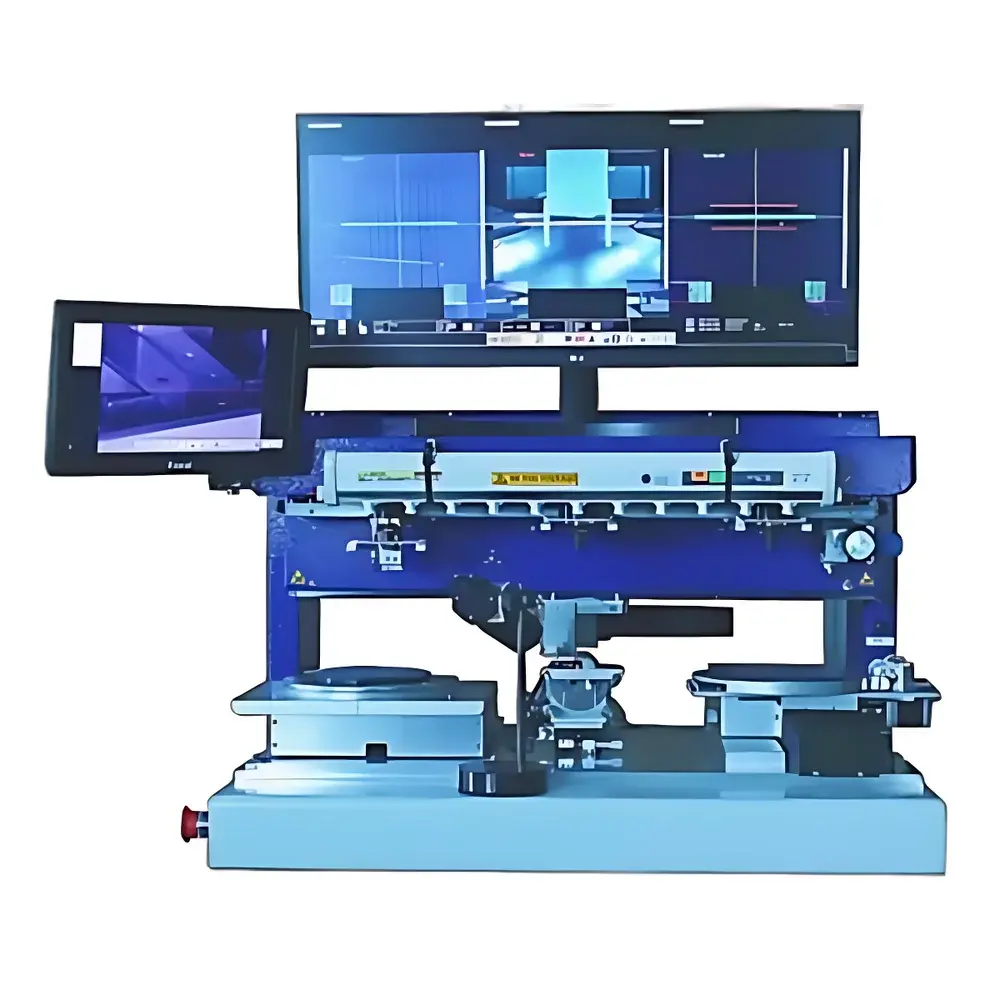
JFP PP Stacker Flip Chip Bonder for Laser Diode Bar Stacking
| Brand | JFP |
|---|---|
| Origin | France |
| Type | Imported Semiconductor Assembly & Packaging Equipment |
| Model | PP Stacker |
| Application | Precision Pick-and-Place, Stacking & De-stacking of Laser Diode Bars |
| Compliance | Designed for ISO Class 5–7 cleanroom environments |
| Software | JFP StackerControl v3.2 with Audit Trail & Event Logging |
| Power Supply | 100/230 VAC, 1 kW |
| Pneumatic Requirements | Dry air at 5 bar, vacuum ≥90% |
| Dimensions (W×D×H) | 900 × 830 × 1750 mm |
| Throughput | 600 units/hour (single bar + single spacer cycle) |
| Pick-up Force | <5 g (non-damaging micro-handling) |
| XY Stage Resolution | 1 µm (micrometer-adjustable manual stage) |
| Vision System | Triple 5 MP color cameras (vertical orientation), independent digital video control, LED illumination (adjustable intensity), field-of-view up to 20 mm, continuous optical zoom, 11× digital zoom, PIP mode (3 windows), calibrated scale bar (0.6 mm @ 20×) |
| Sample Compatibility | Laser diode bars (max. 18 mm length |
| Tooling Options | Manual blue-tape ejection kit |
Overview
The JFP PP Stacker is a dedicated flip chip bonder engineered for high-precision, non-contact stacking and de-stacking of laser diode bars in semiconductor packaging workflows. Unlike general-purpose die bonders, the PP Stacker implements a specialized pick-and-place architecture grounded in controlled vacuum micro-handling and sub-micron mechanical alignment—principally leveraging Coulombic adhesion and low-force (<5 g) pneumatic suction to prevent cleavage or coating damage during transfer. Its core function is the deterministic assembly of multi-layer optoelectronic stacks comprising laser bars and precision spacers (e.g., dummy test strips or thermal isolation shims), enabling fabrication of vertical-cavity surface-emitting laser (VCSEL) arrays, high-power diode bar modules, and hybrid photonic subassemblies. The system operates within ISO Class 5–7 cleanroom-compatible enclosures and integrates seamlessly into front-end packaging lines where traceability, process stability, and material integrity are governed by IATF 16949 and JEDEC J-STD-020 compliance frameworks.
Key Features
- Triple-axis vertical vision system with three independently adjustable 5 MP color cameras—enabling simultaneous top-down inspection of bar geometry, spacer placement, and stack height verification
- Micrometer-grade manual XY stage (1 µm resolution) for fine-tuning stack registration; optionally upgradeable to motorized XYθ stage with closed-loop feedback and ±0.5 µm positional repeatability
- Modular tooling ecosystem: manual blue-tape ejection kit, heated grid chuck for thermal stabilization during ejection, 4″ waffle tray and gel pack auto-handling modules, and dual-spacer loading station
- Low-force handling architecture: vacuum pickup nozzles calibrated to deliver <5 g nominal force—validated per MIL-STD-883H Method 2011.9 for fragile III–V semiconductor structures
- Configurable stacking sequences: supports up to one laser bar and two spacers per layer, with programmable layer count (max. 20 mm stack height) and interlayer offset mapping
- Real-time process logging: timestamped event records for pickup success/failure, vacuum loss, misalignment detection, and stage position deviation—exportable as CSV for SPC analysis
Sample Compatibility & Compliance
The PP Stacker accommodates laser diode bars with physical dimensions spanning 150 µm minimum cavity length and 80 µm minimum thickness—compatible with standard 2″ and 4″ waffle trays, gel-based carriers, blue-tape frames, and custom-designed carriers meeting SEMI E10 metrology reference standards. All handling surfaces are electrostatically dissipative (10⁶–10⁹ Ω/sq) and chemically inert (316L stainless steel + anodized aluminum). The system meets CE machinery directive 2006/42/EC, complies with ISO 14644-1 Class 5 airborne particulate limits when operated inside laminar flow hoods, and supports FDA 21 CFR Part 11-compliant electronic records when paired with JFP StackerControl v3.2’s audit-trail-enabled configuration.
Software & Data Management
JFP StackerControl v3.2 provides a deterministic, script-driven workflow engine with hierarchical sequence programming: users define stacking logic via graphical layer templates (e.g., “Bar → Spacer A → Spacer B → Bar”) or import CSV-defined coordinate maps. The software features synchronized triple-camera image capture, real-time overlay of calibration grids and fiducial markers, and automatic contrast-adaptive edge detection for bar width and facet angle measurement. All operational events—including vacuum pressure logs, stage encoder values, lighting intensity settings, and operator login sessions—are stored with SHA-256 hashing for GLP/GMP audit readiness. Data export supports HDF5 and ASAM ODS formats for integration with MES platforms such as Siemens Opcenter or Camstar.
Applications
- Assembly of high-brightness laser bar stacks for fiber-coupled pump modules used in medical laser systems (ISO 13485-certified production)
- Prototyping of monolithic VCSEL arrays requiring precise inter-bar spacing control for wavelength multiplexing
- Thermal interface testing using calibrated dummy spacers to quantify interfacial resistance in multi-junction photonic packages
- Re-work and de-stacking of failed assemblies for failure analysis (FA) labs—preserving bar-level metallization integrity
- Pre-bond alignment verification prior to eutectic or thermo-compression bonding steps in compound semiconductor packaging lines
FAQ
What carrier formats does the PP Stacker support for laser diode bars?
It accepts blue-tape frames, 2″/4″ waffle trays, gel packs (including 4″ × 4″ and 7″ × 7″ variants), 185 mm wafer rings, and custom carriers with mechanical registration features compliant with SEMI E10.
Is the system qualified for use in regulated manufacturing environments?
Yes—the hardware design conforms to CE Machinery Directive 2006/42/EC, and the software supports 21 CFR Part 11-compliant audit trails, electronic signatures, and data integrity controls when configured per GAMP 5 guidelines.
Can stacking sequences be exported and reused across multiple machines?
Yes—stacking recipes are saved as encrypted .stk files with embedded calibration metadata and can be deployed across identical PP Stacker installations via USB or network share, ensuring cross-fab process equivalence.
Does the vision system support automated defect detection during stacking?
While primary operation focuses on geometric registration, optional firmware add-ons enable AI-assisted anomaly detection (e.g., chipped facets, misoriented bars) using pre-trained convolutional neural networks trained on >50,000 labeled images from JFP’s internal FA database.
What maintenance protocols are required for long-term vacuum nozzle performance?
Nozzle cleaning is performed automatically every 500 cycles using pulsed nitrogen purge; full nozzle calibration (force verification + vacuum decay test) is scheduled every 2,000 cycles and logged in the maintenance history module.