
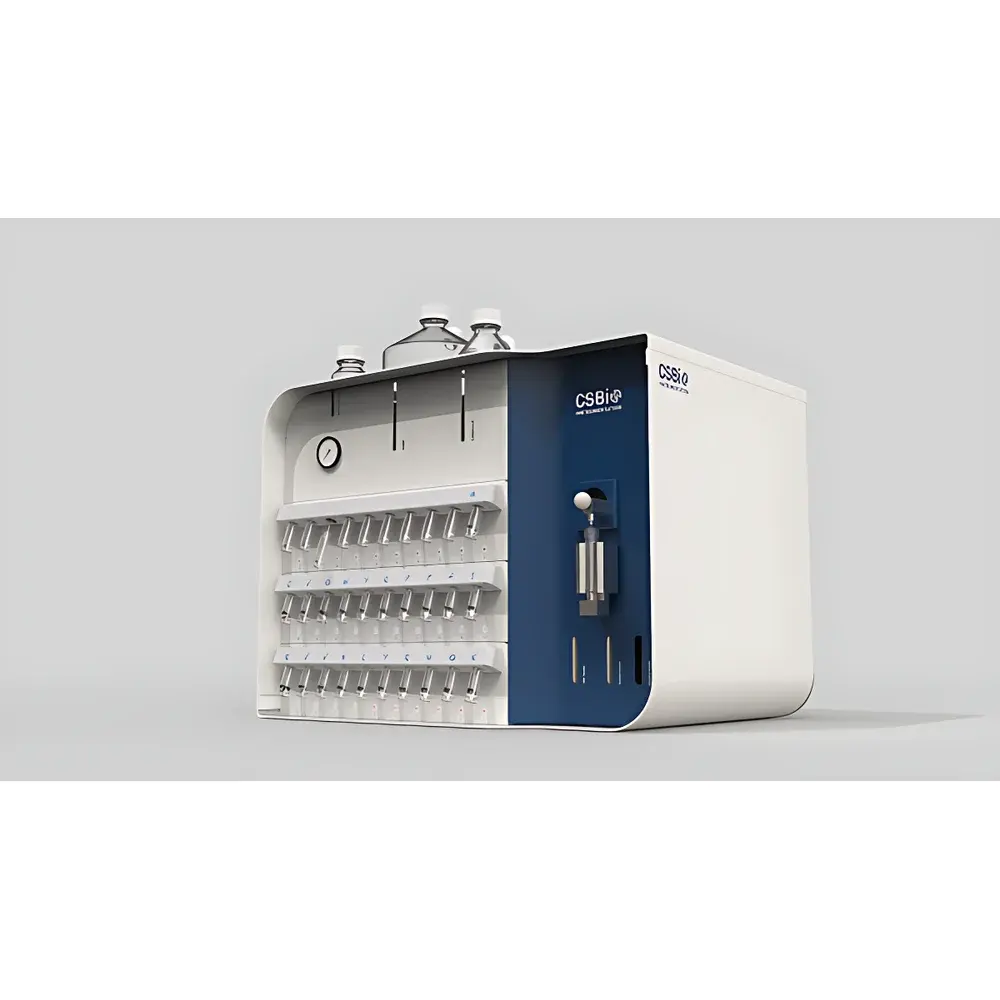
CSBio CSBIO II Automated Peptide Synthesizer
| Brand | CS Bio |
|---|---|
| Origin | USA |
| Manufacturer Type | Authorized Distributor |
| Origin Category | Imported |
| Model | CSBIO II |
| Price Range | USD 42,000 – 70,000 |
Overview
The CSBio CSBIO II Automated Peptide Synthesizer is a benchtop solid-phase peptide synthesis (SPPS) platform engineered for reproducible, user-directed synthesis of custom peptides at research-scale quantities—specifically 50 mg to 500 mg per run. It implements standard Fmoc- or Boc-based SPPS chemistry via sequential coupling, deprotection, washing, and cleavage cycles under programmable nitrogen-purged reaction environments. Designed with accessibility as a core engineering objective, the CSBIO II integrates simplified fluidic architecture, pre-validated method templates, and intuitive touchscreen navigation—enabling researchers without prior synthetic chemistry training to achieve high-fidelity peptide assembly in standard laboratory settings. Its modular reactor design supports single-vessel synthesis using standard 10–50 mL reaction vessels and accommodates common resin types (e.g., Wang, Rink amide MBHA) and amino acid derivatives.
Key Features
- Fully automated synthesis protocol execution—including amino acid delivery, activation, coupling, Fmoc deprotection (piperidine), resin washing (DMF, DCM, MeOH), and optional on-instrument cleavage
- Integrated reagent manifold with eight independently controlled solvent and reagent lines, each equipped with precision solenoid valves and pressure-regulated delivery
- Programmable reaction temperature control (ambient to 90 °C) for accelerated coupling kinetics and difficult sequence synthesis
- Real-time monitoring of critical process parameters: pressure, flow rate, valve status, and cycle timing—logged with timestamped event records
- Compact footprint (60 × 60 × 55 cm) suitable for standard fume hood or dedicated lab bench installation
- Onboard method library with >30 pre-optimized protocols covering common peptide lengths (5–50 residues), modifications (acetylation, amidation, biotinylation), and challenging motifs (e.g., aggregation-prone sequences)
Sample Compatibility & Compliance
The CSBIO II supports synthesis of linear and branched peptides containing standard α-L-amino acids, as well as selected non-canonical and post-translationally modified residues (e.g., phosphoserine, N-methylated glycine). It is compatible with polystyrene- and PEG-based resins (1% DVB crosslinked, 0.2–1.2 mmol/g loading), and accepts commercially available Fmoc-protected amino acids with standard side-chain protecting groups (tBu, Trt, Pbf, Boc). The system meets general laboratory safety requirements for organic solvent handling (per OSHA 29 CFR 1910.1200) and conforms to CE marking directives for electrical safety (EN 61010-1) and electromagnetic compatibility (EN 61326-1). While not certified for GMP manufacturing, its audit-ready operation log and method versioning support GLP-compliant documentation workflows required for preclinical research submissions.
Software & Data Management
The CSBIO II runs on embedded Linux-based firmware with a 7-inch capacitive touchscreen interface. Method creation and editing occur through a hierarchical menu system supporting stepwise definition of reagent volumes, dwell times, mixing modes (pulse/vortex), and conditional branching (e.g., double couplings for sterically hindered residues). All synthesis runs generate immutable digital logs—including timestamps, valve actuation events, pressure transients, and user annotations—which are exportable in CSV format for traceability. The system supports USB-based method import/export and allows manual override of individual steps during active synthesis. No cloud connectivity or remote access functionality is implemented; data residency remains fully local to ensure compliance with institutional IT security policies and HIPAA/FDA data integrity expectations for early-stage biomolecule development.
Applications
- Rapid generation of antigenic peptides for antibody production and epitope mapping studies
- Synthesis of labeled peptides (e.g., fluorescein-, FITC-, or biotin-conjugated) for binding assays and cellular uptake experiments
- Preparation of short-to-medium-length therapeutic peptide candidates for in vitro pharmacological profiling
- Production of peptide standards for LC-MS/MS method development and quantitative proteomics calibration
- Teaching laboratory implementation for hands-on instruction in modern synthetic biology techniques
- Iterative SAR studies requiring parallel synthesis of peptide analog libraries (via sequential runs)
FAQ
What is the maximum peptide length achievable on the CSBIO II?
While dependent on sequence composition and coupling efficiency, the system routinely delivers crude purities >70% for peptides up to 45 residues using optimized protocols; lengths beyond 50 residues require empirical validation and may necessitate double couplings or pseudoproline dipeptide strategies.
Does the CSBIO II support microwave-assisted synthesis?
No—microwave enhancement is not integrated; all reactions proceed under conventional thermal control and mechanical agitation.
Can I use my own custom amino acid derivatives or resins?
Yes—provided they are compatible with standard Fmoc-SPPS chemistry and physically fit within the 10–50 mL reaction vessel geometry; users must validate coupling kinetics and deprotection completeness empirically.
Is maintenance training provided with purchase?
CSBio offers on-site or virtual technician training covering daily operation, preventive maintenance (e.g., line flushing, filter replacement), and basic troubleshooting; annual service contracts include firmware updates and hardware calibration verification.
How does the CSBIO II handle difficult sequences prone to aggregation?
It supports backbone amide protection (e.g., Hmb, Dmb), elevated temperature coupling (up to 90 °C), and in-situ neutralization protocols—all configurable via the method editor to mitigate on-resin aggregation and improve chain elongation fidelity.





