
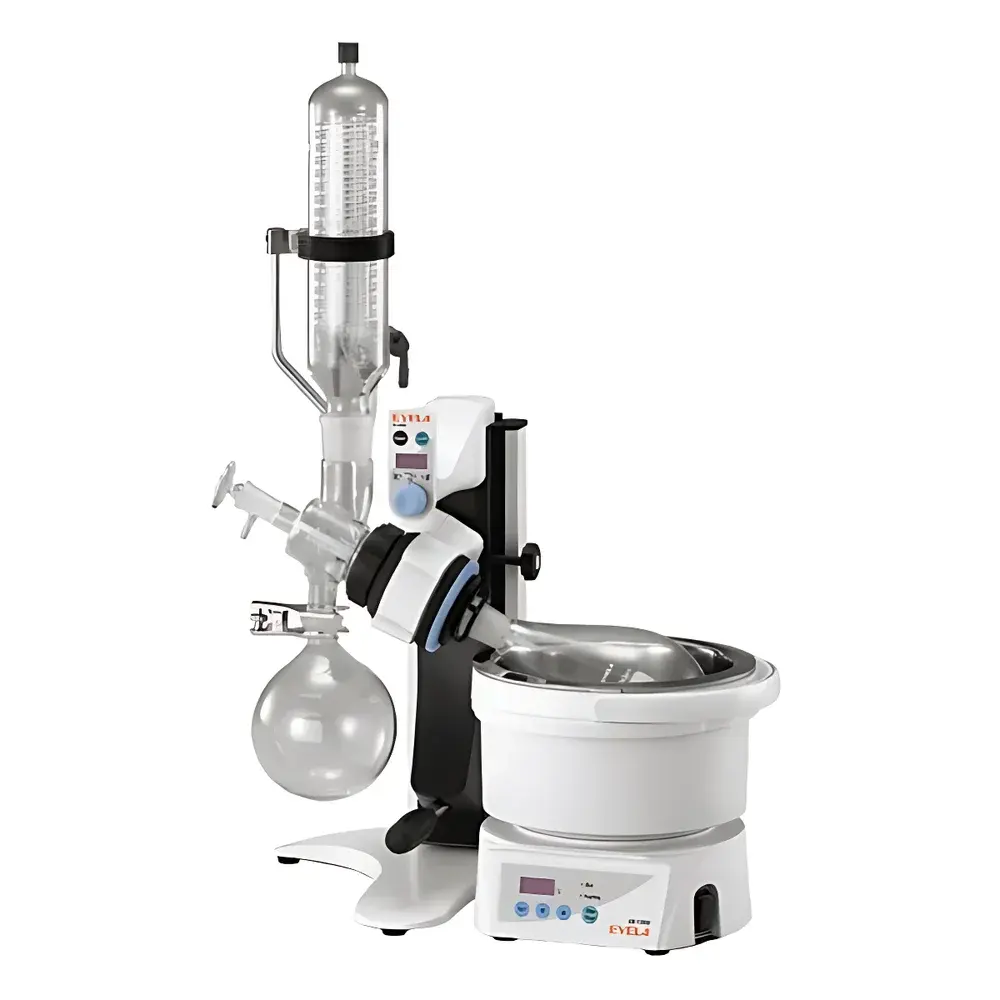
EYELA N-1300V Rotary Evaporator
| Brand | EYELA |
|---|---|
| Origin | Japan |
| Model | N-1300V |
| Rotational Speed | 10–310 rpm |
| Bath Temperature Range | RT+5°C to 90°C (water) / RT+5°C to 180°C (oil) |
| Temperature Accuracy | ±1.5°C (water), ±3°C (oil) |
| Max. Evaporation Rate | 25 mL/min (water) |
| Ultimate Vacuum | ≤399.9 Pa (≤3 mmHg) |
| Condenser Surface Area | 0.146 m² |
| Lift Stroke | 180 mm (manual, stepless) |
| Power Input | AC 220 V, 50 Hz, 6.5 A, 1.43 kVA |
| Heating Power | 1.3 kW |
| Bath Dimensions (SB-1300) | Ø220 × 120 mm H, ~4.3 L (SUS304) |
| Bath Dimensions (OSB-2200) | Ø240 × 120 mm H, ~5.4 L (aluminum with PTFE coating) |
| Weight | 12.8 kg (N-1300V-W) / 13.4 kg (N-1300V-WB) |
| Overall Dimensions | 543 × 352 × 823 mm (W×D×H) |
| Cooling Water Inlet/Outlet | Ø10 mm |
| Sealing Material | Dual-layer PTFE/Viton vacuum seal |
Overview
The EYELA N-1300V Rotary Evaporator is an engineered solution for efficient, reproducible solvent removal under reduced pressure in research, quality control, and synthetic chemistry laboratories. Based on the fundamental principle of rotary evaporation—where a rotating sample flask increases surface area while controlled heat and vacuum lower the boiling point of solvents—the N-1300V delivers precise thermal and mechanical control for gentle yet effective concentration, purification, and recovery of heat-sensitive compounds. Designed and manufactured in Japan, this system integrates a compact vertical condenser architecture, dual-bath compatibility (water or oil), and a robust DC brushless motor drive to ensure long-term stability and low-maintenance operation. Its modular design supports seamless integration with optional accessories—including vacuum controllers (e.g., NVC series), solvent recovery units (DPE-1300/DPE-1400), and large-capacity flasks—making it suitable for both routine benchtop workflows and method-developed GLP-compliant processes.
Key Features
- Vertical double-layer condenser (0.146 m² cooling surface) minimizes footprint and maximizes condensation efficiency, reducing solvent carryover and backflow.
- Four-way distillation adapter enables direct condensate routing into the collection flask—eliminating suction tube reflux and preventing cross-contamination of samples.
- Stepless manual lift mechanism (180 mm travel) with ergonomic handle ensures smooth, vibration-free vertical positioning for optimal bath immersion and flask alignment.
- Bidirectional, timer-controlled flask rotation (forward/reverse) enhances homogeneity during drying of powders or slurries containing suspended solids.
- PTFE/Viton dual-seal vacuum interface guarantees leak-tight performance down to ≤399.9 Pa, critical for low-boiling-point or high-volatility solvent recovery.
- Rotational speed range of 10–310 rpm is digitally displayed and continuously adjustable via precision knob, supporting fine-tuned control for viscous or foaming samples.
- Interchangeable bath options: SB-1300 (stainless steel, 4.3 L, water-only, RT+5°C to 90°C) and OSB-2200 (PTFE-coated aluminum, 5.4 L, water/oil-compatible, RT+5°C to 180°C).
Sample Compatibility & Compliance
The N-1300V accommodates standard ground-glass jointed glassware (including optional 3 L thick-shaft H-type flasks) and supports a wide range of organic solvents, aqueous solutions, and thermally labile extracts. All wetted parts—including condenser, four-way adapter, and collection vessels—are constructed from high-transparency, chemically resistant borosilicate glass (e.g., Pyrex-type), ensuring optical clarity for real-time process monitoring and minimizing adsorption artifacts. The system complies with general laboratory safety standards (IEC 61010-1) and is compatible with ISO/IEC 17025-aligned workflows when paired with traceable calibration protocols for bath temperature and vacuum sensors. While not intrinsically certified for hazardous area use, its sealed heating elements and recessed bath design reduce exposure risks during routine operation.
Software & Data Management
The N-1300V operates as a standalone analog-digital hybrid instrument with no embedded microprocessor or network interface. All operational parameters—rotational speed, bath temperature, and lift position—are set manually and monitored via analog dials or digital LED displays. For regulated environments requiring audit trails, the system may be integrated with external vacuum controllers (e.g., EYELA NVC-2000 series) that support RS-232 communication, programmable ramp profiles, and data logging compliant with FDA 21 CFR Part 11 requirements when deployed with validated third-party software platforms. Calibration records for temperature and vacuum sensors should be maintained per GLP/GMP documentation standards.
Applications
- Concentration of natural product extracts without thermal degradation
- Removal of volatile reaction solvents (e.g., dichloromethane, ethyl acetate, hexanes) post-synthesis
- Preparative-scale solvent exchange (e.g., DMSO to methanol)
- Drying of crystalline intermediates and amorphous powders under controlled rotation reversal
- Recovery and recycling of high-purity solvents in compliance with ISO 14001 waste minimization objectives
- Parallel processing support when coupled with multi-position bath stands or automated flask changers (via third-party interfaces)
FAQ
What is the maximum flask capacity supported by the N-1300V?
The standard configuration accepts up to 2 L flasks; however, a 3 L thick-shaft H-type flask is available as an optional accessory.
Can the N-1300V be used with corrosive solvents such as concentrated HCl or HF?
No—standard glass components are not resistant to hydrofluoric acid or fuming hydrochloric acid. Use only with solvents compatible with borosilicate glass and PTFE/Viton seals.
Is automatic vacuum regulation possible with this model?
Yes, when connected to the EYELA NVC-series vacuum controllers, which provide feedback-controlled pressure stabilization and programmable distillation sequences.
Does the unit include a vacuum pump?
No—the N-1300V requires an external vacuum source (e.g., diaphragm or water aspirator pump) and is not supplied with one.
How often should the PTFE/Viton vacuum seal be replaced?
Under normal usage (≤8 hrs/day, non-aggressive solvents), replacement is recommended every 12–18 months or upon visible compression set, cracking, or vacuum leakage exceeding 10 Pa/min drift.
Related Products



