
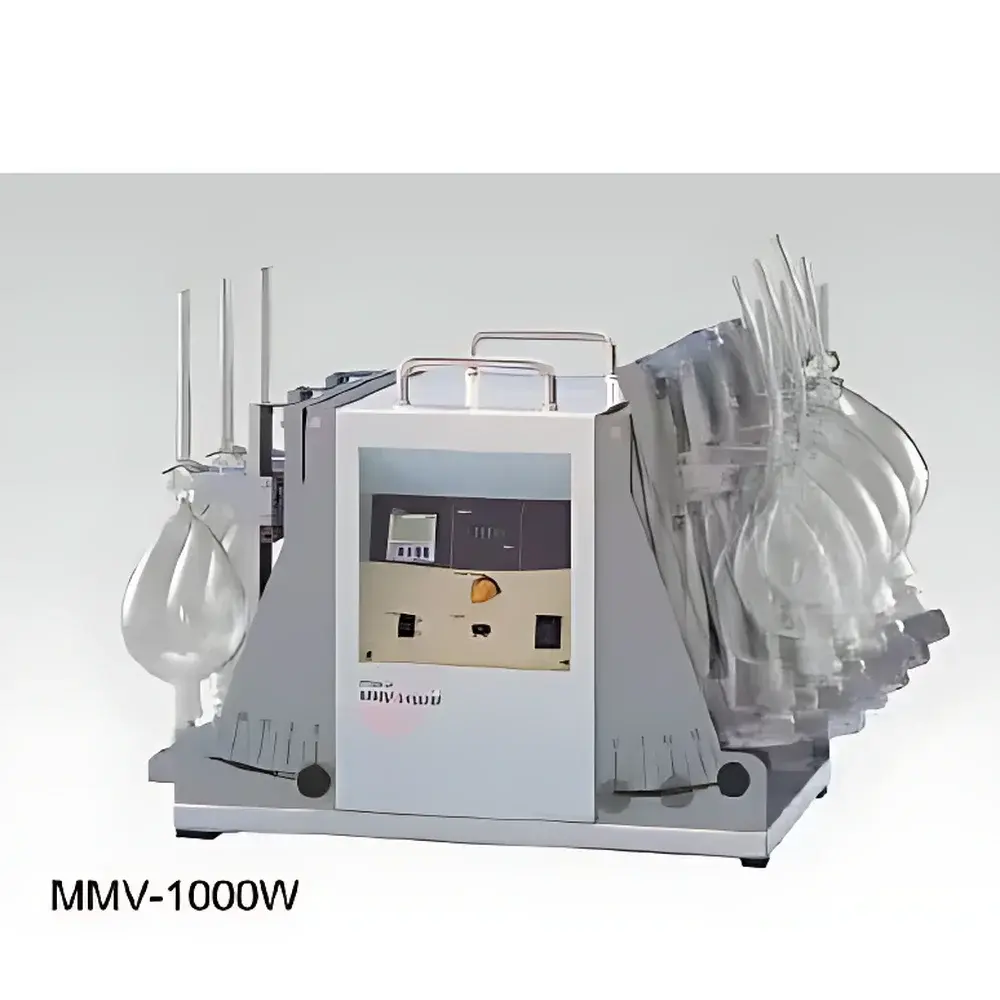
EYELA MMV-1000W Separatory Funnel Shaker
| Brand | EYELA (Tokyo Rikakikai Co., Ltd.) |
|---|---|
| Origin | Japan |
| Model | MMV-1000W |
| Oscillation Mode | Vertical or Tilted |
| Tilt Angle Adjustment | 0–20° |
| Oscillation Speed Range | 20–300 cycles/min (vertical), 20–250 cycles/min (tilted) |
| Amplitude | 40 mm |
| Max Load Capacity | ~7 kg × 2 (including clamps) |
| Flask Compatibility | Standard Clamp: 50–1000 mL |
| Large Clamp | 50–3000 mL |
| Noise Level | ≤55 dB(A) |
| Drive System | Brushless DC Motor |
| Control Interface | Digital Display with Memory Function (retains last set frequency) |
| Operation Modes | Timed or Continuous |
| Acceleration/Deceleration Profile | Soft-start and soft-stop ramping |
Overview
The EYELA MMV-1000W Separatory Funnel Shaker is an engineered laboratory instrument designed for precise, reproducible, and gentle agitation of liquid–liquid extraction systems. It operates on a dual-mode oscillation principle—either vertical reciprocating motion or controlled tilted oscillation—enabling optimized phase dispersion and interfacial contact in separatory funnels. Unlike orbital or rotary shakers, the MMV-1000W employs a linear reciprocating drive mechanism with fixed amplitude (40 mm), ensuring consistent mechanical energy transfer across varying flask volumes and viscosities. Its brushless DC motor architecture delivers long-term speed stability under continuous duty cycles, making it suitable for extended extraction protocols required in analytical chemistry, pharmaceutical QC, and environmental sample preparation workflows.
Key Features
- Dual oscillation geometry: Selectable vertical or tilted mode (0–20° adjustable tilt angle) to modulate shear intensity and mixing efficiency—tilted mode enhances vortex formation in larger-volume funnels (up to 3000 mL), while vertical mode provides uniform agitation for smaller, high-precision extractions.
- Wide, digitally controlled speed range: 20–300 cycles/min (vertical) and 20–250 cycles/min (tilted), with true stepless adjustment via intuitive front-panel controls.
- Intelligent motion profiling: Integrated soft-start and soft-stop algorithms minimize mechanical stress on glassware, reducing risk of stopper ejection, seal failure, or funnel fracture during initiation or cessation of agitation.
- Low-noise operation: Acoustic output maintained at ≤55 dB(A) under full load—compliant with ISO 7779 and ANSI S12.55 standards for laboratory ambient noise—ensuring compatibility with quiet-zone labs and shared instrumentation suites.
- Digital memory function: Automatically recalls the previously set oscillation frequency upon power-up, supporting protocol continuity and operator traceability in GLP-regulated environments.
- Modular clamp system: Two interchangeable clamp configurations—standard (50–1000 mL) and large-capacity (50–3000 mL)—designed with silicone-coated jaws and quick-release levers for secure, tool-free flask mounting and rapid exchange between runs.
Sample Compatibility & Compliance
The MMV-1000W accommodates standard ground-glass jointed separatory funnels (ISO 8577, ASTM D2709) ranging from 50 mL to 3000 mL, including both pear-shaped and cylindrical variants. Its dual-clamp design supports borosilicate glass (e.g., Pyrex®, Duran®) and compatible PTFE-stoppered configurations. The unit meets IEC 61010-1:2010 safety requirements for laboratory electrical equipment and carries PSE certification for use in Japan. While not intrinsically rated for hazardous locations, its non-sparking DC motor and sealed control electronics make it appropriate for general-purpose organic solvent handling (e.g., chloroform, ethyl acetate, diethyl ether) when operated within fume hoods per OSHA 1910.1200 and local chemical hygiene plans.
Software & Data Management
The MMV-1000W operates as a standalone hardware platform without embedded software or network connectivity. All operational parameters—including elapsed time, current speed, and selected mode—are displayed on a high-contrast LED interface. For laboratories requiring audit-ready documentation, external data logging can be achieved via optional analog voltage output (0–5 V DC proportional to set speed) interfaced with validated SCADA or LIMS systems. When deployed in FDA-regulated environments (e.g., USP residual solvents testing), users may implement procedural controls—including written SOPs, operator training records, and periodic performance verification using calibrated tachometers—to satisfy 21 CFR Part 11 expectations for manual instrumentation.
Applications
- Quantitative liquid–liquid extraction (LLE) in environmental analysis (e.g., EPA Method 508.1, 525.3) for pesticides, PCBs, and PAHs in water and soil extracts.
- Pharmaceutical intermediate purification, including API isolation steps involving acid–base partitioning and back-extraction.
- Preparative-scale natural product isolation in phytochemistry labs, where gentle yet thorough phase mixing preserves thermolabile compounds.
- Method development and validation studies requiring systematic variation of agitation intensity, tilt angle, and contact time—parameters directly linked to distribution coefficient (log P) determination and mass transfer kinetics.
- Teaching laboratories conducting undergraduate organic chemistry experiments (e.g., benzoic acid partitioning, caffeine extraction), where reproducibility and safety are pedagogical priorities.
FAQ
Does the MMV-1000W support programmable multi-step protocols?
No—the unit offers only single-setpoint timed or continuous operation. Complex sequences require external timer integration or manual intervention.
Can the tilt angle be locked during operation?
Yes—the 0–20° tilt adjustment is mechanically secured via a knurled locking collar; angle remains fixed throughout the run unless manually modified.
Is calibration documentation provided with the instrument?
EYELA supplies factory verification reports for speed accuracy (±2% of set value) and amplitude consistency. Full metrological calibration per ISO/IEC 17025 must be performed by an accredited third-party lab.
What maintenance is required for long-term reliability?
Annual inspection of motor coupling integrity, clamp jaw tension, and vibration damping feet is recommended. No lubrication or consumable replacement is specified under normal usage conditions.
Is the MMV-1000W compatible with automated lab platforms?
It lacks digital I/O or RS-232/Ethernet ports; integration into robotic workcells requires custom pneumatic or relay-based actuation interfaces.




