
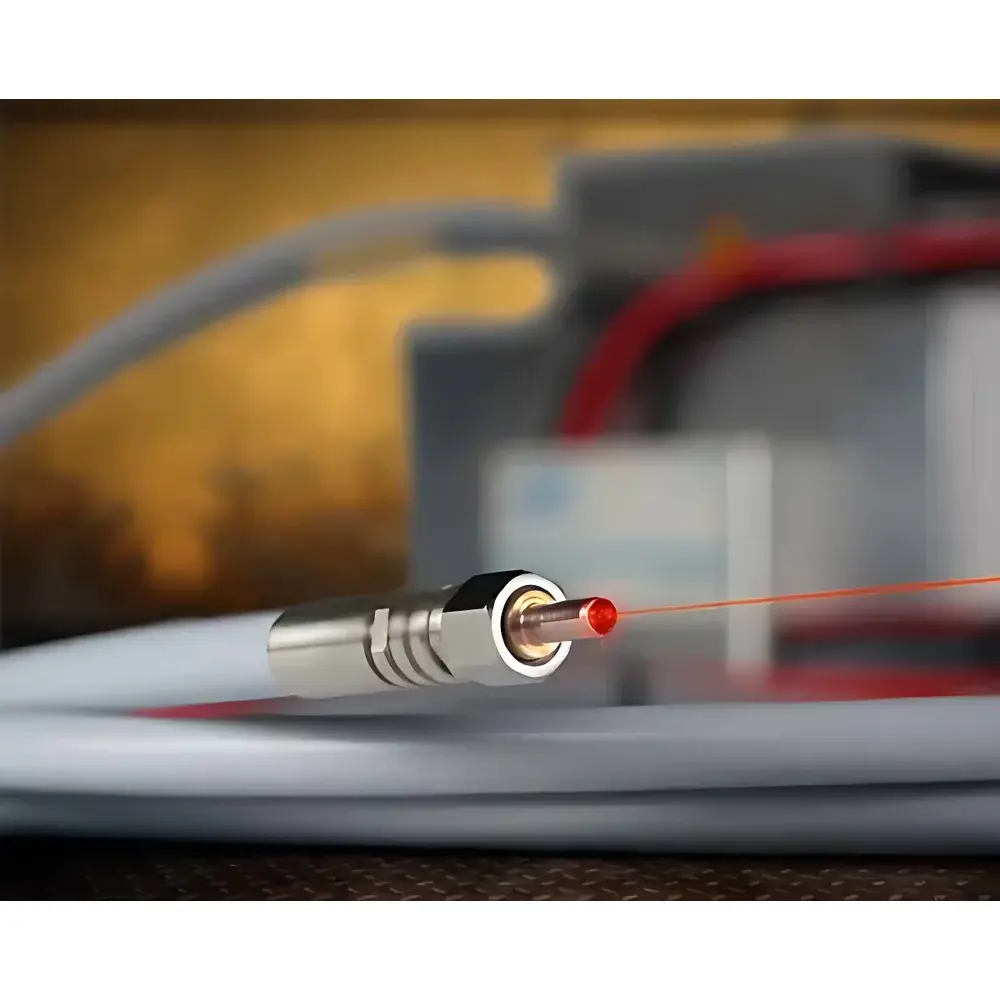
ART Photonics FlexiRay® High-Power Laser Delivery Fiber
| Brand | ART Photonics |
|---|---|
| Origin | Germany |
| Manufacturer Type | Authorized Distributor |
| Origin Category | Imported |
| Model | FlexiRay® High-Power Laser Delivery Fiber |
| Component Category | Optical Component |
| Core Diameter Options | 100 / 200 / 300 / 400 / 600 / 800 µm |
| Core Material | Synthetic Fused Silica (High-OH for UV–VIS |
| Cladding Material | Fluorine-Doped Fused Silica |
| Jacket Materials | Nylon, Ethylene Copolymer, Acrylate, Polyimide, or Metal |
| Numerical Aperture (Standard) | 0.22 ± 0.02 (Full Acceptance Angle: 25°) |
| Optional NA | 0.12 ± 0.02 (14°) or 0.26 ± 0.02 (30°) |
| Connector Types | HP-SMA, D80 |
| Max Power Handling (Typical, CW, with Optimal Coupling) | 100–800 W depending on core size and connector |
| Cable Length Range | 5 cm to 50 m |
| Customization | Available for core geometry, NA, jacketing, and connector integration |
Overview
The ART Photonics FlexiRay® High-Power Laser Delivery Fiber is an engineered optical component designed for reliable, low-loss transmission of high-brightness laser radiation in industrial, medical, and scientific applications. Based on a robust all-silica waveguide architecture—featuring high-purity synthetic fused silica cores and fluorine-doped cladding—the fiber operates across broad spectral ranges: 180–1200 nm (high-OH variant) and 350–2500 nm (low-OH variant). Its performance is grounded in fundamental principles of guided-wave optics and thermal management, where mode confinement, minimized interfacial absorption, and efficient heat dissipation at the termination interface collectively enable stable power delivery under continuous-wave (CW) and quasi-CW conditions. Unlike standard multimode fibers, FlexiRay® integrates proprietary mechanical and thermal design features—including optimized core/cladding geometry, graded-index profiles, and ultra-low-defect fabrication—to mitigate nonlinear effects, reduce photodarkening, and suppress catastrophic end-face damage.
Key Features
- Proprietary HP-SMA and D80 connectors with integrated thermal pathways for active and passive heat extraction, maintaining connector housing temperatures below critical thresholds during sustained operation
- Multiple core diameters (100–800 µm) and numerical apertures (0.12, 0.22, 0.26) to match diverse laser sources—including fiber-coupled diodes, Nd:YAG, Yb:fiber, and CO2-pumped solid-state lasers
- Customizable jacketing options (polyimide, metal braid, stainless-steel tubing) for mechanical ruggedness, EMI shielding, and compatibility with robotic motion systems or sterile environments
- Low propagation loss (1 GW/cm² peak power density for nanosecond pulses)
- Consistent beam quality preservation (M² < 15 for 400 µm/0.22 NA configuration) due to controlled modal distribution and minimal differential mode delay
- Compliance with ISO 11146-1:2005 (laser beam parameters) and IEC 60825-1:2014 (laser product safety) for system integration into Class 4 laser installations
Sample Compatibility & Compliance
FlexiRay® fibers are validated for use with commercial and OEM laser platforms operating in material processing (e.g., IPG, SPI Lasers, Coherent), medical systems (e.g., Lumenis, Biolitec), and defense-grade directed-energy subsystems. The fiber’s mechanical stability supports dynamic positioning in CNC laser workstations and articulated-arm delivery systems. All configurations meet RoHS 2011/65/EU and REACH (EC 1907/2006) requirements. For GMP-regulated medical device manufacturing, documentation packages include traceable lot records, raw material certifications (ASTM F754 for biocompatible coatings), and full test reports per MIL-STD-883 Method 2010 (thermal cycling) and IEC 60793-2-10 (optical fiber specifications).
Software & Data Management
While the FlexiRay® fiber itself is a passive optical component, ART Photonics provides comprehensive technical documentation and integration support packages—including coupling efficiency calculators, thermal modeling templates (MATLAB and Python), and connector alignment guides compatible with common beam profiling tools (Ophir Pyrocam, Gentec-EO Maestro). For traceability in regulated environments, optional serialized labeling and QR-coded calibration certificates comply with FDA 21 CFR Part 11 requirements when paired with ART Photonics’ certified test reports (including spectral attenuation curves, NA verification, and end-face inspection images).
Applications
- Laser welding and brazing of aluminum, copper, and dissimilar metals—leveraging high-brightness coupling for keyhole-mode stability
- Precision cutting of thin-gauge stainless steel and polymers using near-IR and green-wavelength sources
- Non-contact surface hardening and cladding in automotive and aerospace component refurbishment
- Fiber-delivered photocoagulation and lithotripsy in urology and ophthalmology systems
- Remote sensing and LIDAR transmitter chains requiring polarization-maintaining variants (available upon request)
- Target illumination and rangefinding in electro-optical countermeasure systems
FAQ
What is the maximum average power this fiber can transmit?
Power handling depends on core diameter, NA, connector type, and thermal environment. As a guideline: HP-SMA supports up to 400 W (600 µm core); D80 supports up to 800 W (600 µm core) under optimal cooling and collimated input conditions.
Can FlexiRay® fibers be used with pulsed lasers?
Yes—qualified for nanosecond and picosecond pulses with peak powers exceeding 10 MW, provided pulse energy remains within the fiber’s damage threshold and temporal profile avoids self-focusing effects.
Is there a version with polarization-maintaining capability?
Standard FlexiRay® is non-PM; however, PM variants with elliptical stress rods and extinction ratios >20 dB are available as custom-engineered solutions.
How is end-face contamination managed during installation?
All fibers ship with certified cleanroom-processed terminations (ISO Class 5), and ART Photonics recommends using only dry nitrogen purge and certified fiber inspection scopes (e.g., VIAVI FI-7000) prior to mating.
Do you provide beam parameter measurement data for each batch?
Yes—upon request, full characterization reports include M², BPP, NA distribution, and spectral attenuation across 200–2200 nm, traceable to NIST-calibrated reference standards.




