
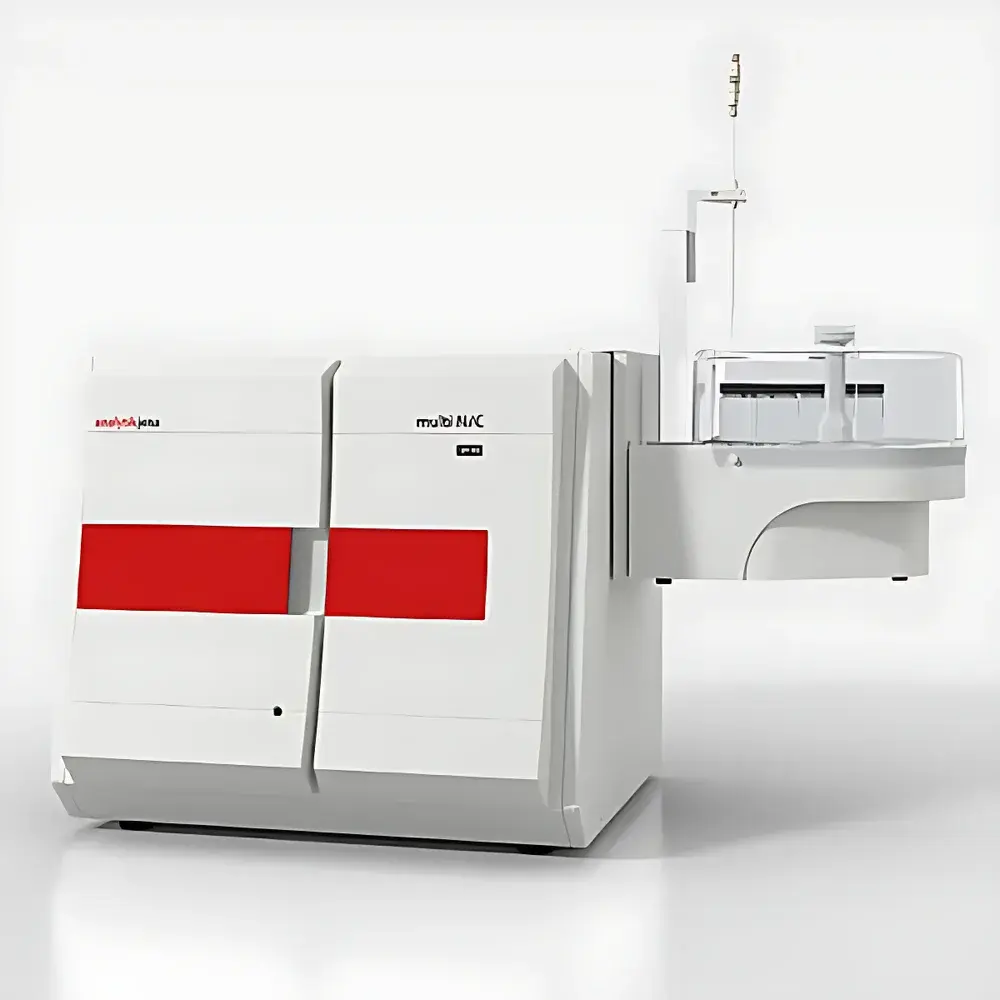
Analytik Jena multi N/C UV HS Total Organic Carbon (TOC) and Total Bound Nitrogen (TNb) Analyzer
| Brand | Analytik Jena |
|---|---|
| Origin | Germany |
| Model | multi N/C UV HS |
| Instrument Type | Laboratory TOC/TNb Analyzer |
| Detection Principle | High-Energy UV/Persulfate Oxidation + NDIR CO₂ Detection |
| Measurement Range | 0–30,000 mg/L TOC |
| Detector | High-Focus NDIR |
| Oxidation | Dual-Wavelength UV (185 nm & 254 nm) + Optional Persulfate |
| Compliance | DIN EN 1484, DIN EN 12260, DIN EN 15936, ISO 20236, HJ 501-2009, HJ 695-2014, GB/T 5750.7-2006 |
Overview
The Analytik Jena multi N/C UV HS is a high-performance laboratory total organic carbon (TOC) and total bound nitrogen (TNb) analyzer engineered for precise, reproducible quantification of carbon- and nitrogen-based contaminants in aqueous, digested, and homogenized solid matrices. It operates on a dual-oxidation principle: high-energy ultraviolet radiation at 185 nm and 254 nm photolytically cleaves refractory organic molecules, while optional sodium persulfate addition extends oxidation capacity for highly recalcitrant compounds. The resulting CO₂ is quantified via a high-focus non-dispersive infrared (NDIR) detector — an optical architecture that concentrates infrared energy onto a miniature thermopile sensor, delivering exceptional signal-to-noise ratio and long-term baseline stability. This configuration enables direct measurement across a full dynamic range of 0–30,000 mg/L TOC without dilution, eliminating manual pre-dilution errors and reducing carryover risk. The system is purpose-built for regulatory-compliant environmental testing, including drinking water, wastewater, surface water, leachates, and digested sludge — with validated performance under DIN EN 1484 (TOC determination), DIN EN 12260 (TNb in water), ISO 20236 (soil and sediment TOC), and Chinese national standards HJ 501 and GB/T 5750.7.
Key Features
- High-focus NDIR CO₂ detection: Optimized optical path and micro-sensor integration ensure superior sensitivity, linearity, and drift resistance over extended operation cycles.
- Dual-wavelength UV oxidation reactor: Simultaneous 185 nm (generates hydroxyl radicals) and 254 nm (direct photolysis) irradiation achieves >95% oxidation efficiency for diverse organics — including humic substances, pharmaceuticals, and surfactants — without mandatory chemical oxidant addition.
- VITA (Variable Injection Timing & Aspiration) flow management system: Dynamically controls sample injection volume, timing, and carrier gas flow to maximize transfer efficiency into the high-temperature catalytic oxidation furnace (680 °C), enhancing precision at trace-level concentrations (<50 µg/L).
- Intelligent calibration logic: Automatically selects optimal calibration range per sample based on preliminary conductivity or acidification response; supports multi-point calibration using single-standard solutions with variable injection volumes — eliminating volumetric pipetting dependency.
- Modular architecture: Supports seamless integration of solid-sample modules (for soils, sediments, and sludges), TNb-specific chemiluminescence or thermal conductivity detectors, and automated reagent dispensing units for unattended batch analysis.
- Robust hardware design: Corrosion-resistant fluidic pathways, ceramic reaction tubes, and sealed optical compartments ensure >10,000 hours of maintenance-free detector operation and <0.5% RSD repeatability over 72-hour continuous runs.
Sample Compatibility & Compliance
The multi N/C UV HS accommodates liquid samples (raw water, filtered effluents, acid-preserved extracts) as well as homogenized solid matrices when paired with the optional solid combustion module. It meets stringent method validation requirements for ISO/IEC 17025-accredited laboratories and supports full audit trails compliant with FDA 21 CFR Part 11 and EU Annex 11 when operated with Analytik Jena’s ASPECT LIMS-integrated software suite. Method equivalence is documented for DIN EN 1484 (TOC), DIN EN 15936 (TOC in soil leachates), ISO 20236 (TOC in sediments), and Chinese EPA protocols HJ 695 (high-chloride water TOC) and HJ 501 (standard methods for water and wastewater). All critical parameters — oxidation efficiency, system suitability, blank correction, and calibration verification — are logged automatically and exportable in CSV or PDF format for GLP/GMP reporting.
Software & Data Management
Control and data acquisition are managed through the ASPECT software platform, a Windows-based application designed for analytical traceability and regulatory readiness. It provides real-time chromatogram visualization, automatic peak integration, customizable report templates (including ISO 17025-compliant certificates), and electronic signature support. Audit trail functionality records all user actions, method changes, calibration events, and raw data modifications with timestamped, immutable entries. Data integrity safeguards include role-based access control (RBAC), encrypted database storage, and configurable backup intervals to network drives or NAS systems. Export options include ASTM E1382-compliant ASCII files for third-party statistical analysis and direct LIMS interfacing via ODBC or HL7 protocols.
Applications
- Drinking water compliance monitoring (TOC as surrogate for disinfection by-product precursors per US EPA Stage 2 DBPR and EU Drinking Water Directive)
- Wastewater treatment plant effluent characterization and biodegradability assessment (BOD₅/TOC ratio)
- Pharmaceutical manufacturing water systems (PW, WFI) per USP and EP 2.2.44
- Soil and sediment remediation site assessment (solid-phase TOC quantification after acid fumigation)
- Research on carbon sequestration dynamics in wetland and agricultural soils
- Leachate analysis from landfills and contaminated sites per DIN 19528 and EPA Method 9060A
FAQ
What oxidation methods does the multi N/C UV HS support?
It primarily uses high-energy dual-wavelength UV (185/254 nm) photolysis; sodium persulfate addition is available as an optional enhancement for samples containing highly stable aromatic or heterocyclic compounds.
Can it measure TOC in high-salinity or chloride-rich samples?
Yes — the system incorporates acidification and sparging to remove inorganic carbon prior to oxidation, and its NDIR detector is inherently insensitive to chloride interference, enabling reliable analysis of seawater, brines, and industrial process waters per HJ 695-2014.
Is TNb analysis performed simultaneously with TOC?
No — TOC and TNb require separate detector configurations; TNb quantification uses either a chemiluminescence detector (CLD) or thermal conductivity detector (TCD), both compatible via the modular platform but not concurrently active with the NDIR unit.
How often does the UV lamp require replacement?
The dual-wavelength UV reactor is rated for ≥10,000 hours of continuous operation; typical service interval is 18–24 months under standard laboratory usage (8 h/day, 5 days/week).
Does the system support unattended overnight operation?
Yes — with optional autosampler (up to 120 positions), reagent auto-dosing, and ASPECT’s queue-based scheduling, fully automated sequences including calibration, blanks, and up to 96 unknowns can be executed without operator intervention.
Related Products







