
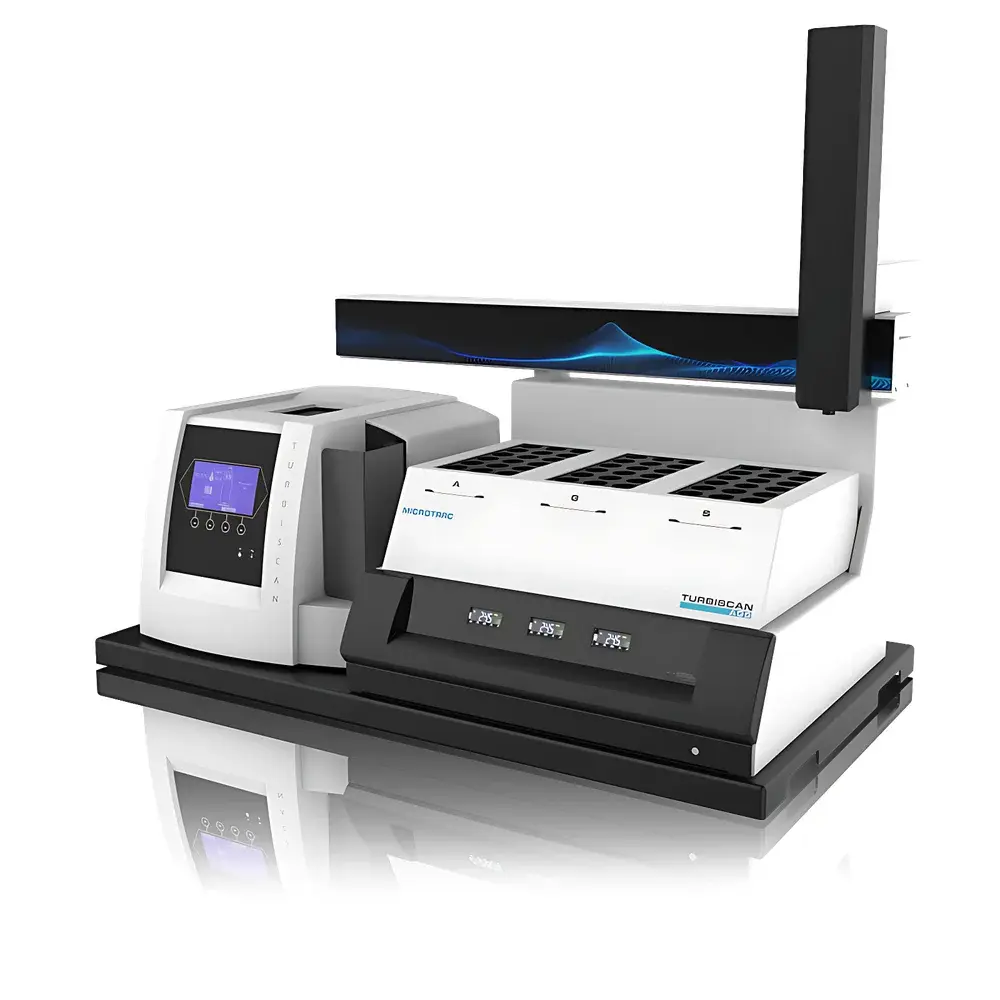
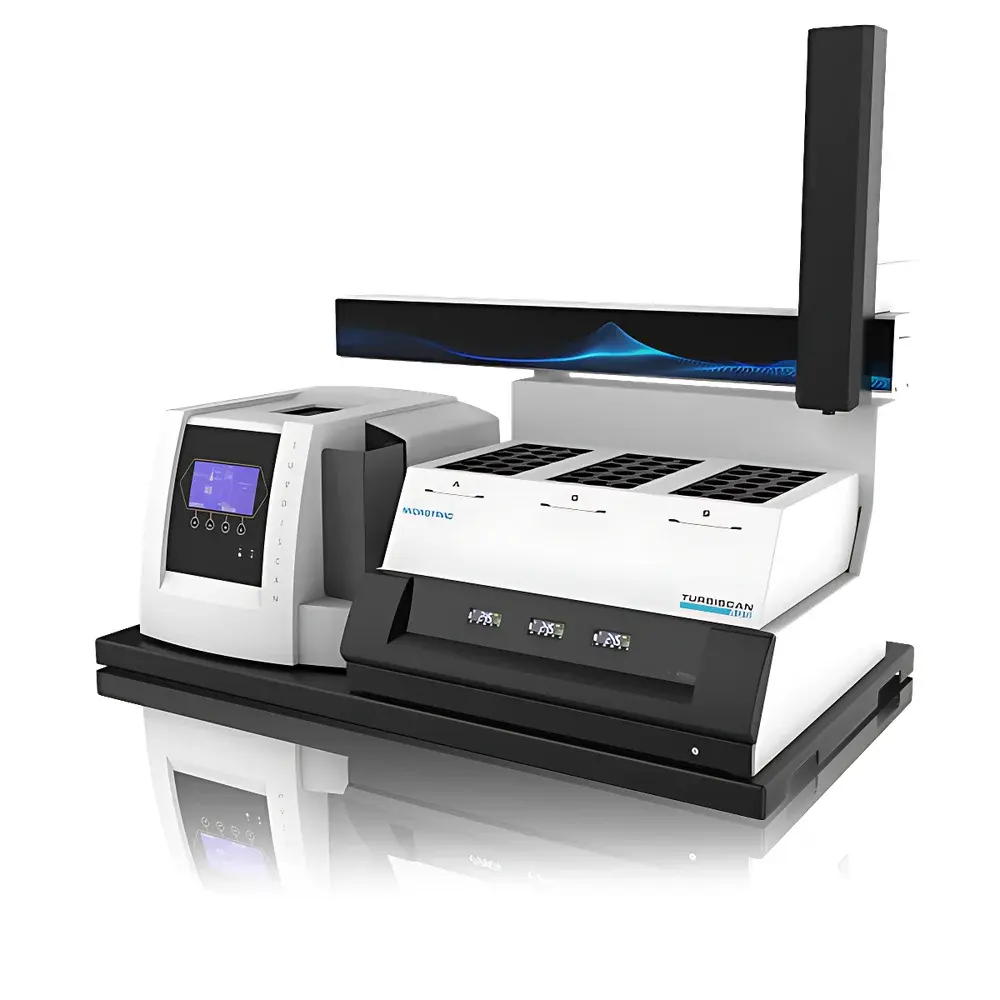
Formulaction TURBISCAN AGS Stability Analyzer
| Brand | Formulaction (Microtrac) |
|---|---|
| Origin | France |
| Model | TURBISCAN AGS |
| Light Source | 880 nm pulsed near-infrared LED |
| Measurement Principle | Multiple Light Scattering (MLS) |
| Particle Size Range | 0.05–1000 µm |
| Maximum Volume Concentration | 95% v/v |
| Temperature Control Range | RT + 5°C to 60°C |
| Temperature Accuracy | ±0.5°C |
| Scan Height | 55 mm |
| Spatial Resolution | 40 µm |
| Scan Interval | As low as 20 s per scan |
| Programmable Scan Sequences | Up to 250 |
| Sample Capacity | 54 positions |
| Dimensions (W×D×H) | 145 × 75 × 85 cm |
Overview
The Formulaction TURBISCAN AGS Stability Analyzer is an advanced, non-invasive instrumental platform engineered for quantitative, real-time assessment of physical stability in concentrated colloidal and dispersed systems. It operates on the principle of Multiple Light Scattering (MLS), a well-established optical technique that simultaneously measures both transmitted (T) and backscattered (BS) light intensities along the vertical axis of a static sample tube. Unlike conventional techniques requiring dilution or centrifugation, MLS enables direct analysis of undiluted formulations—preserving native particle size distribution, interfacial interactions, and bulk rheological behavior. The system employs a pulsed 880 nm near-infrared light source, selected for optimal penetration depth in opaque or highly concentrated media (e.g., emulsions, suspensions, pastes, and protein aggregates), while minimizing absorption by water and common excipients. Each scan captures 1,375 data points across a 55 mm height at 40 µm spatial resolution, generating high-fidelity vertical profiles of local turbidity—directly correlated to local particle concentration (φ, volume fraction) and hydrodynamic diameter (dH). These profiles are acquired repeatedly over time to construct kinetic stability fingerprints, enabling detection of creaming, sedimentation, coalescence, flocculation, and Ostwald ripening with sub-micron positional sensitivity.
Key Features
- Non-destructive, label-free analysis of undiluted samples up to 95% v/v concentration—eliminating artifacts from dilution-induced destabilization or particle rearrangement
- Dual-channel optical detection: synchronized transmission and backscatter photodiodes optimized for transparent (T-dominant) and opaque (BS-dominant) systems
- Precise thermostatic control from RT + 5°C to 60°C (±0.5°C accuracy), supporting ICH Q1A(R3)-compliant accelerated stability protocols
- High-throughput capability: automated 54-position sample carousel compatible with standard 10–25 mL cylindrical glass or plastic vials
- Configurable scanning kinetics: adjustable scan interval (minimum 20 s), number of scans (up to 250), and temperature stabilization cycles (every 30 s)
- Robust mechanical architecture with vibration-dampened optical bench and sealed detector housing for long-term operational stability in QC laboratories
Sample Compatibility & Compliance
The TURBISCAN AGS accommodates a broad spectrum of pharmaceutical and biopharmaceutical formulations—including oil-in-water and water-in-oil emulsions, nanoparticle suspensions, liposomal dispersions, monoclonal antibody solutions, vaccine adjuvants, and semi-solid gels. Its measurement range (0.05–1000 µm) covers submicron colloids (e.g., micelles, exosomes) through coarse suspensions (e.g., insoluble drug particles). The instrument supports regulatory documentation requirements under FDA 21 CFR Part 11 and EU Annex 11 via audit-trail-enabled software, electronic signatures, and user-access-controlled method libraries. Data outputs comply with GLP/GMP traceability standards and align with ISO 13321 (light scattering particle sizing) and USP (drug product uniformity and stability testing). All stability indices—including Turbiscan Stability Index (TSI), migration velocity (v), layer thickness evolution, and dispersion degree—are calculated using first-principles optical models, not empirical correlations.
Software & Data Management
The proprietary TURBISCAN Analysis Software (v4.x) provides full control over acquisition, visualization, and quantitative interpretation. Raw BS/T profiles are processed using validated algorithms to extract time-resolved parameters: dH(t), φ(z,t), creaming/sedimentation front velocity, and phase separation onset time. The software generates six primary analytical outputs: (1) BS/T intensity vs. time curves; (2) stratification thickness vs. time; (3) particle migration velocity and hydrodynamic diameter kinetics; (4) quantitative instability metrics (e.g., ΔdH/Δt, Δφ/Δt); (5) photon mean free path (ℓ) and derived stability descriptors (ℓT, ℓBS); and (6) dispersion degree—a dimensionless index where values >1 indicate increasing heterogeneity. All datasets are exportable in CSV, PDF, and XML formats; raw profiles support third-party statistical modeling (e.g., MATLAB, Python pandas). Method templates can be locked, versioned, and assigned to user roles to enforce SOP adherence.
Applications
The TURBISCAN AGS is routinely deployed in formulation development, preclinical stability assessment, and quality control labs for: accelerated shelf-life prediction of parenteral emulsions and nanosuspensions; screening of surfactant efficacy and co-stabilizer synergism; monitoring aggregation kinetics of therapeutic proteins under thermal stress; evaluating the impact of pH, ionic strength, or freeze-thaw cycling on colloidal integrity; benchmarking generic versus innovator product equivalence; and supporting regulatory submissions with mechanistic stability evidence. Its ability to resolve early-stage instability—often days before visual observation or centrifugal assays—reduces development timelines and mitigates late-stage failure risk in ANDA and BLA filings.
FAQ
Does the TURBISCAN AGS require sample dilution prior to analysis?
No. The MLS technology is explicitly designed for undiluted, concentrated systems—enabling analysis at native formulation conditions without altering particle interactions or interfacial tension.
Can it detect subtle aggregation events in monoclonal antibody solutions?
Yes. With its 40 µm spatial resolution and high signal-to-noise ratio at 880 nm, the system resolves sub-µm changes in local turbidity associated with early-stage reversible self-association and irreversible cluster formation.
Is temperature ramping supported during a single run?
No. The AGS maintains isothermal conditions per programmed sequence; however, users may define multiple sequential runs at different setpoints to simulate stepwise thermal stress protocols.
How is data integrity ensured for regulatory submissions?
The software enforces 21 CFR Part 11 compliance through electronic signatures, immutable audit trails, role-based access control, and encrypted raw data storage with timestamped metadata.
What vial types are compatible with the 54-position carousel?
Standard 10–25 mL cylindrical glass or polypropylene vials with outer diameters of 14–18 mm and heights ≤100 mm; custom holders available for alternative geometries upon request.




