
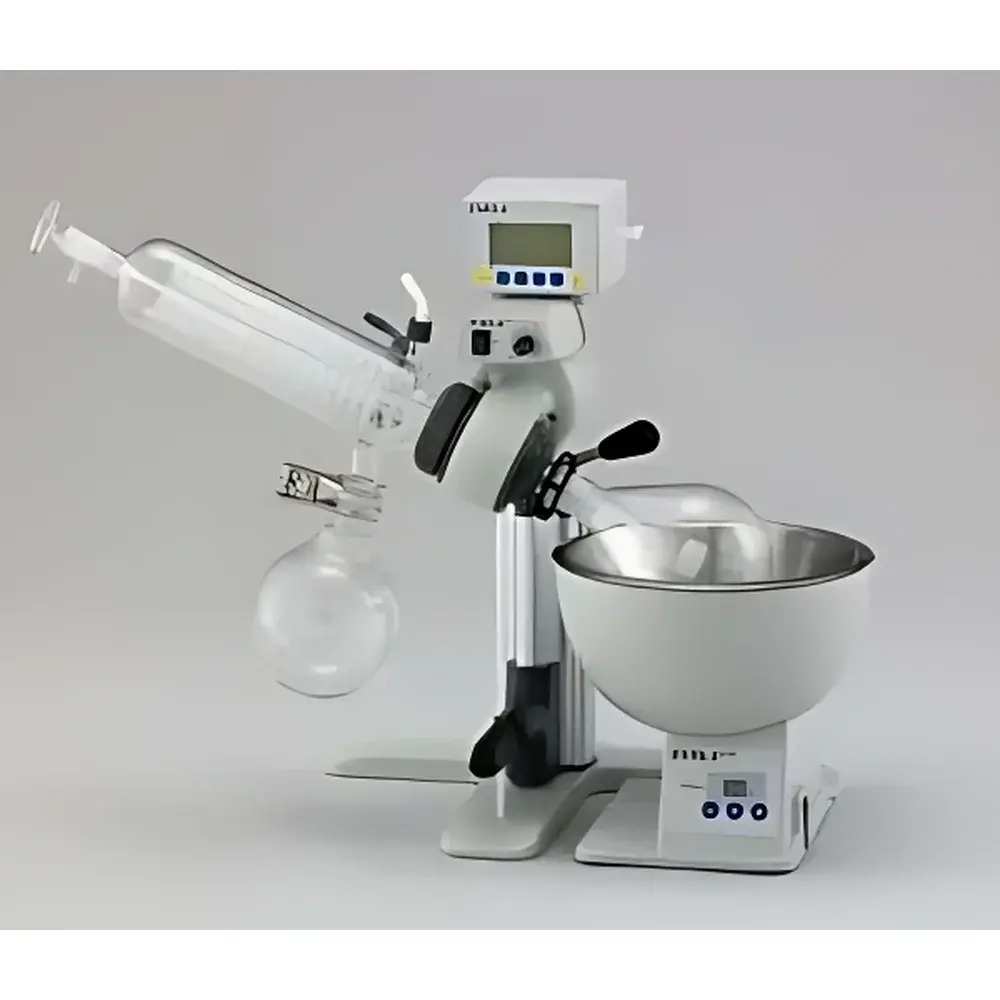
EYELA N-1100S/N-1100SF Advanced Inclined Rotary Evaporator
| Brand | EYELA |
|---|---|
| Origin | Japan |
| Model | N-1100S / N-1100SF |
| Rotation Speed | 20–180 rpm |
| Max. Evaporation Rate | 25 mL/min (water) |
| Ultimate Vacuum | <399.9 Pa (3 mmHg) |
| Bath Temperature Range | RT+5°C to 90°C (N-1100S-W / N-1100SD) or RT+5°C to 180°C (N-1100S-WD) |
| Temp. Control Accuracy | ±1.5°C (water bath, rotating flask) / ±3.0°C (oil bath, rotating flask) |
| Heating Power | 1 kW |
| Condenser | Inclined double-layer coiled tube, cooling area: 0.146 m² |
| Flask Capacity | 1 L pear-shaped (ISO NS29/38) or 500 mL pear-shaped (transparent joint, NS29/38) |
| Receiver | 1 L spherical (ISO S35/20) |
| Shaft Dimensions | ID 18 mm × L 272 mm, TS29/38 |
| Vacuum Seal | Dual-material PTFE/Viton gasket |
| Air Filter | 0.2 µm disk filter (N-1100SD/SFD only) |
| Lift Travel | 100 mm (counterbalanced slide) + 150 mm (manual extension) |
| Bath Dimensions & Capacity | Ø230×100H mm (3 L, water-only) or Ø240×120H mm (5 L, water/oil) |
Overview
The EYELA N-1100S and N-1100SF are precision-engineered inclined-axis rotary evaporators designed for reliable, reproducible solvent removal under controlled vacuum and temperature conditions. Based on the classic Couette flow principle—where rotation induces uniform thin-film formation across the inner surface of a heated flask—the system maximizes heat transfer efficiency and minimizes thermal degradation of thermolabile compounds. The inclined geometry (typically 30°–45° relative to vertical) improves condensate drainage, reduces backflow risk, and enhances operational stability during extended runs. These instruments are widely deployed in pharmaceutical R&D, natural product isolation, polymer synthesis, and environmental analysis laboratories where consistent recovery of volatile organics—such as chlorinated solvents, esters, and low-boiling hydrocarbons—is critical. Both models comply with JIS B 7970 (Rotary Evaporators – General Requirements) and incorporate safety-critical features aligned with IEC 61010-1 for laboratory electrical equipment.
Key Features
- Inclined double-layer coiled condenser (0.146 m² effective cooling area) ensures high-efficiency vapor condensation even at elevated bath temperatures and moderate vacuum levels.
- N-1100SF variant features explosion-resistant coated glassware—including condenser, receiving flask, and four-way adapter—retaining optical clarity while mitigating fragmentation hazards during accidental breakage.
- Counterbalanced vertical lift mechanism (100 mm motorized travel) supplemented by 150 mm manual extension enables precise positioning of flasks across diverse vessel geometries and bath depths.
- Microprocessor-based ON-OFF temperature control with digital setpoint input and real-time display delivers stable thermal regulation within ±1.5°C (water) or ±3.0°C (oil), validated under rotating load conditions per ISO 17025 traceable protocols.
- Integrated safety systems include thermal cut-off fuse and dry-run prevention sensor, preventing heater damage during empty-bath operation.
- PTFE/Viton dual-material vacuum seals ensure long-term integrity at sub-400 Pa operating pressures, compatible with aggressive solvents including DCM, THF, and acetone.
Sample Compatibility & Compliance
The N-1100S series accommodates standard ISO-compliant glassware: 1 L pear-shaped flasks (NS29/38 joint), 500 mL transparent-joint variants (N-1100SF-WD), and 1 L spherical receivers (S35/20). The N-1100SD/SFD configuration replaces ground-glass joints with transparent fused-silica interfaces at the rotation shaft—eliminating particulate shedding and adsorption pathways critical for dioxin-class analyte concentration per EPA Method 1613B. A certified 0.2 µm hydrophobic disk filter is installed in the vent line to prevent ambient particulate ingress during pressure equalization. All models support integration with EYELA’s NVC-series vacuum controllers for programmable ramp-and-hold profiles, meeting GLP documentation requirements for audit trails (21 CFR Part 11 compliant when paired with validated software).
Software & Data Management
While the base N-1100S/N-1100SF operates via standalone microcontroller interface, full digital integration is achieved through optional NVC-2200 or NVC-3000 vacuum controllers. These units log time-stamped vacuum level, bath temperature, rotation speed, and event markers (e.g., start/stop, pressure breach) to internal memory or USB export. Data files conform to CSV format for direct import into LIMS or statistical analysis platforms. Firmware supports password-protected parameter locking and user-defined method storage—essential for regulated environments requiring SOP adherence and operator accountability.
Applications
- Concentration of environmental extracts (e.g., PCBs, PAHs, dioxins) prior to GC-HRMS analysis, leveraging the N-1100SD’s particle-free interface design.
- Removal of reaction solvents from peptide coupling mixtures without racemization or side-chain deprotection.
- High-throughput parallel evaporation using multiple flasks on shared bath platforms, enabled by robust torque transmission up to 180 rpm.
- Recovery of heat-sensitive natural products (e.g., terpenes, alkaloids) under gentle conditions (<90°C water bath, <400 Pa vacuum).
- Integration with DPE-1300/DPE-1400 solvent recovery systems for closed-loop organic waste management, minimizing VOC emissions and regulatory reporting burden.
FAQ
What distinguishes the N-1100SF from the standard N-1100S?
The N-1100SF incorporates explosion-resistant coating on all major glass components (condenser, receiver, four-way adapter), maintaining optical transparency while significantly reducing hazard potential during mechanical impact or thermal shock.
Can the N-1100S operate with oil baths?
Only the N-1100S-WD and N-1100SF-WD configurations support oil heating media, with temperature capability up to 180°C; standard N-1100S-W/N-1100SF-W models are water-bath limited to 90°C.
Is the 0.2 µm air filter replaceable and certified?
Yes—the hydrophobic PTFE disk filter is field-replaceable and supplied with individual lot-specific certification of pore size verification per ASTM F838-22.
Does the system meet ISO/IEC 17025 calibration requirements?
Temperature and vacuum sensors are factory-calibrated against NIST-traceable standards; users may perform periodic verification using external reference probes per ISO/IEC 17025 Clause 6.5.2.
What vacuum controller models are recommended for automated pressure profiling?
EYELA NVC-2200 (single-channel) and NVC-3000 (dual-channel with Ethernet) provide programmable vacuum ramps, endpoint detection, and data logging compatible with validated lab informatics systems.



