
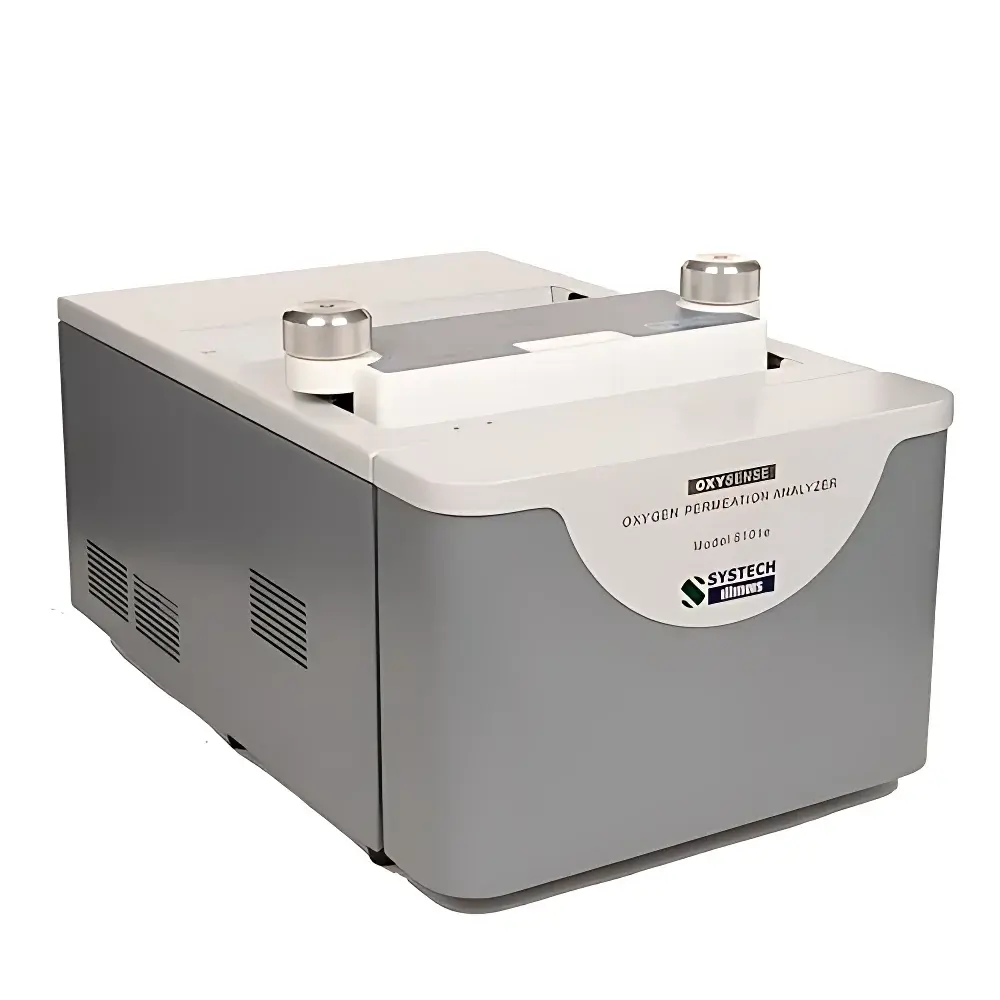
Systech Illinois 8101e Oxygen Transmission Rate Analyzer
| Brand | Systech Illinois |
|---|---|
| Origin | United Kingdom |
| Model | 8101e |
| Test Gas | O₂ |
| RH Control Range | 0–90% ±2% |
| Temperature Control Range | 10–40°C ±0.1°C |
| Sensor Type | eMetric™ Coulometric Sensor |
| Sample Types | Flexible Films & Rigid Packaging |
| Maximum Configurable Stations | 32 |
| Operating System | Windows®-based Platform |
| Sealing Method | Q-Seal™ Chamberless Seal |
| Compliance | ASTM F2622, ASTM D3985, ISO 15105-2, ISO 1186 |
Overview
The Systech Illinois 8101e Oxygen Transmission Rate (OTR) Analyzer is a precision-manufactured, coulometric-based instrument engineered for quantitative measurement of oxygen permeation through flexible and semi-rigid packaging materials under controlled temperature and relative humidity (RH) conditions. Utilizing the fundamental principle of coulometric detection—where oxygen molecules traversing a test specimen are electrochemically reduced at a cathode and quantified via Faraday’s law—the 8101e delivers trace-level sensitivity (down to 0.005 cm³/m²·day·atm) with high reproducibility across diverse polymer films, laminates, coated papers, and pharmaceutical blister foils. Designed for compliance-driven environments including food, pharma, and medical device packaging development, the system operates within standardized environmental envelopes defined by ASTM F2622 (for high-barrier materials), ASTM D3985 (for film testing), and ISO 15105-2 (gas transmission methodology). Its modular architecture supports both single- and multi-station configurations, enabling parallel evaluation of material batches or comparative barrier performance studies under identical climatic conditions.
Key Features
- eMetric™ coulometric sensor technology providing real-time, drift-free O₂ quantification with sub-ppm detection capability and long-term calibration stability
- Q-Seal™ chamberless sealing mechanism eliminating traditional gasketed test cells—reducing setup time, minimizing seal-related failure modes, and improving inter-laboratory repeatability
- Integrated dual-climate control system delivering precise, independent regulation of temperature (10–40°C ±0.1°C) and RH (0–90% ±2%) across all test stations
- Windows®-based embedded operating system supporting user authentication, audit trail logging, and networked data export compliant with FDA 21 CFR Part 11 requirements
- One-touch operation workflow: automatic sample recognition, seal validation, purge sequence initiation, and real-time permeation curve generation upon “Start” command
- Scalable platform architecture allowing expansion from 1 to 32 independent test stations via synchronized controller modules and shared environmental conditioning units
Sample Compatibility & Compliance
The 8101e accommodates standard ASTM/ISO-compliant film specimens (typically 100 mm × 100 mm) as well as pre-formed rigid containers—including vials, trays, and blister cards—via optional fixture kits that maintain geometric integrity during pressurized differential testing. All test protocols adhere to internationally recognized standards: ASTM F2622 for high-barrier materials (e.g., AlOx-coated PET), ASTM D3985 for conventional plastic films, ISO 1186 for food packaging barrier assessment, and ISO 15105-2 for gravimetric and coulometric OTR method equivalence. The system’s environmental control subsystem meets GLP/GMP documentation requirements, with full traceability of setpoints, deviations, and sensor response logs stored in encrypted database format.
Software & Data Management
The proprietary OTRSoft™ application runs natively on the onboard Windows® OS and provides role-based access control (administrator, analyst, reviewer), electronic signatures, and automated report generation in PDF/A-1b and CSV formats. All analytical sessions include timestamped metadata: operator ID, calibration history, RH/temperature profile logs, sensor zero/drift compensation records, and raw coulometric current integrals. Audit trails are immutable and exportable for regulatory submission; data integrity is preserved via SHA-256 hashing and daily backup to network-attached storage (NAS) or cloud repositories configured per organizational IT policy. Optional integration with LIMS platforms is supported via HL7 and ASTM E1384-compliant APIs.
Applications
- Development and qualification of high-barrier flexible packaging for shelf-life extension of oxygen-sensitive products (e.g., snacks, coffee, nutraceuticals)
- Stability testing of pharmaceutical blister packs per ICH Q1A(R2) guidelines under accelerated RH/temperature stress conditions
- Supplier qualification of aluminum foil laminates, SiOx/PET, and multilayer coextrusions used in medical device sterile barrier systems
- In-process quality control of vacuum-sealed meat trays and modified atmosphere packaging (MAP) films
- Comparative analysis of coating efficacy (e.g., PVDC, EVOH, acrylic) under varying humidity gradients to model real-world storage behavior
- Regulatory dossier preparation for FDA 510(k), EU MDR Annex I, and Health Canada Class II device submissions requiring barrier performance evidence
FAQ
What standards does the 8101e comply with for OTR testing?
ASTM F2622, ASTM D3985, ISO 15105-2, ISO 1186, and ISO 2556 for general gas transmission methodology.
Can the system test rigid containers such as blister cards or vials?
Yes—using optional fixture kits designed to maintain uniform pressure differentials and minimize edge leakage during container testing.
Is the coulometric sensor factory-calibrated, and how often does it require recalibration?
Each eMetric™ sensor ships with NIST-traceable calibration certificate; routine verification is recommended every 30 days using certified O₂-permeable reference films.
Does the software support 21 CFR Part 11 compliance for pharmaceutical use?
Yes—featuring electronic signatures, audit trail retention, role-based permissions, and data encryption aligned with Part 11 Subpart B requirements.
How is temperature and RH uniformity maintained across multiple test stations?
Via centralized climate control manifold with individual PID-regulated zone actuators and real-time feedback from calibrated platinum RTD and capacitive RH sensors at each station.






