
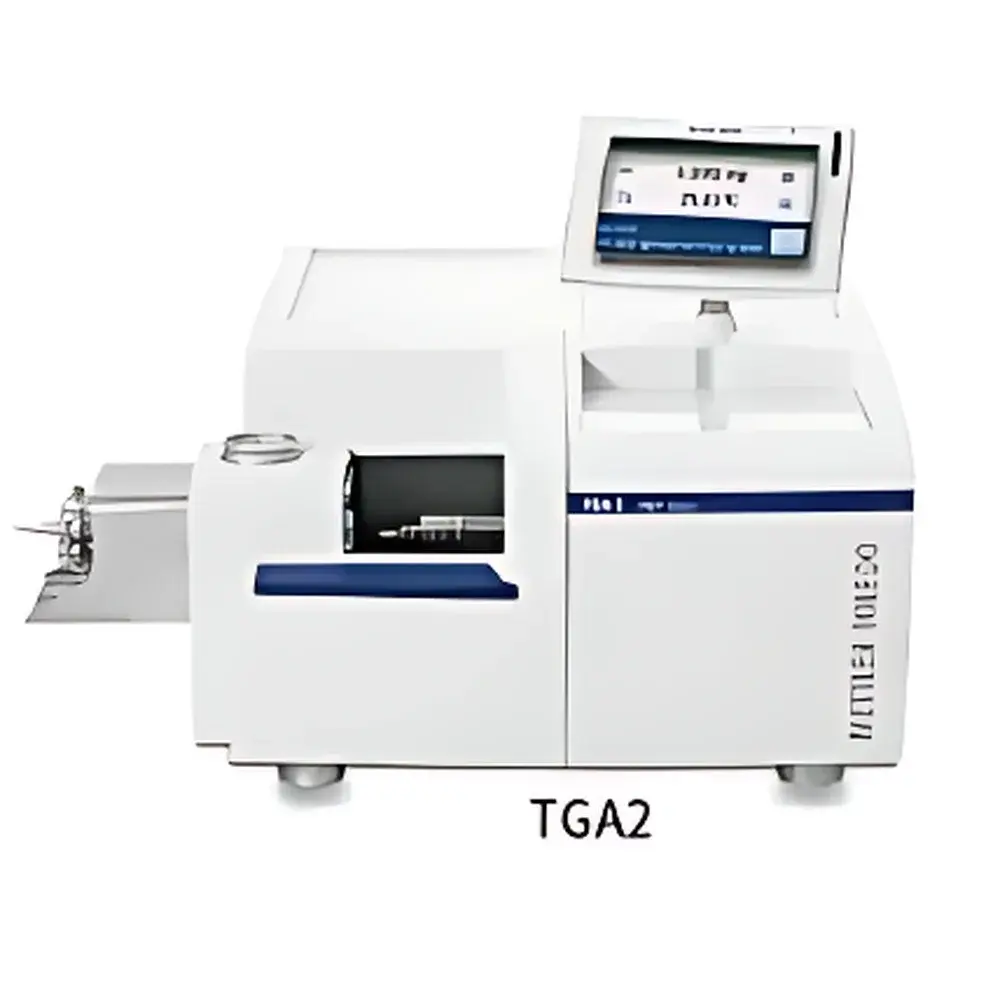
METTLER TOLEDO TGA2 Thermogravimetric Analyzer
| Brand | METTLER TOLEDO |
|---|---|
| Origin | Switzerland |
| Model | TGA2 |
| Temperature Range | 30 °C – 1,100 °C |
| Sampling Rate | 10 data points/second |
| Atmosphere Control | Integrated Mass Flow Controller (MFC) for programmable gas switching |
| Buoyancy Correction | Automatic, model-based, no blank required |
| One-Click Method Launch | Yes |
| Optional Couplings | FTIR, MS, Micro GC, GC/MS |
| Sensor Output | Mass & Temperature |
Overview
The METTLER TOLEDO TGA2 Thermogravimetric Analyzer is an engineered platform for precise, reproducible measurement of mass change as a function of temperature or time under controlled atmospheric conditions. Based on the fundamental principle of thermogravimetry—where sample mass is continuously monitored using a high-resolution microbalance while subjected to a defined thermal program—the TGA2 delivers quantitative insight into thermal stability, decomposition kinetics, moisture/volatile content, filler loading, and oxidative induction time. Designed for routine and research-grade applications in polymer science, pharmaceutical development, materials engineering, and quality control laboratories, the instrument operates across a validated temperature range from 30 °C to 1,100 °C with ±1 K temperature accuracy per ISO 11358 and ASTM E1131. Its robust single-beam furnace architecture ensures thermal homogeneity and long-term baseline stability, minimizing drift and enhancing measurement repeatability across multi-day campaigns.
Key Features
- High-speed data acquisition at 10 data points per second enables resolution of rapid mass-loss events, such as solvent evaporation or low-activation-energy decomposition steps.
- Integrated mass flow controller (MFC) provides precise, programmable gas dosing for inert (N₂, Ar), oxidative (air, O₂), or reactive atmospheres—supporting sequential or simultaneous gas switching during a single run.
- Automatic buoyancy correction algorithm accounts for convective and density-driven effects without requiring separate blank measurements, reducing operator dependency and analysis time.
- One-Click method launch allows direct execution of pre-validated, user-defined thermal protocols from the intuitive 7-inch color touchscreen interface—minimizing training overhead and procedural variability.
- Modular coupling architecture supports seamless hyphenation with Fourier-transform infrared spectroscopy (FTIR), quadrupole mass spectrometry (MS), micro-gas chromatography (Micro GC), and GC/MS systems for evolved gas analysis (EGA).
- Thermal calibration traceable to NIST-certified reference materials ensures compliance with GLP, GMP, and FDA 21 CFR Part 11 requirements when used with optional audit trail and electronic signature modules.
Sample Compatibility & Compliance
The TGA2 accommodates standard crucibles (alumina, platinum, gold, and ceramic) with capacities up to 200 mg, enabling analysis of powders, granules, films, fibers, and small solid components. Its dual-pan balance design minimizes thermal noise and supports high-sensitivity detection of sub-microgram mass changes. The system complies with international standards including ISO 11358-1 (general principles), ISO 11358-2 (determination of degradation onset), ASTM E1131 (standard test method for compositional analysis), and USP (residual solvents). When configured with METTLER TOLEDO’s LabX software and security options, it meets regulatory expectations for data integrity, user access control, and electronic record retention per ALCOA+ principles.
Software & Data Management
Acquisition and evaluation are performed via METTLER TOLEDO’s dedicated STARe (Simultaneous Thermal Analysis and Rheology) software suite. STARe provides automated peak detection, derivative (DTG) calculation, kinetic modeling (e.g., Friedman, Ozawa-Flynn-Wall), and multi-curve comparison tools. All raw and processed data—including instrument logs, method parameters, and environmental metadata—are stored in a secure, timestamped database. Export formats include CSV, PDF, and XML for integration with LIMS or enterprise analytics platforms. Audit trail functionality records all user actions, parameter modifications, and report generations—fully compliant with 21 CFR Part 11 when deployed with digital signatures and role-based permissions.
Applications
- Quantification of polymer degradation onset, char yield, and filler content (e.g., CaCO₃, SiO₂) in composites.
- Determination of residual solvents and water content in active pharmaceutical ingredients (APIs) per ICH Q5C guidelines.
- Assessment of thermal oxidation stability in lubricants and elastomers using OIT (oxidative induction time) protocols.
- Characterization of catalyst deactivation mechanisms through coke deposition analysis under controlled gas environments.
- Supporting regulatory filings by generating thermally stable batch-to-batch comparability data aligned with ICH Q1E and Q5D.
FAQ
What is the maximum operating temperature of the TGA2?
The TGA2 is rated for continuous operation up to 1,100 °C with certified temperature accuracy of ±1 K across its full range.
Does the TGA2 require manual blank subtraction for accurate mass readings?
No—its built-in buoyancy correction model eliminates the need for separate blank runs by dynamically compensating for convection and gas density effects.
Can the TGA2 be integrated with a mass spectrometer for evolved gas analysis?
Yes—the instrument features standardized vacuum and signal interfaces compatible with commercial quadrupole MS systems for real-time EGA.
Is the TGA2 compliant with FDA 21 CFR Part 11 requirements?
When paired with LabX software, appropriate user authentication, electronic signatures, and audit trail modules, the system supports full Part 11 compliance.
How does the One-Click functionality improve laboratory workflow?
It enables trained operators to initiate fully validated methods—including temperature ramp rates, gas sequences, and data processing rules—directly from the touchscreen without navigating complex menus or risk of parameter misentry.



