
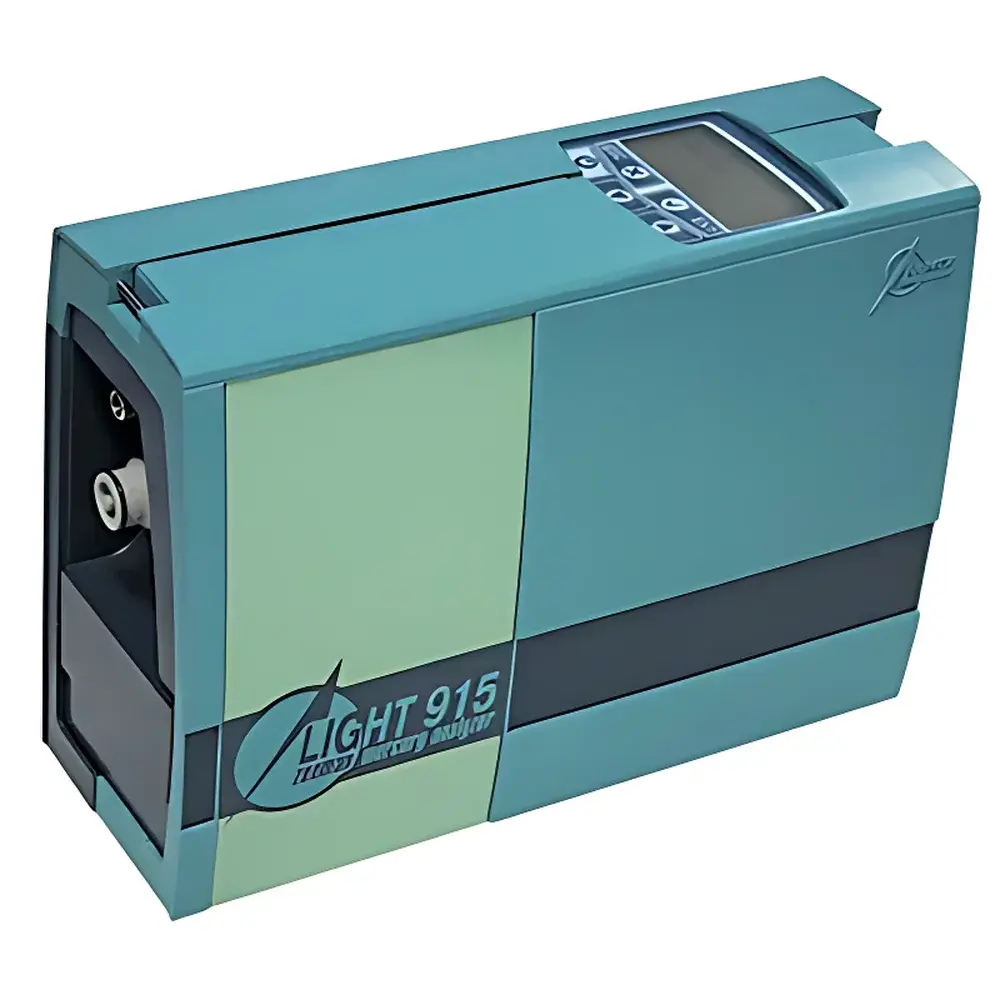
LUMEX Light 915 Portable Mercury Analyzer
| Brand | LUMEX |
|---|---|
| Origin | Canada |
| Model | Light 915 |
| Instrument Type | Portable |
| Measurement Principle | Zeeman Atomic Absorption Spectrometry with High-Frequency Modulation (ZAAS-HFM) |
| Detection Limit | 100 ng/m³ |
| Repeatability | ±1% RSD |
| Linearity Error | ±1% |
| Measurement Range | 0.1–3000 µg/m³ |
| Air Pump Flow Rate | 10 L/min |
| Analysis Time | Real-time |
| Dimensions | 290 × 210 × 110 mm |
| Weight | 3.3 kg |
| Power Supply | Internal 12 V DC rechargeable battery (12 h operation) / External 110–240 V AC, 50/60 Hz |
| Power Consumption | 20 W |
| Data Storage | Internal memory with USB and Bluetooth connectivity |
| Compliance | EPA Emergency Response Equipment List, ASTM D6784-22 (for mercury in air), ISO 6978-1:2003 (natural gas—mercury determination) |
Overview
The LUMEX Light 915 Portable Mercury Analyzer is a field-deployable, high-sensitivity instrument engineered for real-time quantification of elemental mercury vapor (Hg⁰) in ambient air and industrial gas streams. It employs Zeeman Atomic Absorption Spectrometry with High-Frequency Modulation (ZAAS-HFM), a physically robust variant of cold vapor atomic absorption that eliminates the need for chemical pre-concentration (e.g., gold amalgamation) or carrier gases. The technique leverages the characteristic 254 nm resonance line of mercury atoms under magnetic field-induced spectral splitting, enabling direct, interference-resistant detection via polarization-modulated light. This optical architecture delivers intrinsic background correction, high signal-to-noise ratio, and immunity to matrix-related spectral overlaps—critical for reliable operation in complex environments such as smelters, chlor-alkali plants, waste incineration facilities, and post-spill scenarios. Designed for regulatory-grade field use, the Light 915 meets technical requirements referenced in ASTM D6784-22 (Standard Test Method for Determination of Mercury in Coal and Coal Combustion Residues by Cold Vapor Atomic Absorption) and aligns with measurement principles outlined in ISO 6978-1:2003 for mercury in natural gas matrices.
Key Features
- Real-time, continuous measurement without sample pre-treatment—no gold traps, no reagents, no external gas supply required
- Zeaman-effect background correction ensures stable baseline and minimal drift during extended field deployment
- Integrated performance verification module with automatic zero-check and internal calibration verification sequence
- Ultra-low detection limit of 100 ng/m³ (0.1 µg/m³) with ±1% repeatability and ±1% linearity error across five decades of dynamic range (0.1–3000 µg/m³)
- Compact form factor (290 × 210 × 110 mm) and lightweight design (3.3 kg) optimized for handheld or vehicle-mounted operation
- 12-hour continuous runtime on rechargeable 12 V DC battery; dual-power compatibility (110–240 V AC input)
- Ruggedized housing rated for laboratory, industrial, and outdoor environmental conditions
Sample Compatibility & Compliance
The Light 915 is validated for direct analysis of gaseous samples containing elemental mercury vapor in air, nitrogen, argon, natural gas, and flue gas dilutions. It is not intended for liquid or solid-phase mercury speciation (e.g., methylmercury, Hg²⁺). Its analytical protocol complies with U.S. EPA’s emergency response instrumentation criteria and is listed on the EPA Emergency Response Equipment List for rapid source identification and clearance verification. The instrument supports GLP-aligned data integrity through timestamped internal logging and audit-ready export formats. While not FDA 21 CFR Part 11–certified out-of-the-box, its data output structure (CSV, XML) is compatible with validated LIMS and ELN platforms used in regulated environmental testing laboratories operating under ISO/IEC 17025:2017 accreditation.
Software & Data Management
Data acquisition and instrument control are managed via embedded firmware with local storage capacity for ≥10,000 measurement records. Field data can be retrieved via USB 2.0 interface or Bluetooth 4.2 wireless connection to Windows/macOS systems. The included PC software provides time-series visualization, trend analysis, alarm threshold configuration, and report generation compliant with ISO 14001 environmental monitoring documentation standards. Raw absorbance spectra and Zeeman modulation diagnostics are accessible for method validation and troubleshooting. Firmware updates are delivered via secure HTTPS download and support over-the-air (OTA) deployment in networked fleet deployments.
Applications
- Emergency response to mercury spills (e.g., broken thermometers, sphygmomanometers, fluorescent lamp breakage) — rapid source localization and decontamination verification
- Occupational hygiene monitoring in chlor-alkali production, dental laboratories, and LED manufacturing facilities
- Continuous stack emission monitoring at coal-fired power plants and municipal waste incinerators (when configured with heated sampling lines)
- Ecological field surveys near artisanal gold mining sites or legacy industrial zones
- Process control in mercury recovery units and activated carbon filter efficiency testing
- Research applications in atmospheric chemistry, mercury biogeochemical cycling, and indoor air quality studies
FAQ
Does the Light 915 require gold-coated traps or chemical reagents for operation?
No. It performs direct atomic absorption measurement using Zeeman-modulated 254 nm light, eliminating dependence on amalgamation chemistry or carrier gases.
Can it measure mercury in water or soil samples?
No. The Light 915 is strictly a gas-phase analyzer for elemental mercury vapor. Liquid or solid samples require separate digestion and cold vapor generation systems.
Is the instrument suitable for unattended long-term monitoring?
Yes — with external power and optional weatherproof enclosure, it supports 24/7 operation; internal battery enables >12 h autonomous field use.
How is calibration traceability established?
Calibration is performed using NIST-traceable mercury vapor permeation sources or certified gas standards; factory calibration certificates include uncertainty budgets per ISO/IEC 17025 guidelines.
What maintenance intervals are recommended?
Optical alignment verification every 6 months; pump filter replacement every 200 hours of operation; annual full functional check recommended by LUMEX-certified service centers.





