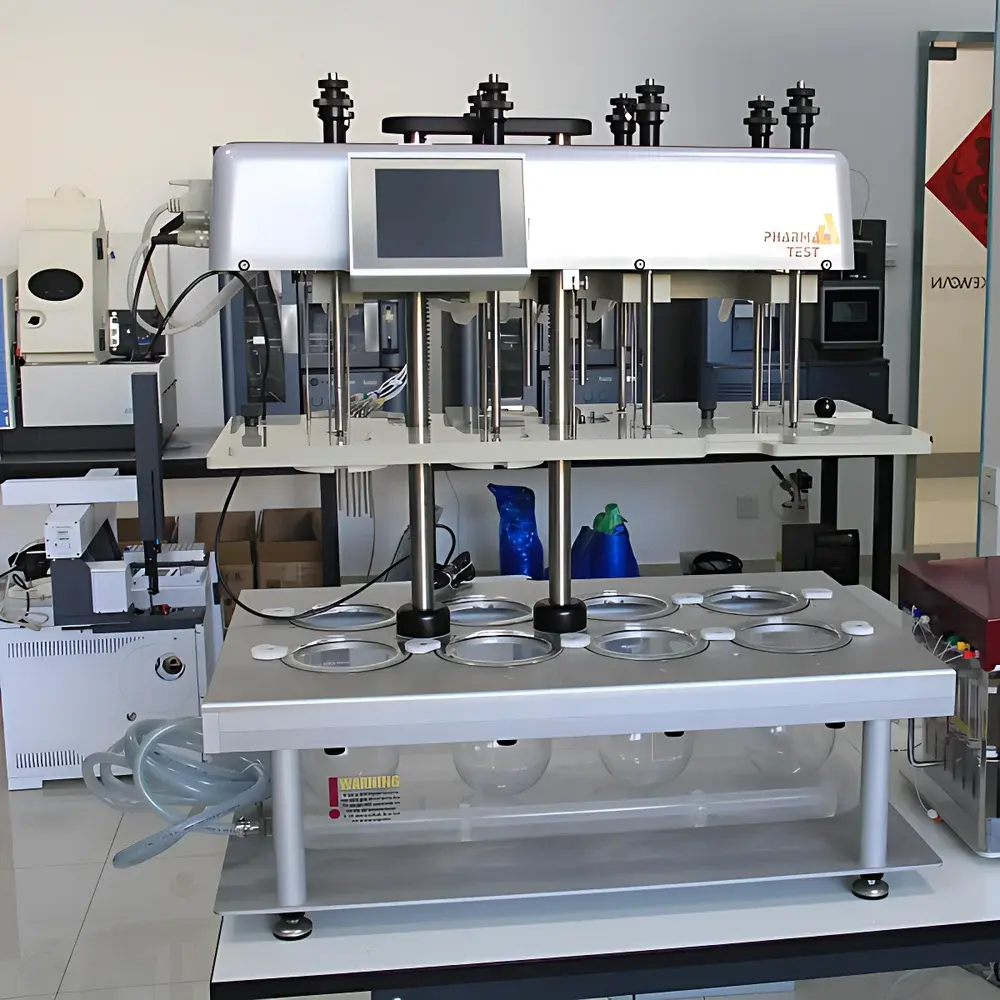
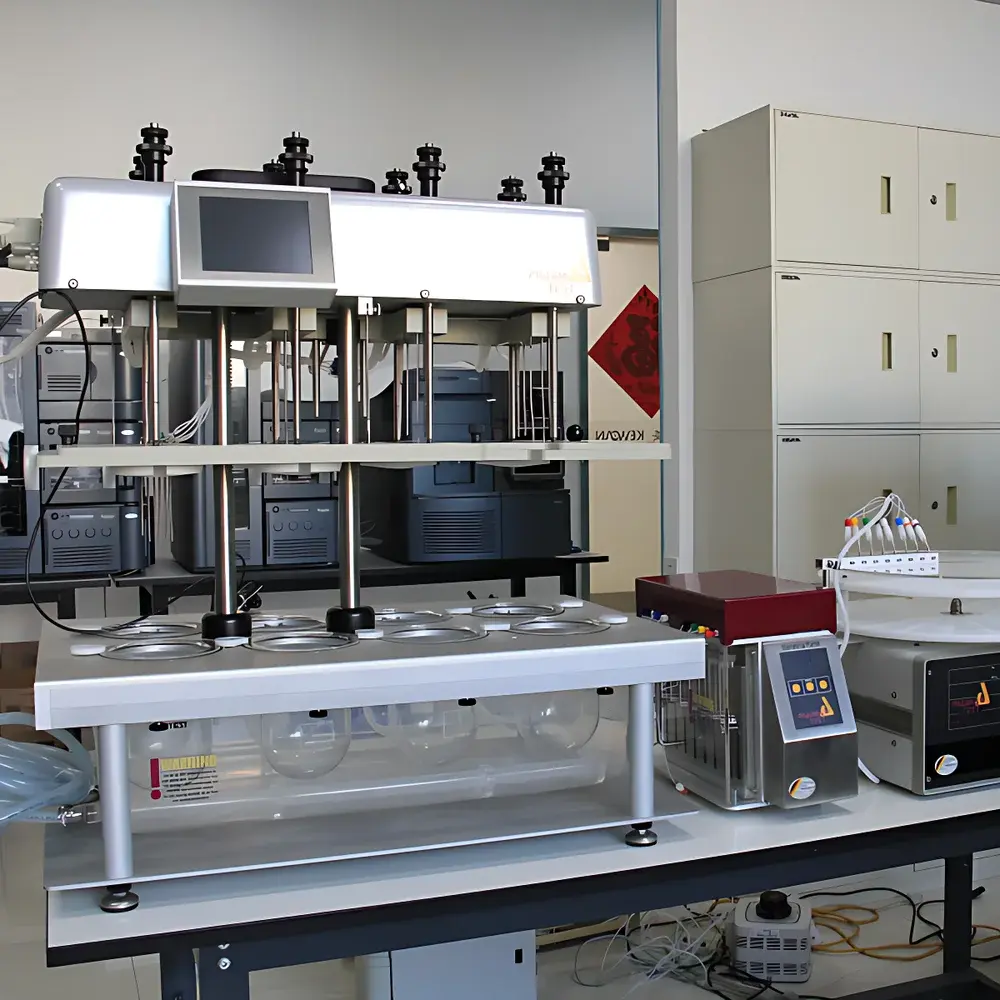
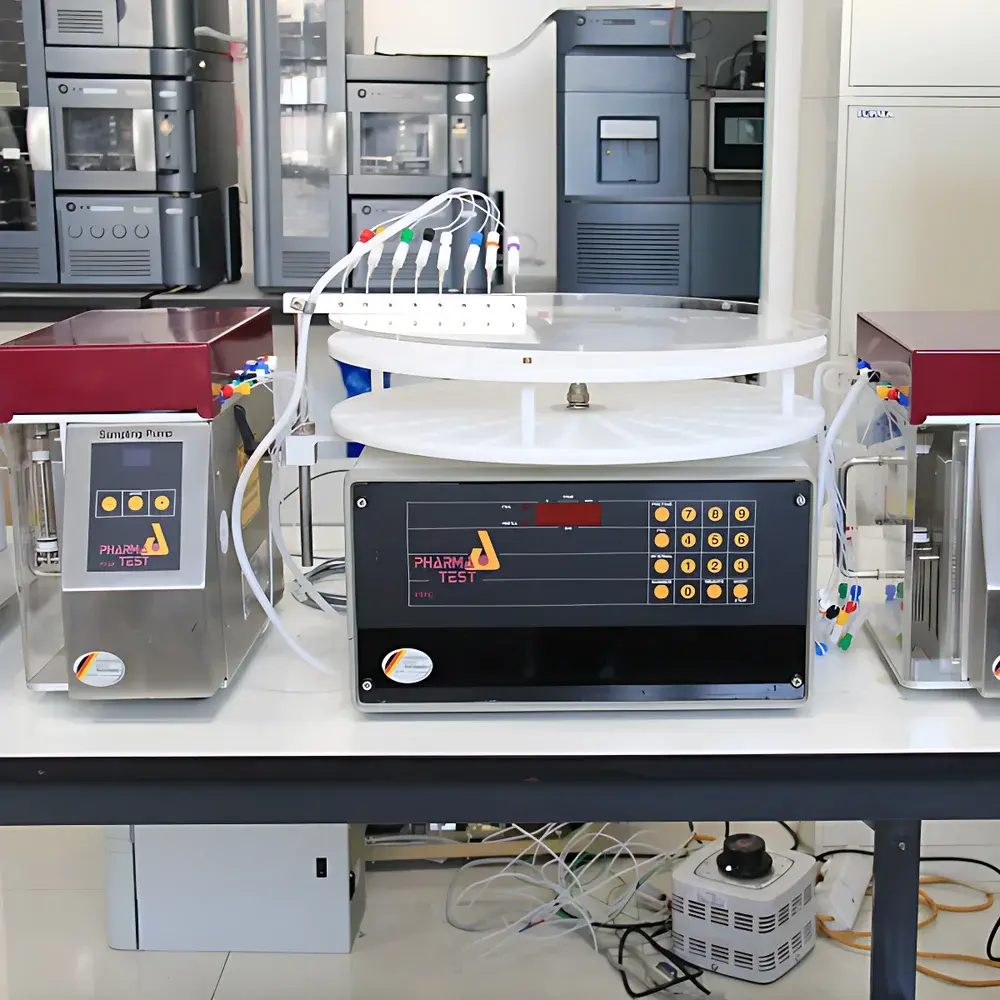
Pharma-test PTWS 1420 Used USP Dissolution Tester
| Brand | Pharma-test |
|---|---|
| Origin | USA |
| Model | PTWS 1420 |
| Configuration | Dual-drive, 14-vessel dissolution system with independent paddle/stirrer speed control per side |
| Compliance | Fully compliant with USP <711>, <724>, EP <2.9.3>, <2.9.4>, BP, DAB, and JP <15> |
| Vessel capacity | 14 test positions + 2 auxiliary temperature-controlled media reservoirs |
| Temperature monitoring | Individual cup-level ITM sensors (±0.2 °C accuracy) |
| Automated dosing | TMA tablet drop module |
| Sampling system | EPE robotic autosampler with precise XYZ positioning and immersion depth control |
| Drive architecture | Monoshaft™ single-shaft design for seamless USP Apparatus 1 (basket), 2 (paddle), 5 (paddle-over-disk), and 6 (cylinder) interchangeability without re-heighting |
| Method storage | Unlimited methods via SD card with user-accessible encryption and audit trail metadata |
| Pump system | DSR-M 13-channel piston pump with LCD interface, 20-sample programmable sequence, compatible with standard HPLC vials and tube racks (2–20 mL) |
| Water bath | 1500 W rapid-heating stainless-steel bath with detachable design, integrated diffuser for ±0.1 °C thermal uniformity across all vessels |
| Acoustic & vibration performance | Low-noise circulation pump with anti-vibration mounting |
| Pre-run diagnostics | Integrated self-test with visual LED indicators and audible status tones |
| Qualification support | Built-in OQ/PQ checklist prompts and timestamped event logging |
| Connectivity | USB host for PC remote operation |
| Safety & ergonomics | Low-volatility vessel lids, step-start manual mode, dual-motor left/right independent drive control |
| Software compliance | Audit-trail-enabled method execution logs meeting FDA 21 CFR Part 11 requirements for electronic records and signatures |
Overview
The Pharma-test PTWS 1420 is a rigorously validated, dual-drive USP dissolution testing system engineered for pharmaceutical quality control laboratories requiring full regulatory alignment with compendial standards. Operating on the hydrodynamic principle of controlled fluid flow around solid dosage forms, the PTWS 1420 precisely replicates in vivo dissolution behavior under standardized conditions defined by USP <711> (Dissolution), <724> (Drug Release), European Pharmacopoeia <2.9.3> and <2.9.4>, British Pharmacopoeia, Deutsches Arzneibuch (DAB), and Japanese Pharmacopoeia Chapter <15>. Its 14-vessel configuration supports parallel batch testing while maintaining strict vessel-to-vessel thermal and mechanical equivalence—critical for statistical robustness in release testing and stability studies. The system’s core architecture integrates real-time temperature sensing (ITM), automated tablet delivery (TMA), and robotic sampling (EPE) into a unified platform that meets the operational and documentation demands of GLP- and GMP-regulated environments.
Key Features
- Monoshaft™ single-shaft drive system enabling rapid, height-invariant interchange of USP Apparatus 1, 2, 5, and 6 without recalibration or manual adjustment.
- Independent dual-motor control for left- and right-side stirrers—essential for method development involving asymmetric agitation profiles or comparative dissolution kinetics.
- EPE robotic autosampler with closed-loop positional feedback, sub-millimeter Z-axis immersion precision, and automatic return-to-home sequencing between sampling events.
- ITM (Individual Temperature Monitoring) sensors mounted directly at each vessel base deliver continuous, traceable temperature data (±0.2 °C) logged alongside dissolution results.
- DSR-M 13-channel piston pump with integrated LCD interface, capable of 20 discrete sampling cycles per run and compatibility with 2–20 mL HPLC vials and custom tube racks.
- 1500 W stainless-steel water bath featuring modular construction for tool-free removal, cleaning, and validation; integrated thermal diffuser ensures ≤±0.1 °C spatial uniformity across all 14 vessels.
- Built-in OQ/PQ prompt engine with configurable checklists, timestamped completion flags, and exportable PDF reports supporting regulatory inspection readiness.
- Full 21 CFR Part 11 compliance via encrypted SD-card method storage, user-role-based access control, electronic signature capture, and immutable audit trails for all critical events.
Sample Compatibility & Compliance
The PTWS 1420 accommodates standard USP-compliant dissolution vessels (900 mL, 1000 mL), as well as extended-volume configurations for modified-release formulations. It supports immediate-release tablets, capsules, orally disintegrating tablets (ODTs), transdermal patches, and extended-release matrix systems. All hardware and firmware are pre-validated against USP <711>, <724>, EP <2.9.3/4>, JP <15>, and ISO 19001:2015-aligned QC processes. Documentation packages include IQ/OQ templates, calibration certificates traceable to NIST standards, and vendor-supplied PQ protocols suitable for site-specific adaptation under GMP Annex 15 and ICH Q5C guidelines.
Software & Data Management
The embedded control software provides method-driven operation with password-protected user tiers (Administrator, Technician, Viewer). Methods—including agitation speed, temperature setpoint, sampling schedule, and pump parameters—are stored on removable SD cards with SHA-256 hash verification. Every run generates a timestamped binary log file containing raw sensor data, motor status, sampling timestamps, and environmental deviations. Export options include CSV (for LIMS integration), PDF (for audit submission), and XML (for enterprise ELN systems). Remote USB control enables integration with laboratory automation frameworks, while RS232 output supports direct printing of run summaries to networked thermal printers—fully compliant with ALCOA+ data integrity principles.
Applications
- QC release testing of commercial batches per pharmacopoeial monographs.
- Comparative dissolution profiling for generic drug bioequivalence assessment (FDA Guidance for Industry, 2013).
- Stability-indicating method development under ICH Q1–Q5 frameworks.
- Excipient interaction studies and formulation optimization using multi-point kinetic modeling.
- 3Q qualification (IQ/OQ/PQ) execution and maintenance for regulated manufacturing sites.
- Reference standard dissolution rate benchmarking in analytical R&D laboratories.
FAQ
Is this unit supplied with full calibration and certification documentation?
Yes—each PTWS 1420 undergoes pre-shipment metrological verification including temperature uniformity mapping, rotational speed validation (±0.5 rpm), and volumetric sampling accuracy testing (±1.0% RSD). NIST-traceable calibration certificates and IQ/OQ summary reports are included.
Can the system be integrated into an existing LIMS or MES environment?
Absolutely—the instrument supports CSV and XML data export via SD card or USB, and its event log structure complies with ASTM E2500-18 for automated data ingestion into validated LIMS platforms.
What level of technical support is provided post-purchase?
All units include 12 months of remote engineering support, on-site 3Q assistance (optional add-on), and access to Pharma-test’s global service network for spare parts and firmware updates.
Are replacement consumables and USP-certified accessories available?
Yes—we maintain inventory of USP-certified baskets, paddles, sinkers, and dissolution vessels sourced directly from Pharma-test’s authorized distribution channel.
Does the system meet current FDA and EMA expectations for electronic record retention?
Yes—audit trails are time-stamped, immutable, and exportable; user authentication, electronic signatures, and role-based permissions fully satisfy 21 CFR Part 11 and EU Annex 11 requirements.