
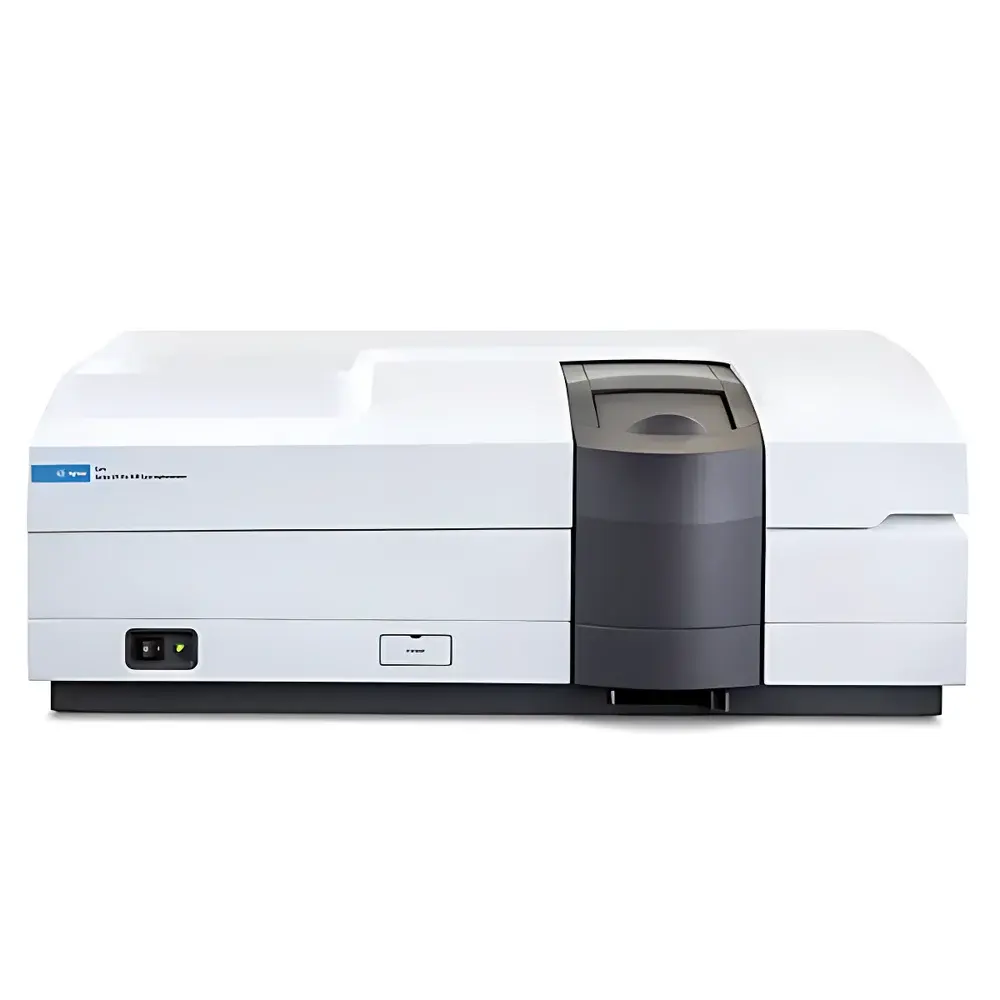
Agilent Cary 4000 UV-Vis Spectrophotometer
| Brand | Agilent Technologies |
|---|---|
| Origin | Malaysia |
| Manufacturer Type | Original Equipment Manufacturer (OEM) |
| Import Status | Imported |
| Model | Cary 4000 |
| Optical Design | Double-Beam |
| Detector | Photomultiplier Tube (PMT) |
| Wavelength Range | 175–900 nm |
| Automation Level | Motorized Wavelength Scanning |
| Spectral Bandwidth | 0.01–5.00 nm (variable) |
| Photometric Range | 0–8.0 Abs |
| Light Sources | Deuterium Lamp (UV), Tungsten-Halogen Lamp (Vis) |
| Maximum Scan Speed | 2000 nm/min |
| Sample Compartment Z-Height | 20 mm |
| Dimensions (W×D×H) | 1020 × 710 × 380 mm |
| Weight | 91 kg |
| Power Requirement | 100–240 VAC, 50/60 Hz |
Overview
The Agilent Cary 4000 UV-Vis Spectrophotometer is a high-performance double-beam instrument engineered for precision photometric measurement across the deep ultraviolet to near-infrared spectral region (175–900 nm). It employs a dual monochromator architecture based on an off-axis Littrow design, coupled with a Schwarzschild focusing optical system to maximize throughput while minimizing stray light and electronic noise. This configuration delivers exceptional photometric accuracy, long-term stability, and reproducibility—critical for quantitative analysis in regulated environments such as pharmaceutical quality control, biopharmaceutical characterization, and materials science research. Unlike single-beam systems, the Cary 4000’s real-time reference beam correction compensates for source drift and detector sensitivity fluctuations, ensuring baseline integrity over extended acquisition periods. Optional nitrogen purging of both the monochromator and sample compartment eliminates atmospheric oxygen absorption bands below 200 nm, enabling reliable measurements down to 175 nm without spectral artifacts.
Key Features
- Double-beam optical path with motorized reference beam attenuator—enables accurate absorbance measurements up to 8.0 Abs by dynamically balancing signal intensity between sample and reference channels
- Variable spectral bandwidth (0.01–5.00 nm) controlled via precision slit mechanisms—optimizes resolution/sensitivity trade-offs for narrow peaks (e.g., protein secondary structure analysis) or broad-band applications (e.g., polymer film transmission)
- LockDown mechanical interface in the large-volume sample compartment—facilitates rapid, repeatable accessory exchange with sub-micron alignment repeatability
- Cast-aluminum vibration-damping chassis combined with isolated optical bench—reduces microphonic interference and thermal drift, supporting stable operation in non-dedicated lab spaces
- Integrated nitrogen purge ports for independent purging of monochromator and sample chamber—ensures spectral fidelity in the far-UV region and extends lamp lifetime
- High-speed scanning capability (up to 2000 nm/min) with <10 ms data point interval—supports time-resolved kinetics studies and rapid QC screening workflows
Sample Compatibility & Compliance
The Cary 4000 accommodates diverse sample formats through a modular accessory ecosystem: temperature-controlled cuvette holders (−10 °C to 110 °C), solid-sample reflectance stages (specular and diffuse), automated solid sample changers, multi-cell carousels (up to 12 positions), and fiber-optic probes for in-situ measurements. All accessories are mechanically registered to the LockDown interface, preserving optical alignment across configurations. The system complies with ISO 9001 manufacturing standards and supports 21 CFR Part 11 compliance when deployed with validated WinUV software configurations—including electronic signatures, audit trails, and user-access controls. It meets ASTM E275 and E169 for spectrophotometer performance verification and aligns with ICH Q5A/Q5B guidelines for biopharmaceutical purity assessment via UV spectral fingerprinting.
Software & Data Management
Controlled exclusively by Agilent’s Cary WinUV software—a Windows-based, modular application platform—the Cary 4000 supports method-driven workflows from basic absorbance scans to complex multi-step protocols (e.g., enzyme kinetics with variable temperature ramps, thermal denaturation profiling, or multicomponent quantitation using derivative spectroscopy). Raw data are stored in vendor-neutral .csv and .jdx formats; proprietary .uv files retain full metadata including instrument configuration, calibration history, and user annotations. Software modules for DNA/RNA quantification, protein A280/A260 ratio analysis, and GLP-compliant report generation are available as validated options. Audit trail functionality records all parameter changes, data exports, and user logins—fully traceable for FDA or EMA inspection readiness.
Applications
- Quantitative determination of nucleic acid concentration and purity (A260/A280, A260/A230 ratios) in genomic and transcriptomic workflows
- Protein secondary structure analysis via far-UV CD-coupled UV absorbance or thermal melt profiling (Tm determination)
- Pharmaceutical assay development and release testing per USP and EP 2.2.25
- Thin-film optical density mapping and bandgap estimation in semiconductor and photovoltaic R&D
- Stability-indicating methods for forced degradation studies under oxidative, thermal, and photolytic stress conditions
- Colorimetric assay validation (e.g., ELISA, BCA, Bradford) with rigorous linearity and LOD/LOQ verification
FAQ
What is the lowest measurable wavelength with nitrogen purge enabled?
With continuous nitrogen purge of both the monochromator and sample compartment, the Cary 4000 achieves stable, low-noise operation down to 175 nm—verified per ASTM E275 Annex A1.
Can the instrument be integrated into a laboratory automation system?
Yes—the Cary 4000 supports RS-232, USB, and Ethernet communication protocols and exposes COM-based API access for integration with LIMS, MES, or robotic liquid handlers via Agilent’s Instrument Control Framework (ICF).
Is GMP/GLP-compliant software validation support available?
Agilent provides IQ/OQ documentation packages and on-site PQ services for WinUV software, including preconfigured templates aligned with Annex 11 and ALCOA+ data integrity principles.
How does the dual monochromator design improve stray light rejection?
The off-axis Littrow double monochromator reduces stray light to <0.00008% at 220 nm—two orders of magnitude lower than conventional Czerny-Turner designs—enabling accurate high-absorbance measurements without baseline distortion.
What maintenance intervals are recommended for routine operation?
Lamp replacement every 1,000–2,000 hours (deuterium) and 5,000–10,000 hours (tungsten-halogen); annual optical alignment verification and biannual PM service including slit calibration and detector gain optimization.





