
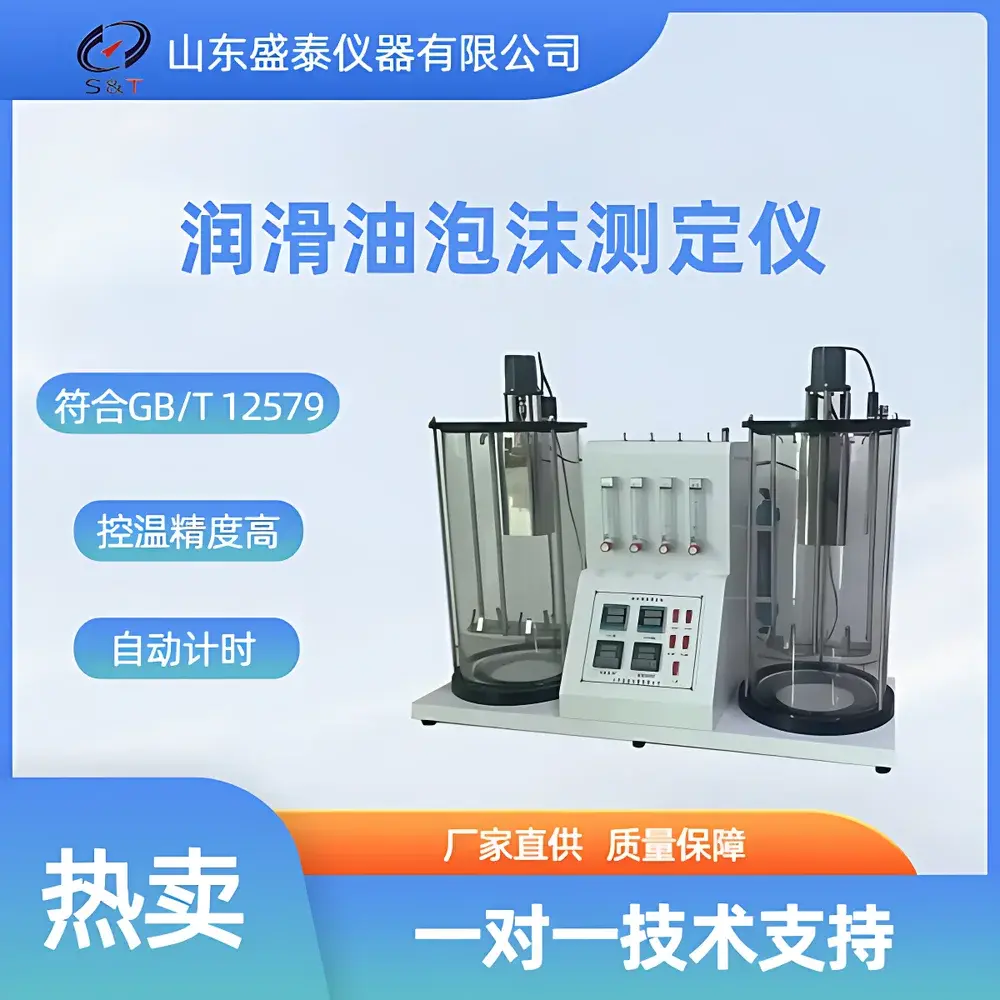
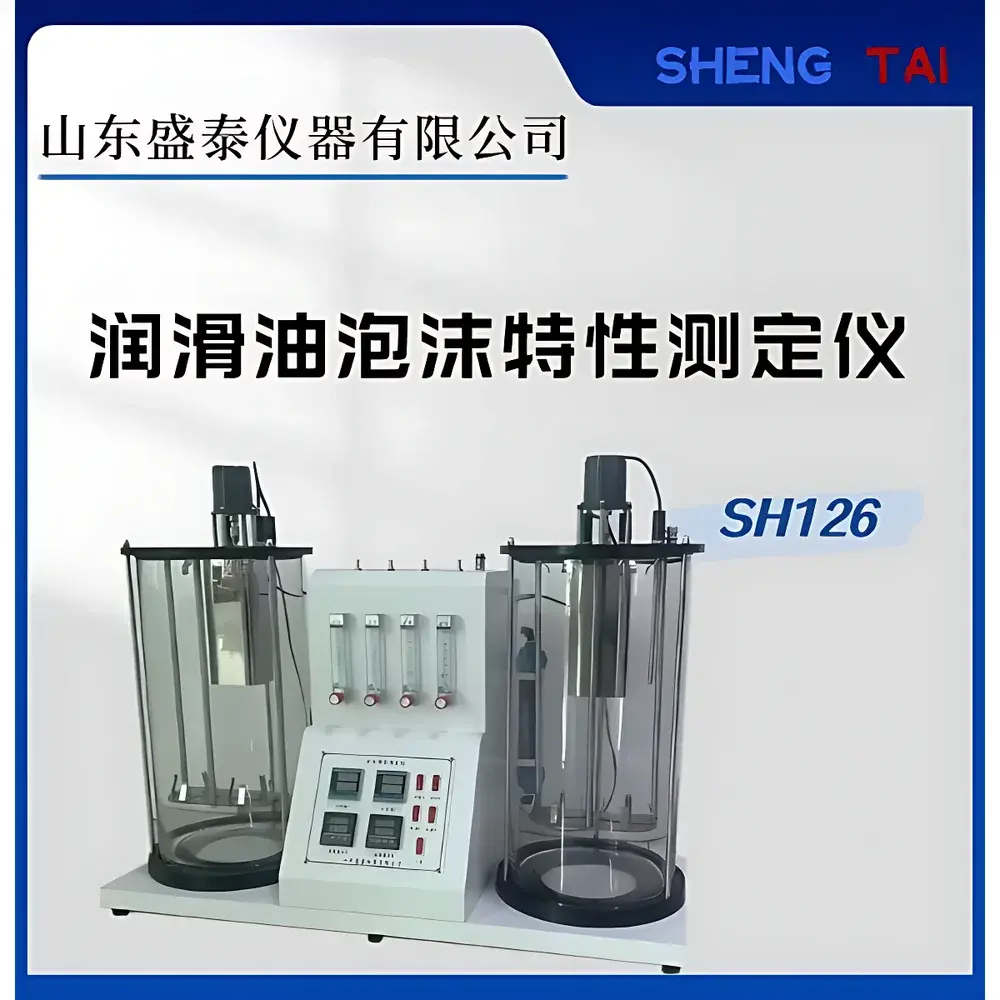
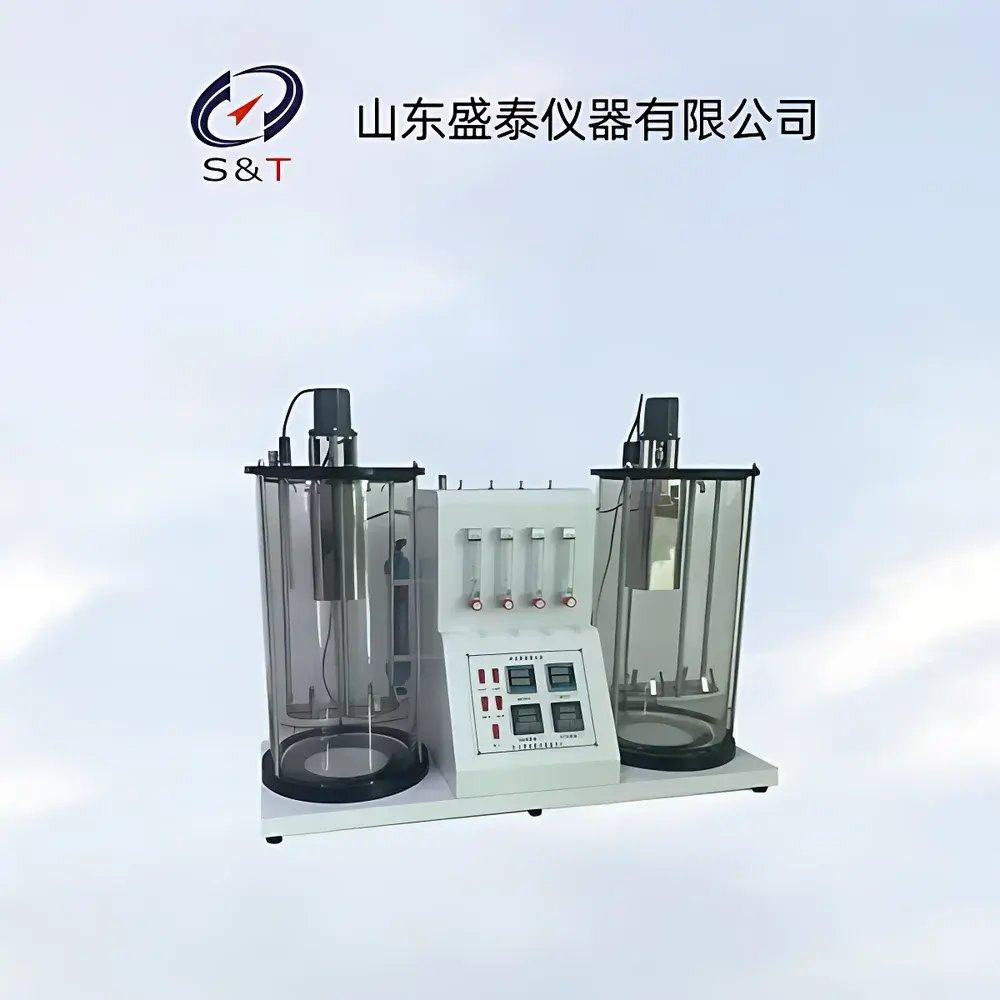
Shengtai Instruments SH126 Lubricating Oil Foam Analyzer with Integrated Refrigeration Unit
| Brand | Shengtai Instruments |
|---|---|
| Origin | Shandong, China |
| Manufacturer Type | Direct Manufacturer |
| Country of Origin | China |
| Model | SH126 |
| Applicable Standards | GB/T 12579, ASTM D892, JIS K2518 |
| Temperature Control Range | 0 °C to 99.9 °C |
| Temperature Accuracy | ±0.5 °C |
| Low-Temp Bath Setting | 24 °C ±0.5 °C |
| High-Temp Bath Setting | 93.5 °C ±0.5 °C |
| Air Flow Rate | 16–160 mL/min (adjustable via rotameter) |
| Built-in Air Source | 3 L/min |
| Gas Diffuser Capacity | 3000–6000 mL/min at 2.45 kPa |
| Timer Range | 0–99.99 h |
| Timer Accuracy | ±1 s |
| Sample Cylinder | 1000 mL calibrated glass cylinder (dedicated) |
| Dimensions | 680 × 380 × 550 mm |
| Weight | 35 kg |
Overview
The Shengtai Instruments SH126 Lubricating Oil Foam Analyzer with Integrated Refrigeration Unit is a precision-engineered instrument designed for the quantitative evaluation of foam tendency (FT) and foam stability (FS) in lubricants and industrial oils under standardized thermal and pneumatic conditions. It operates on the principle of controlled air sparging through a defined diffuser into a standardized 1000 mL calibrated cylinder containing the test sample, followed by automated measurement of foam volume at specified time intervals—directly aligned with the physical mechanisms described in ISO 6247, ASTM D892 (Method A), GB/T 12579, and JIS K2518. The inclusion of an integrated refrigeration module enables stable sub-ambient temperature operation down to 0 °C, extending method compliance beyond conventional high-temperature testing (e.g., 93.5 °C) to low-temperature protocols critical for evaluating cold-start performance of engine oils, gear oils, and hydraulic fluids in arctic or winter-grade formulations.
Key Features
- Dual-zone digital PID temperature control system with independent low-temperature (24 °C ±0.5 °C) and high-temperature (93.5 °C ±0.5 °C) bath regulation, supported by built-in refrigeration for sustained sub-ambient operation
- High-resolution 7-inch color touchscreen interface with intuitive menu navigation, real-time parameter display, and on-screen timer synchronization
- Integrated air generation system (3 L/min output) with calibrated rotameter (16–160 mL/min range) and pressure-regulated gas diffusion head (3000–6000 mL/min at 2.45 kPa)
- Automated timing sequence compliant with ASTM D892 Section 7.3 and GB/T 12579 Clause 6.2, offering programmable start/stop triggers and ±1 s accuracy over 0–99.99 h range
- Structural rigidity and thermal isolation design minimize ambient drift; stainless-steel chassis and insulated bath housing ensure long-term calibration stability
- Modular accessory kit including four 1000 mL Class-A borosilicate glass cylinders, four standardized sintered-glass foam diffusers, sealing stoppers, and calibrated tubing—all traceable to manufacturer QC documentation
Sample Compatibility & Compliance
The SH126 is validated for use with mineral-based, synthetic, and semi-synthetic lubricants—including engine oils (API SP, CK-4), turbine oils (ISO L-TGA), hydraulic fluids (ISO L-HM, L-HV), gear oils (API GL-5), and phosphate ester-based anti-wear fluids. Its operational envelope satisfies the mechanical and environmental constraints of ASTM D892 Type I (24 °C) and Type II (93.5 °C) procedures, as well as the sequential dual-temperature protocol in GB/T 12579. All wetted components comply with ASTM D4176 compatibility guidelines for hydrocarbon and ester-based media. The instrument’s temperature control architecture meets ISO/IEC 17025 metrological requirements for thermal uniformity and repeatability in accredited laboratory environments. Data acquisition and parameter logging support audit-ready documentation for GLP and GMP-aligned quality systems.
Software & Data Management
While the SH126 operates as a standalone benchtop analyzer with embedded firmware, its digital control architecture supports optional RS-232 or USB-to-serial export of timestamped test logs (foam height vs. time, temperature setpoint vs. actual, airflow rate, elapsed duration). Exported CSV files are compatible with LIMS integration and statistical process control platforms (e.g., Minitab, JMP, or internal QA databases). Firmware versioning, calibration history tracking, and user-access-level configuration (operator/admin) are managed via the touchscreen UI. Audit trails—including parameter changes, test initiation events, and system error flags—are retained locally for ≥1000 cycles and conform to FDA 21 CFR Part 11 principles when paired with validated external data capture software.
Applications
- Quality control release testing of finished lubricants per OEM specifications (e.g., Ford WSS-M2C945-A, GM dexos1 Gen 3, VW TL 521 82)
- R&D screening of antifoam additive packages (e.g., silicone polymers, polyacrylates, alkyl phosphates) across temperature gradients
- Stability assessment of re-refined base oils and bio-based lubricants under oxidative stress conditions
- Comparative foam behavior analysis between Group II, III, and PAO-based formulations
- Supporting root-cause investigations in field failures linked to air entrainment, cavitation, or pump starvation
- Validation of filtration and degassing system efficacy in circulating oil systems
FAQ
Does the SH126 meet ASTM D892 Type I and Type II requirements?
Yes—the instrument implements both 24 °C and 93.5 °C test modes with certified thermal accuracy (±0.5 °C), calibrated airflow delivery, and standardized 1000 mL cylinder geometry per ASTM D892 Annex A1.
Is the built-in air source oil-free and moisture-scavenged?
The integrated compressor includes a multi-stage filtration system (particulate, coalescing, and activated carbon stages) to deliver ISO 8573-1 Class 2:2:2 compressed air, ensuring no hydrocarbon or moisture interference with foam nucleation.
Can the SH126 be used for non-lubricant fluids such as transformer oils or greases?
Transformer oils may be evaluated per ASTM D892 with appropriate viscosity correction; greases require pre-dilution and are not covered under standard methods—consult application engineering for modified protocols.
What maintenance is required for long-term accuracy?
Monthly verification of rotameter linearity using NIST-traceable flow calibrators, biannual recalibration of PT100 temperature sensors, and annual replacement of sintered diffusers after 200 test cycles are recommended per Shengtai’s Maintenance Protocol MP-SH126 Rev. 3.2.



