
B&W Tek BTC665N TE-Cooled Intelligent Fiber Optic Spectrometer
| Brand | B&W Tek |
|---|---|
| Origin | USA |
| Manufacturer Type | Authorized Distributor |
| Product Category | Imported Instrument |
| Model | BTC665N |
| Pricing | Upon Request |
| Spectral Range | 532–1100 nm |
| Detector | Back-Illuminated CCD |
| Optical Resolution (FWHM) | 0.16–0.37 nm |
| Sensitivity | 75 photons/count @ 400 nm |
| Dynamic Range | 50,000 (typical) |
| Stray Light | <0.08% @ 600 nm |
Overview
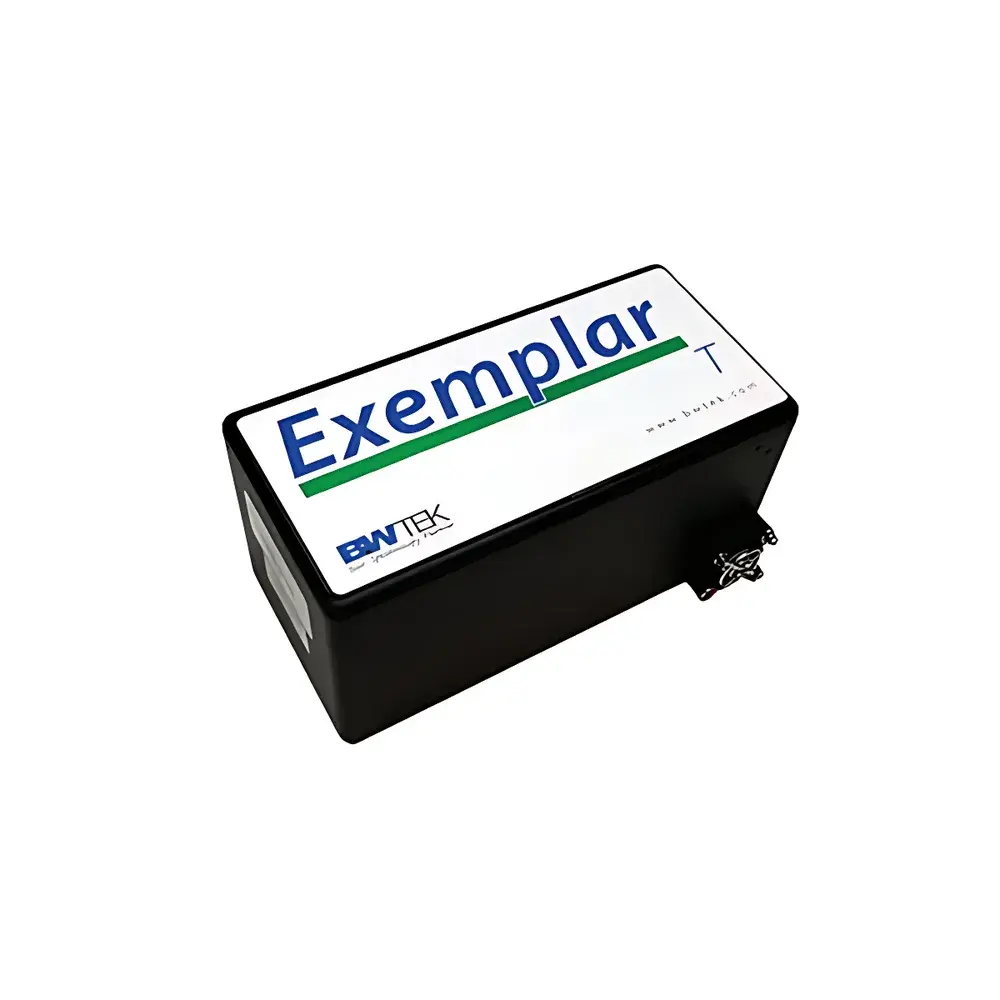
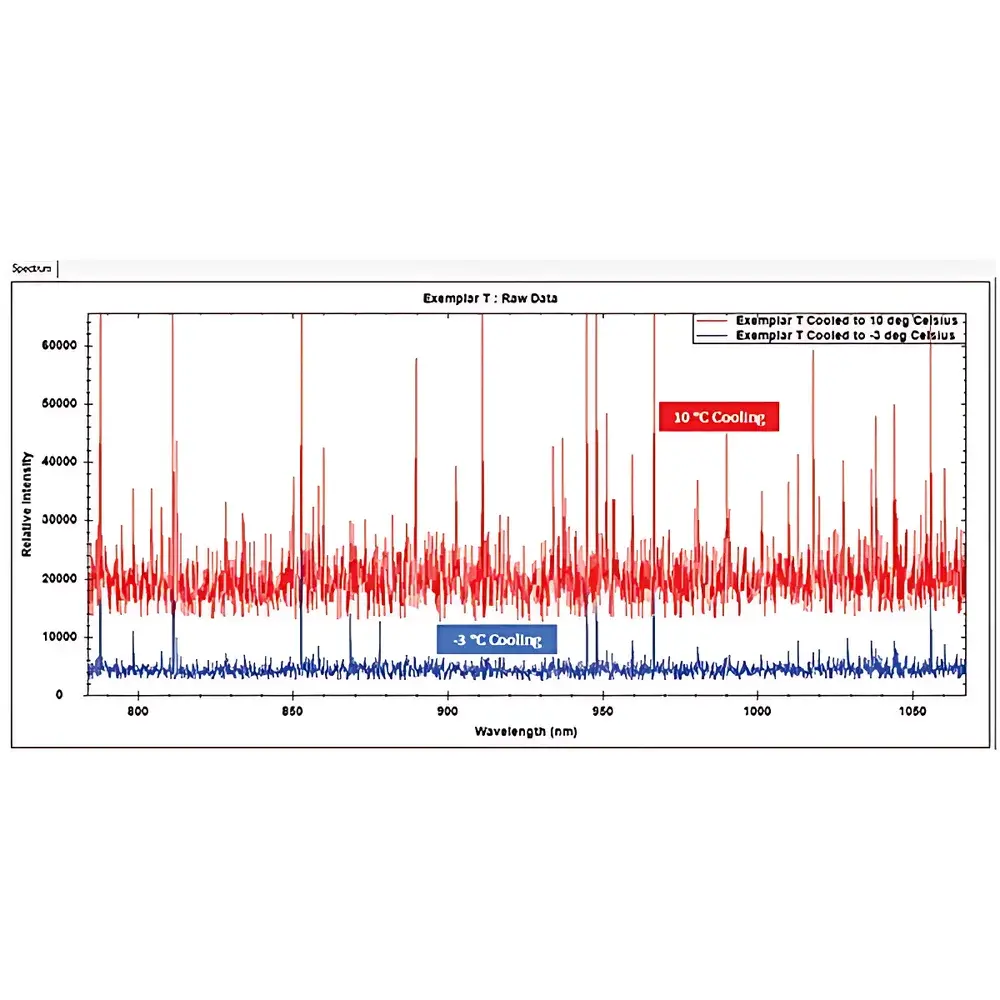
The B&W Tek BTC665N is a high-performance, thermoelectrically cooled fiber optic spectrometer engineered for demanding spectroscopic applications requiring high signal fidelity, low-noise detection, and stable spectral response across the visible-to-near-infrared (VIS-NIR) range. Built upon a dual-path transmissive optical architecture and integrated with a back-thinned, back-illuminated (BT) CCD detector, the BTC665N delivers exceptional quantum efficiency—exceeding 60% at 200 nm and peaking near 80%—while maintaining low read noise and high dynamic range. Its core measurement principle relies on wavelength-dispersive detection via a ruled or holographic diffraction grating, where incident light is collimated, diffracted, and focused onto the 2048-pixel linear CCD array. The instrument’s f/2.2 optical design ensures high light throughput, while its TE cooling system stabilizes the detector at –2°C (relative to ambient 25°C), significantly suppressing dark current—critical for long-integration measurements and low-light applications such as Raman scattering, fluorescence lifetime analysis, and trace gas absorption spectroscopy.
Key Features
- TE-cooled back-illuminated CCD detector operating at –2°C (adjustable in software), enabling ultra-low dark current and thermal stability over extended integration times (up to 30 minutes)
- Dual-slit configuration support: 10 µm slit for high-resolution operation (0.16 nm FWHM, 532–687 nm) and 20 µm slit for enhanced throughput (0.37 nm FWHM, 788–1067 nm); custom slits available upon request
- Transmissive optical bench with f/2.2 aperture and optimized grating selection (e.g., 1800 l/mm for VIS, 1000 l/mm for NIR) to maximize throughput and minimize aberrations
- Onboard digital signal processing: real-time dark subtraction, spectral smoothing (Savitzky-Golay), averaging (up to 65,535 scans), and baseline correction
- High-speed data acquisition: >140 spectra/sec at 100 ms integration time; >400 kHz readout rate; sub-microsecond trigger latency (95 ns ±20 ns)
- Full USB 3.0/2.0 compatibility with Windows 7–11; 16-bit ADC resolution (65,535:1) and >50,000:1 typical dynamic range
- Integrated auxiliary I/O: 4 digital outputs (2 for shutter control), 2 digital inputs, analog input/output, and system reset—enabling synchronized multi-instrument experiments
Sample Compatibility & Compliance
The BTC665N is designed for flexible sample interfacing via standard SMA 905 fiber optic connectors. It supports direct coupling to fiber-coupled light sources (e.g., LEDs, lasers, halogen lamps), remote probe heads (including immersion, reflection, and transmission configurations), and custom optical benches. Its spectral calibration is NIST-traceable, and factory-certified linearity and photometric accuracy comply with ISO/IEC 17025 requirements for analytical instrumentation laboratories. While not certified for regulated GMP environments out-of-the-box, the system supports audit-ready data acquisition when used with BWSpec® software configured for 21 CFR Part 11 compliance (electronic signatures, audit trails, user access controls)—making it suitable for method development and QC validation under GLP/GMP frameworks.
Software & Data Management
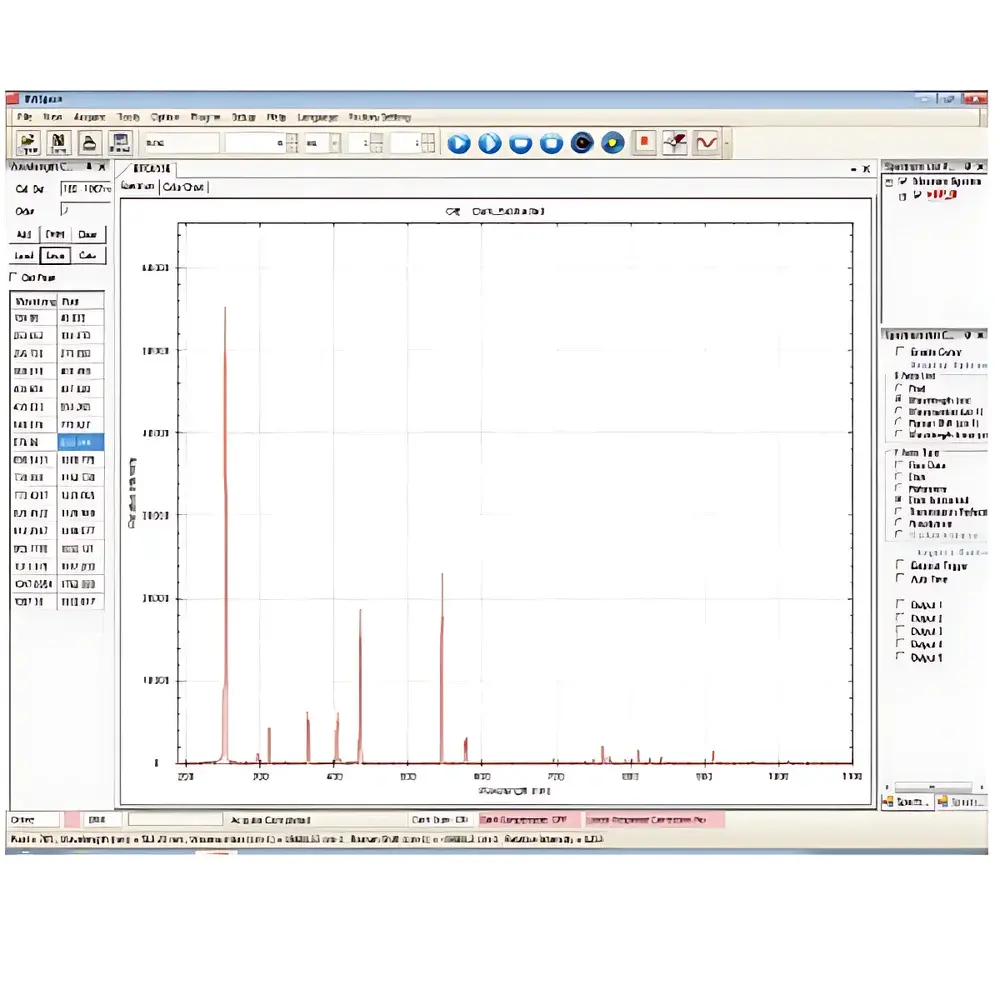
BWSpec® is the native spectral acquisition and analysis suite for the BTC665N, supporting real-time visualization, batch processing, and export in multiple formats (CSV, TXT, SPC, JCAMP-DX). It enables full control of integration time (100 µs–30 min), TE setpoint, gain, and trigger mode (free-run, external TTL, or software-initiated). Advanced features include automatic dark frame subtraction, adaptive baseline correction (manual or polynomial-based), and embedded spectral math (ratios, derivatives, peak area integration). A comprehensive SDK (C/C++, Python, LabVIEW, MATLAB) is provided with documented API calls and working demo code, facilitating integration into automated platforms, OEM systems, or custom chemometric workflows. All raw and processed spectra are timestamped and metadata-tagged—including detector temperature, integration time, grating ID, and slit configuration—for full experimental traceability.
Applications
- Raman spectroscopy: High SNR and low dark noise enable reliable detection of weak Stokes/anti-Stokes bands in pharmaceutical crystallinity studies, polymer characterization, and carbon nanomaterial analysis
- Fluorescence and luminescence spectroscopy: Ideal for biological assays, quantum dot emission profiling, and LED phosphor characterization due to wide dynamic range and UV-VIS-NIR coverage
- Gas and liquid phase analysis: Quantitative absorption spectroscopy for O2, CO2, CH4, and H2O vapor using differential optical absorption spectroscopy (DOAS) or tunable diode laser absorption spectroscopy (TDLAS) configurations
- Process analytical technology (PAT): Real-time monitoring of chemical reactions, fermentation kinetics, and solvent composition in bioreactors or continuous flow reactors
- Material reflectance/transmittance: Solid-state optical property mapping of thin films, solar cells, and coated optics across 532–1100 nm
FAQ
What is the maximum recommended integration time for optimal dark current performance?
The BTC665N maintains stable dark current performance up to 30 minutes when operated at –2°C detector temperature; longer integrations require active dark frame referencing.
Can the BTC665N be used with third-party fiber probes or OEM optical modules?
Yes—it accepts standard 200–600 µm core diameter fibers with SMA 905 termination and is compatible with most commercial Raman probes, cuvette holders, and integrating spheres.
Is spectral calibration performed at the factory, and is recalibration required?
Each unit ships with NIST-traceable wavelength and intensity calibration; periodic verification (every 6–12 months) is recommended per ISO/IEC 17025 guidelines, especially after mechanical shock or thermal cycling.
Does the SDK support real-time spectral streaming to external DAQ or control systems?
Yes—the SDK provides low-latency memory-mapped buffer access and event-driven callbacks, enabling sub-100 µs spectral transfer to FPGA-based controllers or real-time OS environments.
How does the BTC665N handle stray light in high-dynamic-range measurements?
With <0.08% stray light at 600 nm and an optimized double-transmission optical path, the BTC665N minimizes spectral crosstalk—critical for accurate quantification of weak absorption features adjacent to strong peaks.
Related Products






