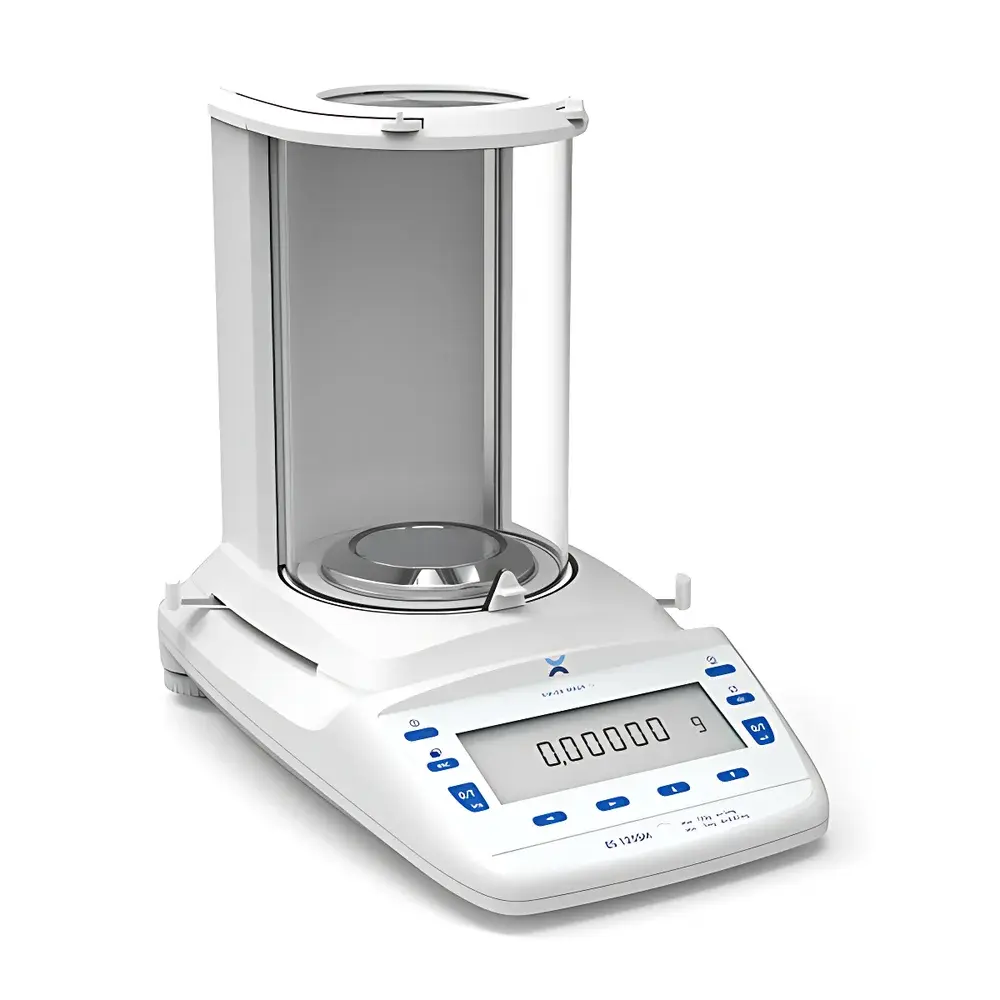
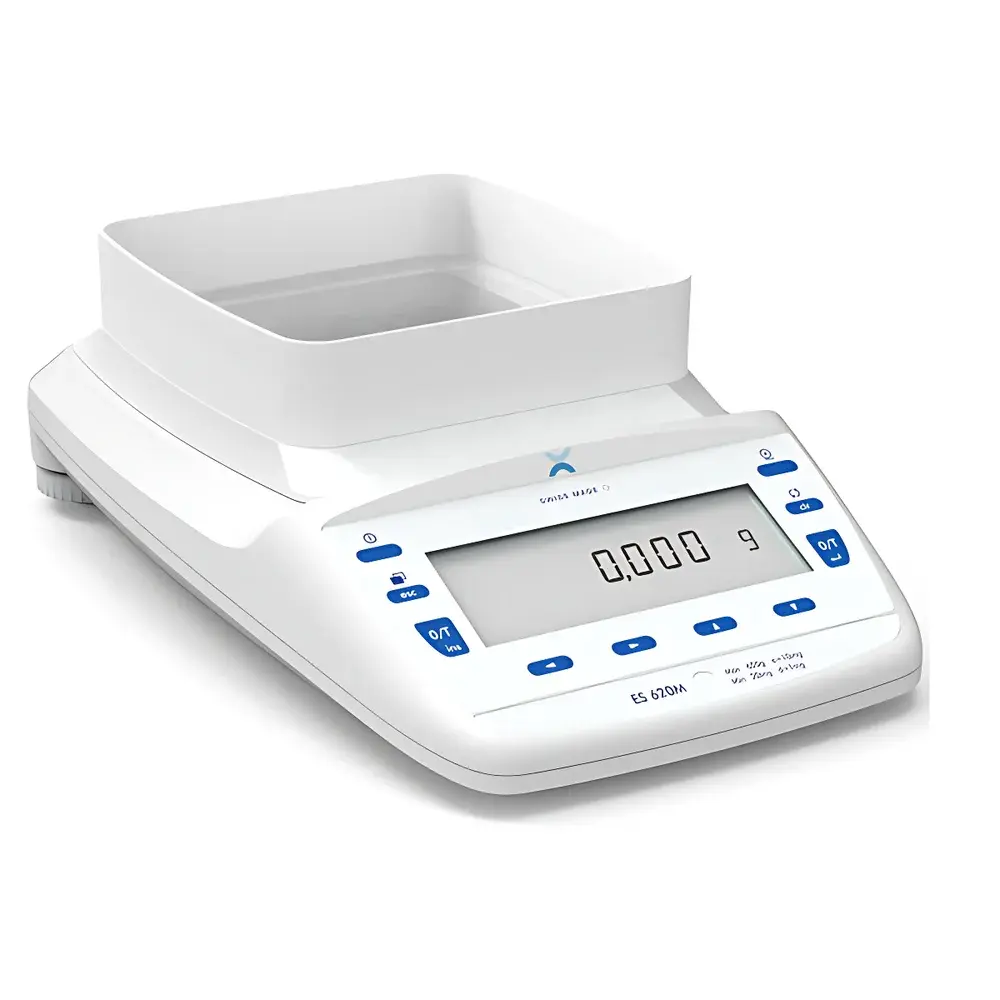
Precisa 360ES Series Electronic Analytical Balance
| Brand | Precisa |
|---|---|
| Origin | Switzerland |
| Model | Precisa 360ES |
| Instrument Type | Ultra-Micro Balance |
| Maximum Capacity | 125 g |
| Readability | 0.01 mg |
| Repeatability | 0.01 mg |
| Calibration | SmartCal System (SCS) — Automatic Internal Calibration |
| Compliance | EN 45501 |
| Enclosure Options | Round Draft Shield (standard for 0.01 mg models) and Square Draft Shield |
| IP Rating (optional) | IP65 |
| Connectivity | RS232, USB (standard) |
| Optional modules | Ethernet (wired/wireless), Bluetooth, RS485, PS2 |
| Application Modes | Counting, Percentage Weighing, Density Determination, Animal Weighing, Checkweighing, Statistics, Formulation, Minimum Sample Weight (MSW), Automatic Repeatability Test (ART), Multi-Batch Weighing (MBW), Buoyancy Correction (BSET), Pipette Calibration, Dynamic Weighing, Below-Hook Weighing |
| Security | Mechanical Lock, Password Protection |
Overview
The Precisa 360ES Series Electronic Analytical Balance is a high-precision, Swiss-engineered weighing instrument designed for demanding laboratory environments where trace-level mass measurement, long-term stability, and regulatory compliance are critical. Utilizing electromagnetic force compensation (EMFC) sensor technology—specifically the proprietary MFR (Magnetic Force Restoration) transducer—the 360ES achieves exceptional resolution of 0.01 mg across its 125 g maximum capacity range. Its core architecture adheres to EN 45501 (the European standard for non-automatic weighing instruments), ensuring metrological integrity, mechanical robustness, and immunity to electromagnetic interference. The balance features a fully isolated sensor chamber constructed from high-strength cast aluminum, segmented into thermally and aerodynamically decoupled cavities to minimize thermal drift and air current influence on the load cell. This design directly contributes to rapid stabilization times (<3 s typical for 0.01 mg readings) and high reproducibility under variable ambient conditions.
Key Features
- SmartCal System (SCS): Fully automated internal calibration triggered by user-defined time intervals or real-time temperature fluctuations (±0.5 °C threshold), eliminating manual intervention while maintaining traceable accuracy.
- Ergonomic Draft Shield Options: Round draft shield (standard for 0.01 mg models) minimizes bench footprint; square shield available for higher-capacity variants—both feature smooth manual operation and optimized airflow management.
- Advanced Sensor Architecture: MFR transducer with ultra-high-density permanent magnets (10× conventional flux density) and corrosion-resistant sensor housing materials ensure extended service life and consistent linearity over >100,000 weighing cycles.
- Modular Connectivity: Standard RS232 and USB interfaces support direct PC integration and printer output; optional hot-swappable communication modules enable seamless upgrade to Ethernet (10/100BASE-T, wired or Wi-Fi), Bluetooth 5.0, RS485, or PS2 without firmware reconfiguration.
- Security & Audit Readiness: Integrated mechanical lock, multi-level password protection (administrator/user/operator tiers), and built-in real-time clock with battery backup facilitate GLP/GMP-compliant documentation and 3Q validation (IQ/OQ/PQ).
- Human-Centered Interface: Backlit graphical LCD display with intuitive EP (Enhanced Panel) layout—12 programmable keys including six customizable function keys—supports rapid navigation through complex workflows without menu nesting.
Sample Compatibility & Compliance
The 360ES accommodates diverse sample forms—from powders and granules to volatile liquids and small-volume containers—via configurable weighing pans, below-hook suspension kits, and optional anti-static accessories. Its design supports routine use in ISO Class 5–7 cleanrooms and controlled environments compliant with USP , USP , and ASTM E898-22. All firmware and calibration logs maintain full audit trails meeting FDA 21 CFR Part 11 requirements when used with validated software platforms. Optional IP65-rated enclosure kits extend operational suitability to QC labs with elevated dust or moisture exposure risks.
Software & Data Management
Precisa’s WinCT Balance Software (v5.0+) provides bidirectional data exchange, automated report generation (PDF/CSV/XLSX), and electronic signature support for regulated workflows. The balance natively stores up to 1,000 weighing records with timestamps, operator IDs, and environmental metadata (temperature/humidity if external sensors are connected). SCS calibration events are logged with full traceability—including reference temperature, deviation values, and pass/fail status—enabling retrospective analysis during internal audits or regulatory inspections.
Applications
The 360ES serves as a primary mass standard in pharmaceutical formulation development (API dosing, excipient blending), clinical research (biomarker quantification, cell culture media preparation), materials science (nanoparticle yield assessment, catalyst loading), and forensic toxicology (controlled substance quantitation). Its ART (Automatic Repeatability Test) and MSW (Minimum Sample Weight) functions support USP compliance for analytical method validation, while BSET buoyancy correction ensures accurate density determination per ISO 1183-1. Dynamic weighing mode enables real-time monitoring of evaporation or reaction mass loss at sub-milligram resolution.
FAQ
Does the 360ES support GLP-compliant data export?
Yes—when paired with WinCT v5.0+ and configured with electronic signatures, all raw data, calibration logs, and user actions comply with ALCOA+ principles and 21 CFR Part 11 requirements.
Can the round draft shield be replaced with a square one after purchase?
Yes—shield interchangeability is supported via standardized mounting hardware; no recalibration is required post-swap.
What is the warranty coverage for the MFR sensor?
Precisa provides a 5-year limited warranty on the MFR transducer against manufacturing defects, reflecting its proven longevity in continuous-use environments.
Is external calibration required if SCS is enabled?
SCS maintains daily accuracy but does not replace periodic external verification using certified weights per ISO/IEC 17025 or internal SOPs—typically recommended every 3–6 months depending on usage intensity.
How is temperature compensation implemented in the SCS algorithm?
The balance integrates a high-resolution thermistor array adjacent to the sensor cavity; SCS initiates calibration when delta-T exceeds ±0.5 °C from the last valid calibration baseline, ensuring thermal hysteresis is actively corrected.