
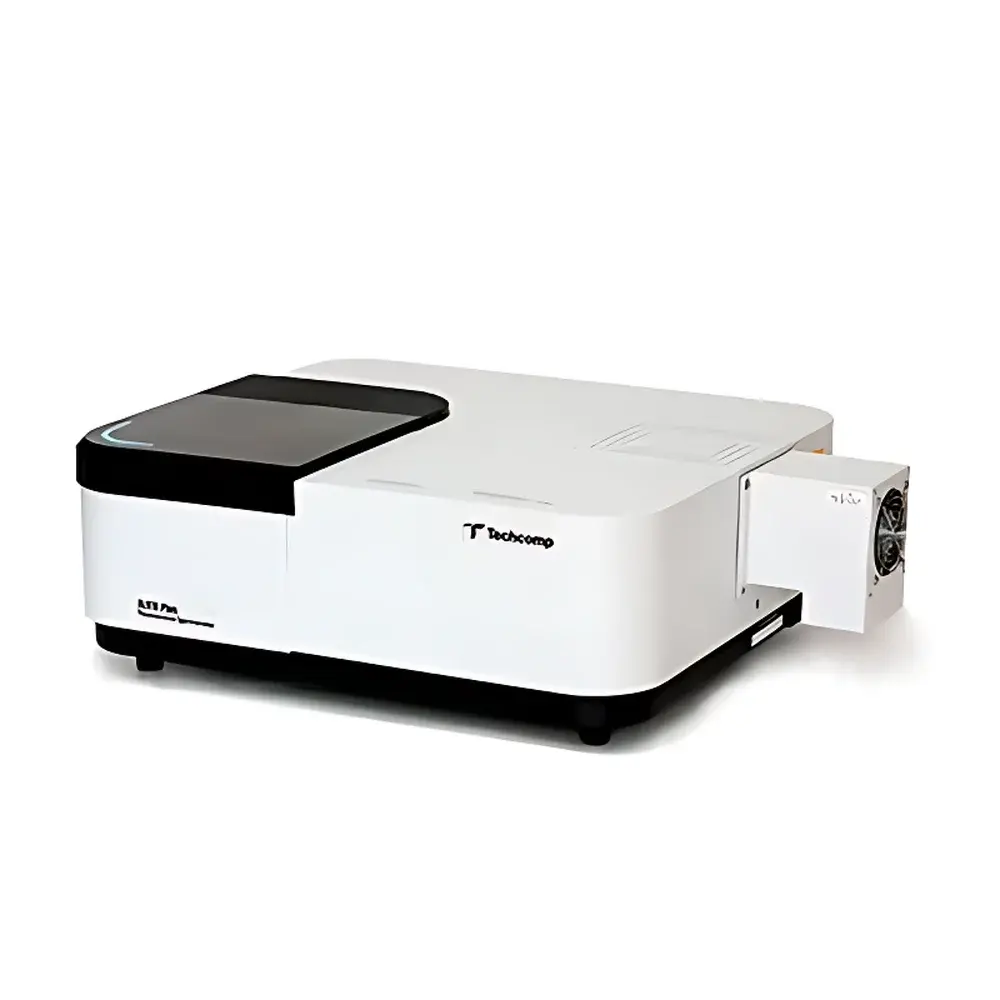
Techcomp FL970 Plus Molecular Fluorescence Spectrometer
| Brand | Techcomp |
|---|---|
| Origin | Shanghai, China |
| Manufacturer Type | Direct Manufacturer |
| Instrument Type | Steady-State Fluorescence Spectrometer |
| Wavelength Dispersion Element | Grating |
| Slit Width (Spectral Bandpass) | 1.0–20 nm |
| Optical Resolution | 0.2 nm |
| Sensitivity | >450:1 (Peak-to-Peak) |
| Wavelength Accuracy | ±2.0 nm |
| Excitation Source | Xenon Arc Lamp |
| Standard PMT Range | Up to 900 nm |
| Maximum Scan Speed | 30,000 nm/min |
| Spectral Correction | Full-mode (Excitation/Emission/Spectral Response) |
Overview
The Techcomp FL970 Plus Molecular Fluorescence Spectrometer is a high-performance, research-grade steady-state fluorimeter engineered for quantitative and qualitative analysis of fluorescent and phosphorescent species in solution, solid, and thin-film formats. It operates on the principle of photoluminescence spectroscopy: a monochromated xenon lamp excites samples across the deep UV to visible range (typically 185–900 nm), and emitted photons are dispersed via a dual-grating monochromator system and detected by a low-noise, wide-spectral-range photomultiplier tube (PMT). Its optical architecture—optimized for stray-light suppression, signal-to-noise ratio (SNR), and photometric linearity—enables robust quantification under demanding analytical conditions. Designed for laboratories requiring trace-level detection, spectral fidelity, and long-term measurement reproducibility, the FL970 Plus meets foundational requirements for method validation in regulated environments including pharmaceutical QC, environmental monitoring, and academic spectroscopy research.
Key Features
- Optimized double-monochromator optical path with high-efficiency holographic gratings, delivering <0.2 nm resolution and <±2.0 nm wavelength accuracy across the full spectral range.
- High-intensity pulsed xenon lamp with extended UV output down to 185 nm, enabling excitation of aromatic amino acids, nucleic acid bases, and UV-absorbing contaminants without ozone-generating deuterium lamp maintenance.
- Standard wide-range PMT detector (185–900 nm) with thermoelectric cooling option for reduced dark current and enhanced RMS sensitivity (>1400:1) and background-corrected dynamic range (>18,000:1).
- Motorized slit control (1.0–20 nm) with real-time bandpass calibration, allowing adaptive optimization of resolution vs. signal intensity for each measurement.
- Ultra-fast scanning capability up to 30,000 nm/min—critical for kinetic fluorescence studies, temperature-dependent emission mapping, and high-throughput screening workflows.
- Integrated spectral correction engine supporting excitation, emission, and instrument response function (IRF) normalization—ensuring accurate comparison of absolute quantum yields and cross-laboratory spectral data.
Sample Compatibility & Compliance
The FL970 Plus accommodates standard 10 mm quartz cuvettes, microvolume cells (down to 50 µL), solid-sample holders (powder, film, filter), and fiber-optic probes for remote or in-situ measurements. Its large sample compartment supports custom accessories—including temperature-controlled Peltier stages (−10 °C to +100 °C), polarization modules, and liquid nitrogen cryostats—for advanced photophysical characterization. The instrument complies with ISO 17025 general requirements for testing laboratories and supports audit-ready operation per GLP and GMP guidelines. Data integrity features include electronic signatures, user-access tiers, and full audit trail logging—aligned with FDA 21 CFR Part 11 principles for regulated pharmaceutical and clinical applications.
Software & Data Management
FL Analyst software provides a fully localized English interface with intuitive workflow-driven navigation. It supports automated method creation, multi-parameter acquisition (synchronous, 3D excitation-emission matrix (EEM), lifetime approximation via time-resolved mode with external TCSPC integration), and batch processing of spectral libraries. Raw data are stored in vendor-neutral ASCII and CSV formats; spectral metadata (wavelength calibration, slit settings, PMT voltage, integration time) are embedded and exportable. The software includes built-in tools for baseline correction, peak deconvolution, Stern-Volmer analysis, and Förster resonance energy transfer (FRET) efficiency calculation—validated against NIST-traceable reference standards.
Applications
- Pharmaceutical development: Quantitative assay of active pharmaceutical ingredients (APIs), impurity profiling, forced degradation studies, and stability-indicating methods per ICH Q2(R2).
- Life sciences: Protein conformational analysis (tryptophan fluorescence), DNA intercalation studies, enzyme kinetics (NADH/NADPH monitoring), and cellular metabolite detection in lysates.
- Environmental analysis: Polycyclic aromatic hydrocarbon (PAH) identification in water/soil extracts, dissolved organic matter (DOM) characterization, and heavy metal ion sensing via fluorescent chelators.
- Materials science: Quantum dot photoluminescence quantum yield (PLQY) determination, OLED emitter screening, and photocatalyst recombination dynamics assessment.
- Academic teaching: Hands-on instruction in Jablonski diagram interpretation, inner-filter effect correction, and solvent polarity effects on Stokes shift—supported by preconfigured lab protocols and instructor guides.
FAQ
What is the minimum detectable concentration for quinine sulfate in 0.1 M H2SO4 using the FL970 Plus?
Under standard conditions (10 mm cuvette, 5 nm slits, 1 s integration, 350/450 nm excitation/emission), the limit of detection is typically ≤10 pM.
Does the FL970 Plus support time-resolved fluorescence measurements?
It is configured for steady-state operation by default; time-resolved capability requires optional integration with an external TCSPC module and pulsed laser source.
Can spectral correction data be imported from third-party reference standards?
Yes—users may load custom correction files (CSV or .spc format) generated from NIST SRM 2241 or other certified standards.
Is firmware update supported remotely?
Firmware upgrades are performed via USB-connected PC using Techcomp’s validated update utility; network-based updates are not enabled for security and regulatory compliance reasons.
How is wavelength calibration verified and documented?
Calibration uses holmium oxide and didymium glass filters traceable to NIST; reports include date, operator ID, deviation values, and pass/fail status per ISO/IEC 17025 clause 6.4.10.



