
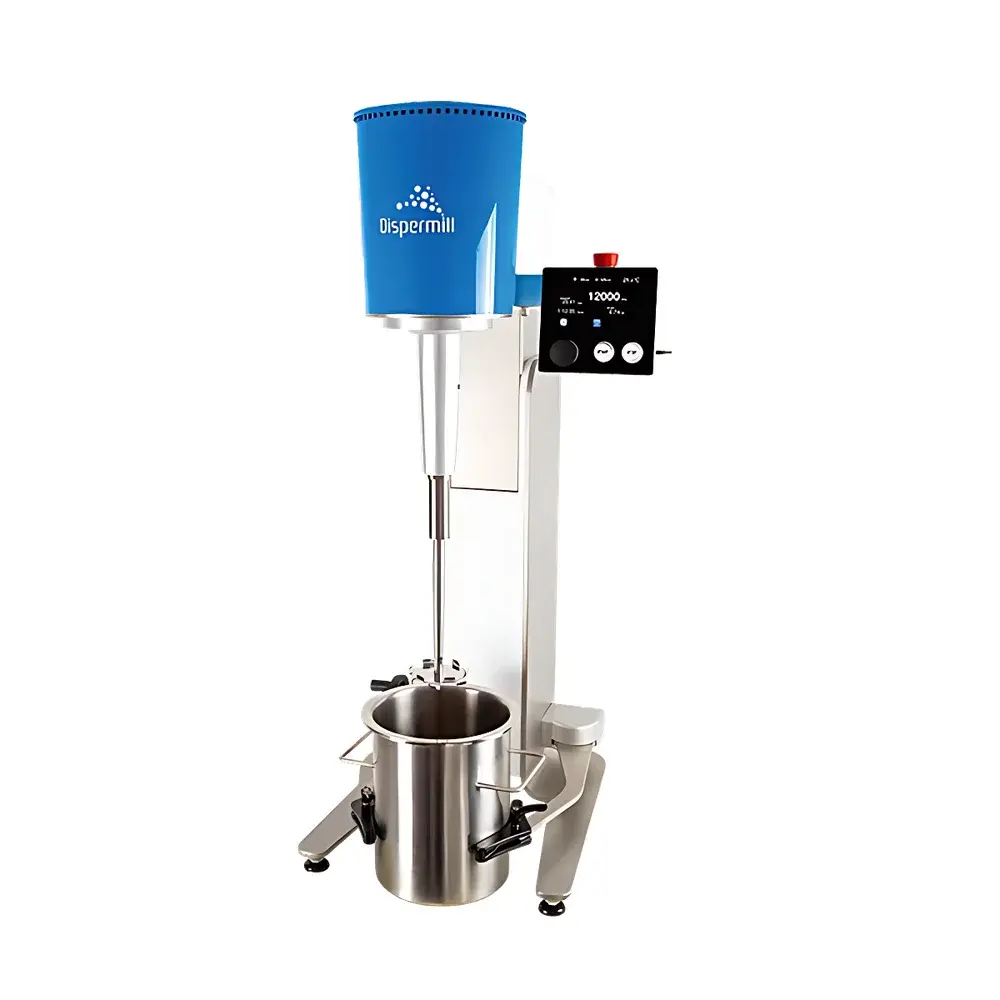
Dispermill Discovery 100 Laboratory Disperser
| Brand | Dispermill |
|---|---|
| Origin | Netherlands |
| Model | Discovery 100 |
| Power | 0.75 kW (1.0 HP) |
| Speed Range | 0 – 12,000 rpm |
| Dispersion Disc Diameter | 70 mm |
| Torque | 1.3 N·m |
| Real-time Speed Display | Yes |
| Voltage/Frequency | 230 V, 50/60 Hz |
| Dimensions (D × W × H) | 485 × 501 × 991 mm |
| Net Weight | 55 kg |
| Container Capacity | 0.5 – 10 L |
Overview
The Dispermill Discovery 100 is a high-performance laboratory disperser engineered for precise, reproducible dispersion of solid particles into liquid media under controlled mechanical shear. Based on rotor-stator hydrodynamic principle, it generates intense localized turbulence and high tip-speed shear forces—critical for breaking down agglomerates and achieving uniform particle distribution down to primary particle size. Designed for R&D laboratories in advanced materials development, the Discovery 100 delivers consistent energy input across scalable batch volumes (0.5–10 L), supporting method development aligned with downstream scale-up requirements. Its modular architecture integrates seamlessly into GLP-compliant workflows, with hardware-level safeguards for operator safety and process integrity.
Key Features
- Electronically adjustable height stand with stainless-steel construction—resistant to solvents, acids, and alkalis; fully autoclavable surface finish for GMP-aligned cleaning validation.
- Compact, solvent-resistant tempered glass touchscreen interface with multi-position LED rotary encoder—enabling intuitive parameter navigation without gloves or stylus.
- Real-time digital display of rotational speed (rpm), power consumption (W), and optional integrated PT100 temperature monitoring (via accessory).
- Programmable timer with automatic shutdown and torque-limited stop function—prevents motor overload and sample overheating during extended runs.
- Acoustically optimized housing and balanced rotor assembly reduce operational noise to ≤72 dB(A) at 1 m distance—suitable for open-plan lab environments.
- Standard 70 mm dispersion disc (DIN 12878 compatible); optional rotor-stator heads, vacuum-rated jackets, and telescopic shaft guards available for specialized applications.
Sample Compatibility & Compliance
The Discovery 100 accommodates Newtonian and non-Newtonian fluids—including low-to-medium viscosity resins, pigment pastes, ceramic slurries, and polymer dispersions—across a broad pH range (1–14). All wetted parts are constructed from electropolished AISI 316L stainless steel, compliant with ISO 8502-9 (surface cleanliness) and USP Class VI biocompatibility standards. When equipped with vacuum accessories, the system supports degassing protocols per ASTM D2755 and ISO 1628-1 for air-sensitive formulations. Full traceability is maintained via optional audit trail logging (21 CFR Part 11–ready when paired with validated software).
Software & Data Management
While the base unit operates via embedded firmware, optional PC connectivity enables export of time-stamped process logs (speed, torque, temperature, duration) in CSV format for LIMS integration. Firmware supports user-defined preset methods (up to 16 profiles), each with independent ramp rates, hold times, and alarm thresholds. Temperature alarms trigger visual/audio alerts and automatic deceleration if configured with PT100 sensor—ensuring thermal stability critical for heat-sensitive nanomaterials or UV-curable systems.
Applications
The Discovery 100 is routinely deployed in formulation development for architectural coatings, automotive basecoats, ceramic tile glazes, conductive inks, aerospace sealants, and pharmaceutical suspensions. It enables robust optimization of pigment deagglomeration kinetics, filler wetting efficiency, and rheological stabilization—directly informing QC release criteria for viscosity, gloss, and haze. In academic research, it serves as a benchmark platform for studying shear-induced structural breakdown in colloidal gels and Pickering emulsions. Its repeatable tip-speed control (18–22 m/s nominal at disc periphery) ensures correlation with industrial-scale homogenizers per ISO 13320 guidance.
FAQ
What is the maximum recommended tip speed for optimal dispersion efficiency?
The optimal peripheral tip speed for the 70 mm disc is 18–22 m/s—achievable within the 0–12,000 rpm range. This aligns with established hydrodynamic dispersion theory for sub-micron particle liberation.
Can the Discovery 100 be used under vacuum?
Yes—when fitted with the optional vacuum jacket kit and sealed vessel adapter, it supports vacuum-assisted degassing down to 10 mbar absolute pressure.
Is calibration traceable to national standards?
Speed and torque sensors are factory-calibrated per ISO/IEC 17025 procedures; calibration certificates (with uncertainty budgets) are available upon request.
What maintenance intervals are recommended?
Biannual inspection of bearing preload and seal integrity is advised; full service—including dynamic balancing verification—is recommended every 2,000 operating hours or annually, whichever occurs first.



