
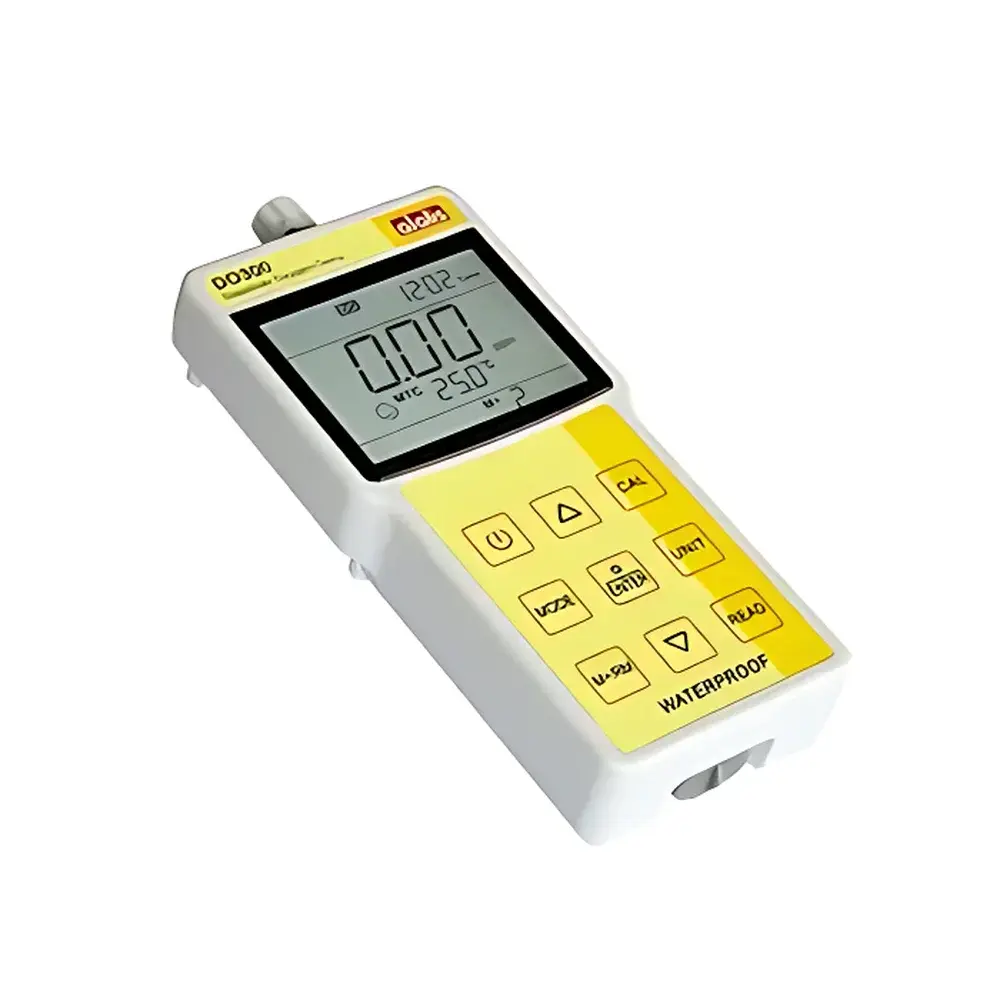
Alalis DO300(5m) Portable Dissolved Oxygen Meter
| Brand | Alalis |
|---|---|
| Origin | Shanghai, China |
| Model | DO300(5m) |
| Instrument Type | Portable |
| Measurement Principle | Electrochemical Clark-type Polarographic Sensor |
| Range | 0–20.00 mg/L |
| Accuracy | ±0.30 mg/L |
| Repeatability | 0.1% |
| Detection Limit | 0.10 mg/L |
| Temperature Compensation | Automatic (0–45 °C) |
| Salinity Compensation | Automatic (0–45 ppt) |
| Barometric Pressure Compensation | Manual (80–105 kPa) |
| Response Time | 30 s (90% at 25 °C) |
| Residual Current Equivalent | 0.10 mg/L |
| Data Storage | 500 sets (manual & auto) |
| Display | 68 × 53 mm LCD with white backlight and time stamp |
| IP Rating | IP57 |
| Interface | USB |
| GLP Compliance | Yes |
| Temperature Range (sensor) | −10 to 110 °C |
| Resolution | DO: 0.01/0.1 mg/L |
| Saturation | 0.1/1 % |
| Temp | 0.1 °C |
| Basic Error (Temp) | ±0.4 °C |
Overview
The Alalis DO300(5m) Portable Dissolved Oxygen Meter is an engineered field instrument designed for precise, on-site measurement of dissolved oxygen (DO) concentration in aqueous environments using the Clark-type polarographic electrochemical principle. It employs a membrane-covered amperometric sensor where molecular oxygen diffuses through a selective gas-permeable membrane and undergoes reduction at a polarized cathode, generating a current linearly proportional to the partial pressure of oxygen in the sample. This method ensures high specificity for O₂ in complex matrices—free from interference by redox-active ions or pH fluctuations—making it suitable for regulatory-compliant environmental monitoring, process control, and research-grade water quality assessment. The integrated temperature and salinity compensation algorithms correct for kinetic and solubility effects in real time, while manual barometric pressure adjustment accounts for altitude-related variations in oxygen saturation equilibrium. Its rugged, IP57-rated housing enables reliable operation in humid, dusty, or splash-prone field conditions—including riverbanks, wastewater outfalls, aquaculture ponds, and coastal sampling stations.
Key Features
- Clark-type polarographic sensor with integrated thermistor and salinity compensation circuitry for accurate DO reporting across variable environmental conditions
- Automatic temperature compensation (0–45 °C) and automatic salinity compensation (0–45 ppt), eliminating manual correction errors during estuarine or brackish water analysis
- Manual barometric pressure adjustment (80–105 kPa) to maintain calibration integrity at elevations up to ~2,000 m above sea level
- One-point calibration using air-saturated water standard—electrode polarization time reduced to 3–5 minutes via optimized Ag/AgCl reference system and stable electrolyte fill
- GLP-compliant data management: timestamped storage of 500 measurement records (both manual and auto-triggered), with audit-ready export via USB interface
- High-contrast 68 × 53 mm backlit LCD display showing simultaneous DO (mg/L and % saturation), temperature (°C/°F selectable), and real-time clock
- Robust mechanical design certified to IP57 ingress protection—dust resistant and capable of temporary submersion (up to 1 m for 30 min)
- Factory-reset functionality and user-accessible calibration history for traceability and instrument requalification
Sample Compatibility & Compliance
The DO300(5m) is validated for use with freshwater, seawater, wastewater effluents, aquaculture recirculation systems, fermentation broths, and potable water distribution networks. Its polarographic probe configuration minimizes fouling sensitivity compared to optical sensors in turbid or organically rich samples, though routine membrane replacement and electrolyte replenishment are required per manufacturer maintenance protocols. The instrument conforms to foundational metrological requirements outlined in ASTM D888-22 (“Standard Test Methods for Dissolved Oxygen in Water”) and supports laboratory practices aligned with ISO 5814:2012 (Electrochemical determination of dissolved oxygen). While not pre-certified for FDA 21 CFR Part 11, its GLP-mode logging structure—including operator ID fields (via optional software configuration), immutable timestamps, and sequential record numbering—facilitates integration into regulated QA/QC workflows under GMP or environmental compliance programs.
Software & Data Management
Data transfer is enabled via standard USB-B interface to Windows-based PCs running included communication software (distributed on CD-ROM). The software supports CSV export for downstream statistical analysis in Excel or LIMS platforms, and permits review of calibration logs, measurement metadata (date/time, temperature, salinity, pressure setting), and operator annotations. All stored entries include checksum-verified integrity flags. No cloud connectivity or proprietary drivers are required—communication follows CDC ACM class protocol for broad OS compatibility (Windows 7–11, macOS 10.15+, Linux kernel ≥5.4). Firmware updates are distributed as signed binary packages with version-controlled release notes accessible via Alalis technical support portal.
Applications
- Environmental field surveys: lake stratification profiling, stream health assessments, marine hypoxia mapping, and wetland restoration monitoring
- Wastewater treatment plant operations: aeration basin optimization, activated sludge respiration rate tracking, and discharge compliance verification per local NPDES or EU Urban Wastewater Treatment Directive thresholds
- Aquaculture management: real-time DO surveillance in hatcheries, net pens, and RAS (recirculating aquaculture systems) to prevent hypoxic stress in finfish and shellfish stocks
- Drinking water distribution: verification of residual oxygen levels post-chlorination and during pipeline aging studies
- Academic and teaching laboratories: undergraduate water chemistry experiments requiring portable, low-maintenance DO instrumentation with pedagogical clarity in signal transduction principles
FAQ
What calibration standards are recommended for routine use?
Air-saturated water at ambient temperature and pressure is the primary single-point standard. For multi-point verification, saturated sodium sulfite solution (zero-oxygen standard) may be used—but only after confirming electrode stability and membrane integrity.
How often should the membrane cap and electrolyte be replaced?
Under typical field use (≤4 hrs/day), replace the membrane cap every 4–6 weeks and replenish electrolyte every 2–3 weeks. More frequent replacement is required in high-sediment or high-H₂S environments.
Does the instrument support dissolved oxygen measurement in non-aqueous solvents?
No. The sensor is calibrated and validated exclusively for aqueous-phase oxygen detection. Use in organic solvents will damage the membrane and invalidate readings.
Is the temperature sensor interchangeable with other Alalis meters?
No. The DO300(5m) uses an integrated Pt1000 thermistor embedded within the DO probe assembly; external temperature probes are not supported.
Can data be exported directly to LIMS without intermediate software?
Not natively. Raw data must first be retrieved via the provided USB software and then imported into LIMS via CSV or manual entry. API or HL7 integration is not available in this model tier.







