
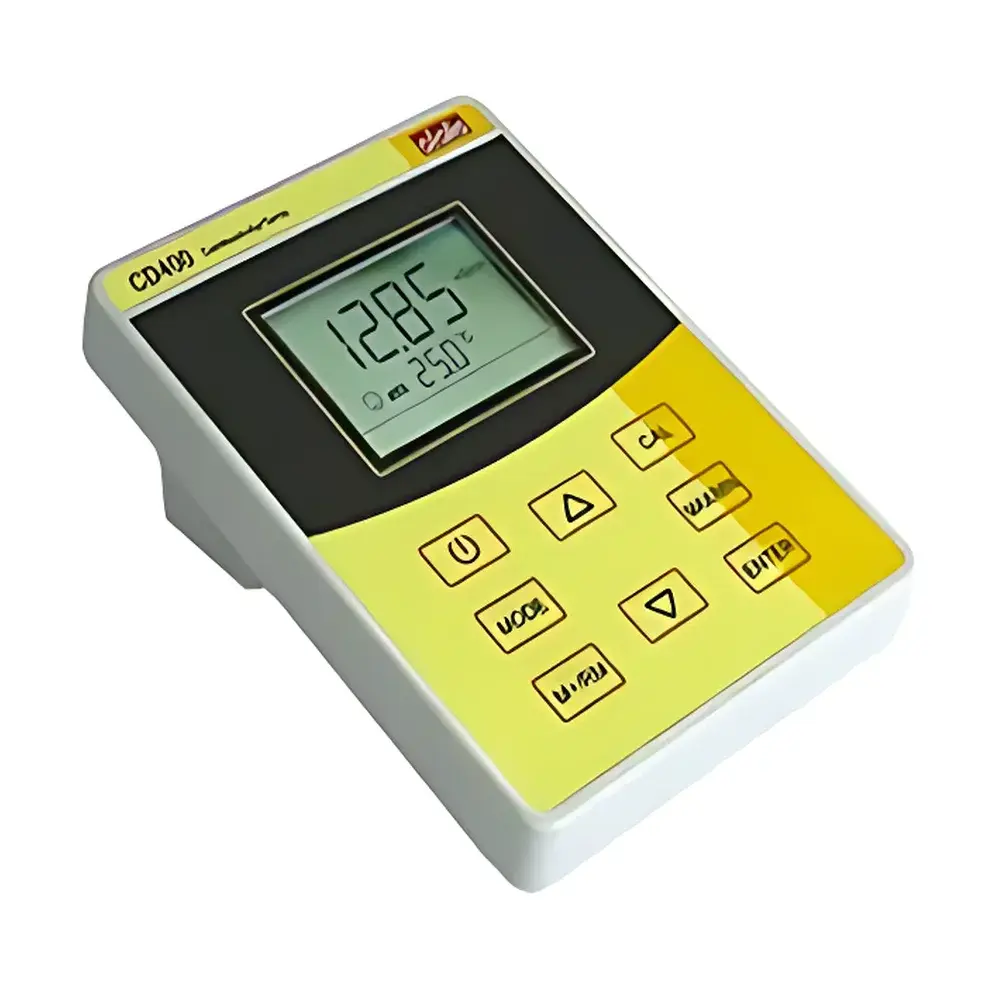
Alalis pH400 Educational Benchtop pH Meter
| Brand | Alalis |
|---|---|
| Model | pH400 Educational |
| Type | Benchtop pH Meter |
| Measurement Parameters | pH and mV (ORP) |
| pH Range | 0.00–14.00 |
| pH Resolution | 0.01 / 0.1 |
| pH Accuracy | ±0.01 |
| Temperature Compensation | Automatic or Manual (0–100 °C) |
| Calibration Options | 1–3 point, with CH and USA buffer series (6 standard buffers supported) |
| Display | 80 × 58 mm LCD, large-font interface |
| Data Storage | 50 manual entries with min/max recall |
| IP Rating | IP54 |
| Included Electrode | Rugged composite plastic-body pH electrode |
| Compliance | Designed for GLP-compliant educational and QC environments |
Overview
The Alalis pH400 Educational Benchtop pH Meter is a precision electrochemical instrument engineered for reliable, repeatable measurement of hydrogen ion activity in aqueous solutions. Based on the potentiometric principle—measuring the potential difference between a pH-sensitive glass electrode and a stable reference electrode—the pH400 delivers traceable, NIST-traceable-compatible measurements across the full physicochemical pH scale (0.00–14.00). Its dual-parameter capability extends functionality to redox potential (ORP) analysis in millivolt mode (±1999 mV), enabling broader applications in water quality assessment, fermentation monitoring, and basic electrochemical education. Designed specifically for academic laboratories, vocational training centers, and entry-level quality control labs, the pH400 balances operational simplicity with metrological rigor—featuring automatic temperature compensation (ATC), endpoint stabilization logic, and intuitive calibration guidance aligned with ISO 8655 and ASTM D1293 best practices.
Key Features
- 1–3 point pH calibration with built-in step-by-step guidance and support for both CH (Chinese national standard) and USA (NIST-traceable) buffer series—totaling six certified calibration points (e.g., pH 4.01, 6.86, 7.00, 9.18, 10.01, 12.45)
- Intelligent self-diagnostic system that identifies electrode response drift, junction blockage, or out-of-range signals—and displays actionable prompts in real time
- Selectable resolution: 0.01 pH for high-precision academic experiments; 0.1 pH for rapid field screening
- Stable endpoint detection algorithm minimizes reading instability and reduces operator-dependent variability during titration or kinetic studies
- Large 80 × 58 mm monochrome LCD with high-contrast, oversized characters—optimized for classroom visibility and prolonged use under varied ambient lighting
- Comprehensive temperature handling: automatic or manual compensation from 0 to 100 °C, with user-selectable units (°C/°F) and ±0.5 °C sensor accuracy
- IP54-rated enclosure with sealed electrode ports and rubber protective caps—ensuring resistance to dust ingress and incidental splashes during student lab use
- One-touch factory reset function for rapid configuration recovery—critical for shared instrumentation in teaching labs
Sample Compatibility & Compliance
The pH400 is validated for routine use with aqueous samples including buffer solutions, process water, culture media, food extracts, and municipal wastewater effluents. It accommodates standard BNC-input pH and ORP electrodes—including the included rugged composite-body combination electrode optimized for durability in undergraduate labs. While not intended for non-aqueous or highly viscous matrices without dilution or specialized electrodes, its design adheres to fundamental electrochemical measurement principles defined in ISO 3696 (water for analytical use) and supports documentation workflows compatible with GLP (Good Laboratory Practice) and HACCP prerequisite programs. The device does not include electronic audit trail or 21 CFR Part 11 compliance features—making it suitable for educational and non-regulated QC settings where formal data integrity controls are not mandated.
Software & Data Management
The pH400 operates as a standalone instrument with no PC connectivity or proprietary software dependency. All data management is performed locally via its embedded memory system: users may manually store up to 50 measurement records, each timestamped with pH, mV, temperature, and date (where enabled by internal clock). Stored datasets support post-acquisition review—including retrieval of minimum, maximum, and last-measured values per session. While export to external systems requires manual transcription, the structured display layout and consistent formatting facilitate accurate data logging into LIMS or spreadsheet-based QA templates. Calibration history is retained in volatile memory until power cycle; for long-term traceability, users are advised to maintain parallel logbooks per ISO/IEC 17025 Clause 7.7.
Applications
- Undergraduate chemistry and environmental science laboratories—supporting curriculum-aligned experiments in acid-base equilibria, buffer capacity, and titration curve analysis
- Vocational training in water treatment operations, food safety inspection, and pharmaceutical manufacturing support roles
- Entry-level QC verification in small-scale beverage, dairy, or aquaculture facilities requiring routine pH verification per internal SOPs
- HACCP plan implementation—used for critical control point (CCP) monitoring in drinking water distribution or ready-to-eat food production lines
- Calibration verification of field pH meters using laboratory-grade reference standards
FAQ
Does the pH400 support automatic calibration recognition (Auto-Read)?
Yes—the instrument detects stable potential change rates and activates Auto-Read mode when endpoint stability meets predefined thresholds (±0.01 pH over 3 seconds), reducing subjective judgment in reading acquisition.
Can I use this meter with non-standard or custom buffer solutions?
Manual calibration allows input of custom pH values, but metrological validity requires traceable standard buffers certified to ISO 17025-accredited providers; CH and USA series buffers are pre-programmed for one-touch selection.
Is the included electrode suitable for measuring high-ionic-strength or low-conductivity samples?
The standard composite electrode performs reliably in typical tap water, buffer, and biological media (conductivity >50 µS/cm); for ultrapure water (<1 µS/cm) or saturated brines, optional low-resistance electrodes with sleeve junctions are recommended.
How often should I recalibrate during continuous use?
For educational use, recalibration before each lab session is recommended; for extended measurements (>2 hours), verify calibration every 30 minutes using a mid-range buffer (e.g., pH 7.00) to monitor electrode drift.
Does the pH400 meet requirements for ISO/IEC 17025 accredited testing?
It provides measurement capability aligned with ISO 6497 and ASTM E70, but lacks electronic audit trail, user access controls, or calibration certificate integration—thus serving as a compliant tool for internal training and non-accredited QC, not for accredited testing reports.





