
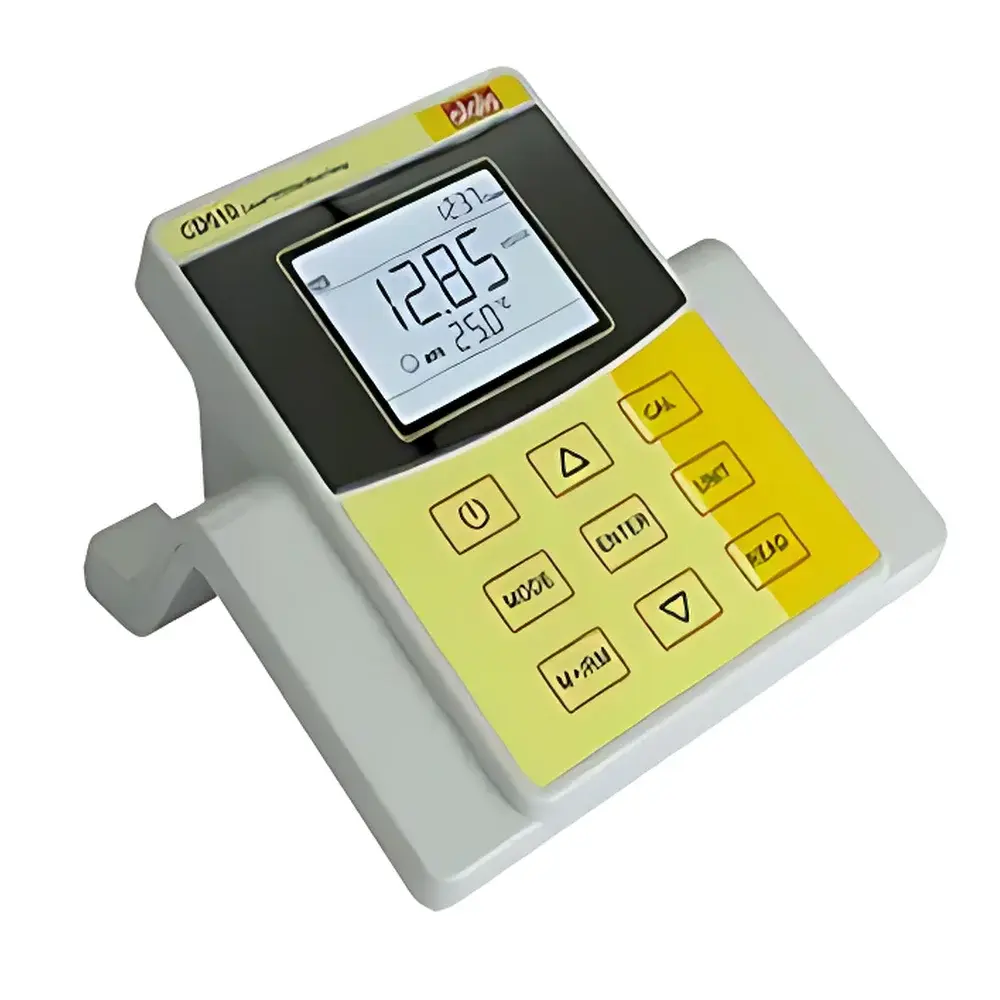
Alalis CD510 Benchtop Conductivity Meter
| Brand | Alalis |
|---|---|
| Origin | Shanghai, China |
| Model | CD510 Standard |
| Form Factor | Benchtop |
| Conductivity Range | 0.00 μS/cm to 2000 mS/cm (6 sub-ranges) |
| TDS Range | 0–100 g/L |
| Resistivity Range | 0–100 MΩ·cm |
| Salinity Range | 0–100 ppt |
| Temperature Range | −10 °C to 110 °C |
| Accuracy | ±0.5% FS (conductivity), ±0.4 °C (temperature) |
| Minimum Resolution | 0.01 μS/cm |
| Temperature Compensation | Automatic/manual (0–50.0 °C), selectable β coefficient |
| Electrode Constant Selection | Yes |
| Data Storage | 500 sets (manual/auto), GLP-compliant |
| Interface | USB |
| IP Rating | IP54 |
| Display | 90 × 68 mm LCD with white backlight, time stamping |
| Calibration | 1–4 point, with CH/USA standard sets (8 preloaded) and custom solution support |
| Special Modes | Ultra-pure water stabilization, auto-endpoint hold, factory reset |
Overview
The Alalis CD510 Benchtop Conductivity Meter is a precision-engineered electrochemical analyzer designed for continuous, high-reliability conductivity monitoring in demanding industrial and regulated laboratory environments. It operates on the principle of two-electrode or four-electrode conductometric measurement—applying an alternating current across a defined electrode geometry and calculating solution conductivity from the measured conductance and cell constant (K). Its extended temperature range (−10 °C to 110 °C) and robust thermal compensation architecture make it particularly suited for applications involving high-temperature process streams—including pharmaceutical multi-effect distillation water systems, boiler feedwater and condensate loops, heat exchanger monitoring, industrial parts cleaning baths, and closed-loop cooling water circuits. Unlike portable meters optimized for field spot checks, the CD510 integrates benchtop stability with industrial-grade environmental resilience, including IP54-rated enclosure protection and sealed electrode ports—ensuring operational integrity in humid, dusty, or chemically exposed settings typical of utility rooms, central utilities plants, and QC laboratories.
Key Features
- Multi-point calibration support (1–4 points) with intelligent calibration guidance and real-time validation feedback—reducing operator error and improving traceability.
- Comprehensive standard solution compatibility: supports both Chinese (CH) and U.S. (USA) conductivity standard series (eight total), plus user-defined calibration solutions for non-standard media.
- Adaptive endpoint detection with stable-read and auto-hold modes—minimizing subjective interpretation and enhancing measurement reproducibility across operators and shifts.
- Large-format 90 × 68 mm LCD display with white LED backlight, large-font numeric rendering, and integrated real-time clock—enabling rapid visual verification and long-term trend logging without external devices.
- Configurable temperature compensation: automatic or manual mode (0–50.0 °C), with adjustable linear temperature coefficient (β) and dual-unit support (°C/°F).
- Dedicated ultra-low-conductivity mode for stable measurement of high-purity water (<1 μS/cm), mitigating polarization effects and noise artifacts common in deionized or WFI-grade streams.
- Integrated K=1 ATC (Automatic Temperature Compensation) conductivity electrode—eliminating separate temperature probe handling while maintaining full range coverage (0.00 μS/cm to 2000 mS/cm) via auto-ranging circuitry.
- Factory-reset functionality and intuitive menu navigation—facilitating rapid reconfiguration after maintenance or personnel turnover.
Sample Compatibility & Compliance
The CD510 accommodates aqueous samples across the full spectrum of industrial water quality—from ultrapure water in pharmaceutical manufacturing (meeting USP and EP 2.2.38 requirements) to highly conductive brines and aggressive cleaning solutions. Its wide dynamic range (six overlapping sub-ranges) eliminates manual range switching during transitional measurements (e.g., blowdown events or rinse cycle progression). The instrument complies with IEC 61000-6-3 (EMC emissions) and IEC 61010-1 (safety for electrical equipment). Data storage adheres to Good Laboratory Practice (GLP) principles: each entry includes timestamp, electrode ID (if encoded), calibration history, operator ID (via optional software input), and measurement conditions—supporting audit readiness for ISO/IEC 17025-accredited labs and FDA-regulated facilities operating under 21 CFR Part 11 (when paired with validated USB data export protocols).
Software & Data Management
Equipped with a standard USB-B interface and bundled PC communication software (Windows-compatible), the CD510 enables secure, bidirectional data transfer—including full calibration logs, stored measurements, and instrument configuration parameters. Exported datasets are structured in CSV format for direct import into LIMS, ELN, or statistical process control (SPC) platforms. The software supports batch annotation, report generation (PDF/Excel), and configurable alarm thresholds for out-of-specification events. All stored data retain immutable metadata (date/time, ambient temperature, electrode status flags), satisfying traceability requirements for GMP and GLP workflows. Firmware updates are delivered via signed executable packages to ensure integrity and version control.
Applications
- Pharmaceutical water systems: Real-time monitoring of purified water (PW), water for injection (WFI), and clean steam condensate per USP and EU Annex 1 guidelines.
- Power generation: Boiler feedwater purity assurance, condensate return loop surveillance, and demineralizer effluent verification.
- Automotive and aerospace: Validation of alkaline and acidic cleaning bath conductivity during precision component degreasing and passivation cycles.
- Food & beverage: Sanitation rinse water verification, CIP solution concentration tracking, and final rinse conductivity release testing.
- Research & education: Teaching fundamental electrochemistry concepts—including Kohlrausch’s law, ion mobility, and temperature-dependent conductivity behavior—in undergraduate and graduate laboratories.
FAQ
Does the CD510 support four-electrode conductivity measurement?
No—the CD510 uses a two-electrode configuration with built-in ATC. For high-accuracy, high-conductivity, or fouling-prone applications requiring four-electrode capability, consider the Alalis CD720 series.
Can the instrument store calibration records separately from measurement data?
Yes—calibration events are logged independently with full metadata (standard used, slope, offset, date/time, operator ID) and retained alongside measurement history in the 500-entry memory buffer.
Is the included electrode suitable for measuring seawater or saturated brine?
Yes—the K=1 ATC electrode covers the full 0–2000 mS/cm range; however, for prolonged exposure to >1000 mS/cm media, periodic cleaning and recalibration are recommended to maintain accuracy.
How does the ultra-pure water mode improve low-conductivity stability?
It applies optimized AC frequency modulation and extended integration time to suppress capacitive coupling noise and electrode polarization—critical for reliable sub-0.1 μS/cm readings in UPW distribution systems.
Is the USB interface compatible with modern Windows OS versions (e.g., Windows 11)?
Yes—the bundled software supports Windows 10 and Windows 11 (64-bit); driver installation is automatic via Windows Update or included INF package.





