
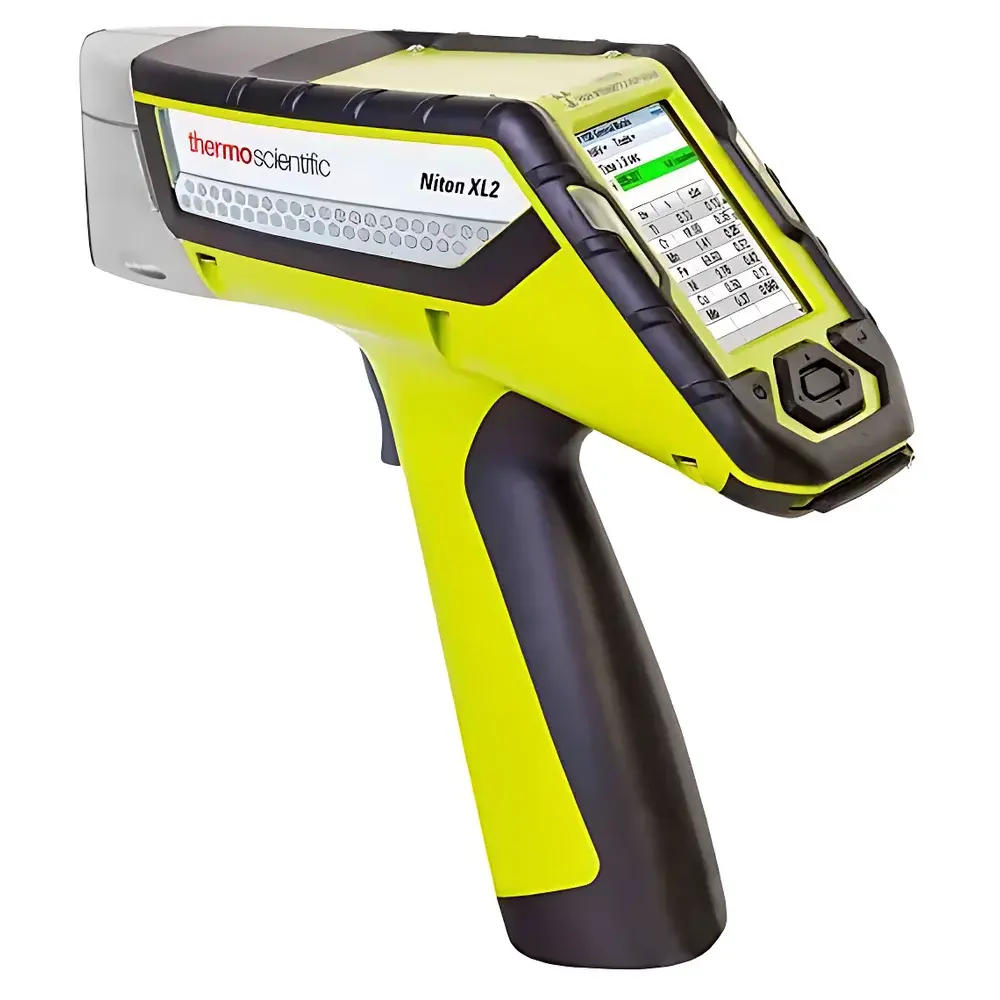
Thermo Scientific Niton XL2 Plus Handheld Energy Dispersive X-Ray Fluorescence (EDXRF) Spectrometer
| Brand | Thermo Fisher |
|---|---|
| Origin | USA |
| Manufacturer | Thermo Fisher Scientific |
| Type | Imported Instrument |
| Model | Niton XL2 Plus |
| Application | Handheld / Portable |
| Industry-Specific Use | Non-Ferrous Metals |
| Elemental Range | Mg to U |
| Quantification Range | ppm to 100% |
| Energy Resolution | 185 eV |
| Repeatability | ±10% |
Overview
The Thermo Scientific Niton XL2 Plus is a rugged, field-deployable handheld energy dispersive X-ray fluorescence (EDXRF) spectrometer engineered for rapid, non-destructive elemental analysis in industrial, environmental, and regulatory compliance settings. Based on fundamental EDXRF physics—where primary X-rays from an Ag-anode tube excite characteristic secondary (fluorescent) X-rays from sample atoms—the instrument delivers quantitative and qualitative compositional data in seconds. Its core architecture integrates a high-power (up to 2 W), dynamically current-regulated microfocus X-ray tube with a silicon drift detector (SDD) optimized for count-rate linearity and spectral fidelity. The system employs proprietary Fundamental Parameters (FP) algorithms to correct for matrix absorption and enhancement effects, enabling accurate quantification across heterogeneous samples without requiring matched reference standards for every material type. Designed for operation under demanding conditions—including metal fabrication floors, scrap yards, mining sites, and contaminated land surveys—the XL2 Plus meets IP54 ingress protection standards (dust- and splash-resistant) and operates reliably across -10 °C to 50 °C ambient temperatures.
Key Features
- Ag-anode X-ray tube (6–45 kV, 1–200 µA, max 2 W) with real-time dynamic current adjustment for optimal excitation per sample composition
- Silicon drift detector (SDD) with 185 eV Mn-Kα resolution at 0 °C, coupled with Detector ProGuard™ mechanical shield to prevent puncture damage during point analysis of sharp or irregular surfaces
- 8 mm collimated beam spot size with integrated CCD camera and nose-cone alignment guide for precise spatial targeting and measurement documentation
- Hot-swappable dual Li-ion battery system (7.4 V) ensuring uninterrupted operation during battery replacement—critical for continuous field workflows
- Resistive touchscreen interface with intuitive icon-driven navigation; optional directional keypad for gloved-hand operation
- Onboard memory: 64 MB system RAM + 128 MB user storage—capable of storing ~10,000 spectra (fewer if image capture enabled)
- Comprehensive connectivity: USB 2.0, Bluetooth 4.0 (supports external GPS, barcode scanners, and thermal printers), RS-232 serial port
Sample Compatibility & Compliance
The Niton XL2 Plus accommodates diverse solid and coated materials without sample preparation: bulk metals, alloys, ores, soils, paints, plastics, electronic components, and jewelry. Its Mg–U elemental coverage supports detection of light elements (e.g., Mg, Al, Si) critical for aluminum alloy verification, as well as heavy toxicants (Pb, Cd, Hg, Cr, Br) required under RoHS, CPSIA, and EU REACH directives. Preloaded calibrations include ASTM E1996 (alloy identification), SAE J403/J404 (steel grades), AA standards (aluminum), and USP / (elemental impurities in pharmaceuticals). The instrument complies with IEC 61010-1 safety requirements and carries CE, FCC, IC (Canada), and RoHS certifications. While not inherently 21 CFR Part 11 compliant out-of-the-box, audit trails and user access controls can be implemented via Niton Data Transfer (NDT) software in validated laboratory environments supporting GLP/GMP workflows.
Software & Data Management
Niton Data Transfer (NDT) PC software enables secure post-acquisition data review, report generation (PDF/CSV), calibration management, and library customization. Users may create application-specific calibration sets—for example, soil heavy-metal screening using EPA Method 6200 or coating thickness quantification via FP-based layer modeling. NDT supports password-protected user roles (Operator, Supervisor, Administrator), electronic signatures, and full audit trail logging—including timestamped parameter changes, spectrum acquisition events, and result exports. All spectral data embed GPS coordinates (when paired with optional Bluetooth GPS), operator ID, and measurement metadata, facilitating traceability in environmental site assessments and quality control documentation.
Applications
- Positive material identification (PMI) of stainless steels, nickel alloys, titanium, and copper-based alloys in piping, valves, and pressure vessels
- Scrap metal sorting by grade and contamination screening (e.g., Cu in Al, Sn in Pb-free solder)
- In-field geochemical analysis of drill cores and grab samples for Ni, Cu, Zn, Pb, As, and Au in exploration and resource estimation
- Rapid lead-in-paint screening per HUD Guidelines and EPA SW-846 Method 6200 for facility deleading and renovation compliance
- Consumer product safety testing: Cd in pigments, Br in flame retardants, Pb in ceramics and toys
- Coating thickness measurement on galvanized steel, electroplated Zn/Ni/Cr layers, and anodized aluminum
- Jewelry assay verification—Au, Ag, Pt, Pd content and hallmark authentication
FAQ
What is the minimum detectable limit (MDL) for lead in paint using the XL2 Plus?
MDL varies with matrix and measurement time but typically achieves ≤10 ppm Pb (dry weight) in 30-second analyses on homogeneous painted surfaces per ASTM F2856.
Can the XL2 Plus analyze light elements such as magnesium and aluminum in alloys?
Yes—its optimized low-energy response and vacuum-free air-path design enable reliable Mg, Al, and Si detection in aluminum, magnesium, and titanium alloys.
Is the instrument suitable for use in explosive atmospheres?
No—Niton XL2 Plus is not ATEX or IECEx certified; it must be operated outside classified hazardous zones per OSHA 1910.120 and NFPA 70E.
How does the FP algorithm improve accuracy compared to empirical calibrations?
FP modeling calculates theoretical X-ray yields using fundamental physical constants and measured geometry, reducing reliance on physical standards and improving extrapolation across uncalibrated alloys or mixed matrices.
What regulatory documentation is provided for instrument validation?
Thermo Fisher supplies factory calibration certificates, performance verification reports (including resolution and repeatability tests), and IQ/OQ templates aligned with ISO/IEC 17025 and GxP expectations.




