
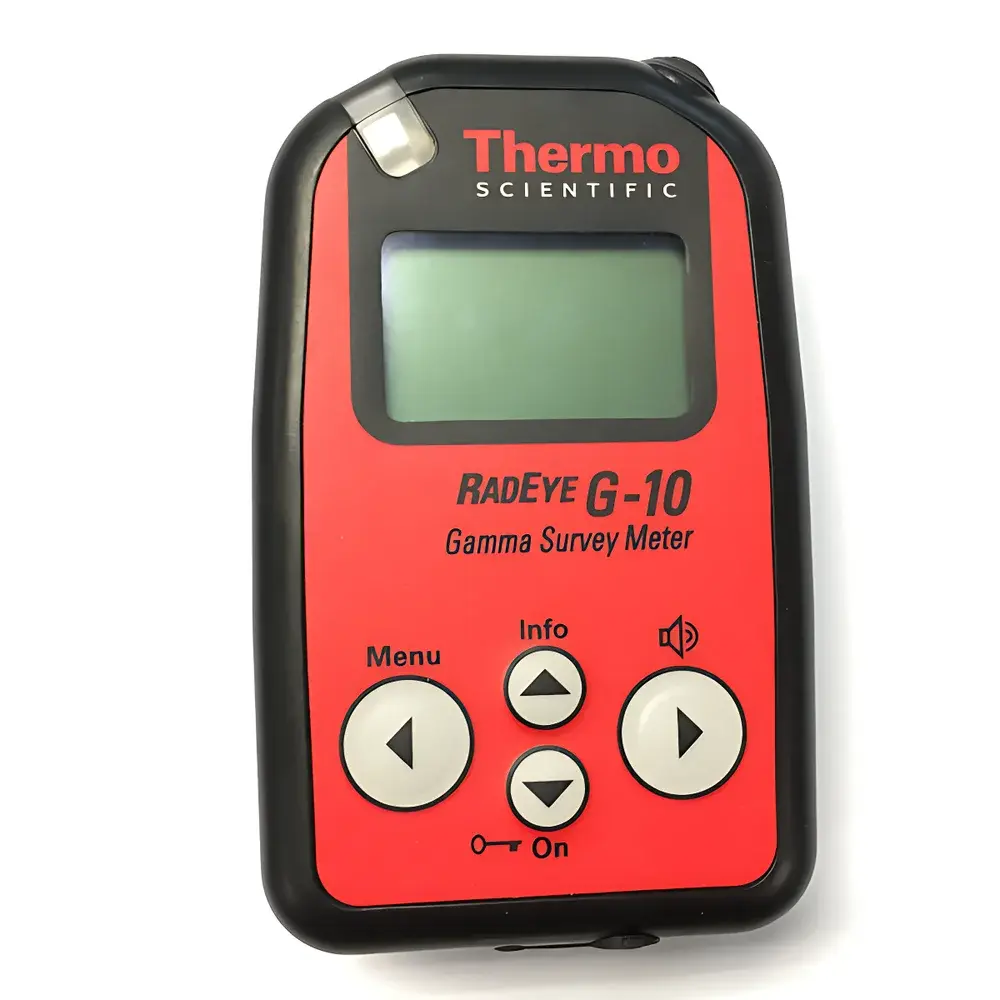
Thermo Fisher RadEye G-10 Portable Gamma Radiation Survey Meter
| Brand | Thermo Fisher |
|---|---|
| Origin | USA |
| Manufacturer Type | Original Equipment Manufacturer (OEM) |
| Product Origin | Imported |
| Model | RadEye G-10 |
| Instrument Category | Dose Rate Meter |
| Form Factor | Portable |
| Radiation Types Measured | X-ray and Gamma (γ) |
| Detector Type | Energy-Compensated Geiger-Müller (GM) Tube |
| Measurement Range | 0.5 µSv/h to 100 mSv/h |
| Energy Response Range | 50 keV to 3 MeV |
| Sensitivity (¹³⁷Cs) | 1.7 cps per µSv/h |
| Compliance | ANSI N42.33-2021, NATO AEP-117 Ed.3 |
| Battery Life | Up to 600 hours on two AAA alkaline cells |
| Environmental Robustness | Vibration-resistant housing, IP65-rated enclosure |
Overview
The Thermo Fisher RadEye G-10 is a rugged, handheld gamma radiation survey meter engineered for rapid, reliable dose rate assessment in field-based environmental monitoring, emergency response, nuclear medicine support, and regulatory compliance applications. Utilizing an energy-compensated Geiger-Müller (GM) detector tube, the instrument delivers accurate ambient dose equivalent rate (H*(10)) measurements across a broad photon energy spectrum—from 50 keV to 3 MeV—without requiring energy-dependent correction factors. Its optimized low-energy response enables sensitive detection of medically relevant isotopes such as 99mTc, 125I, and 241Am, while maintaining linearity and stability under high-dose-rate conditions up to 100 mSv/h. Designed for operational continuity in demanding environments, the RadEye G-10 features a vibration-resistant mechanical architecture and an IP65-rated enclosure, ensuring consistent performance during transport, outdoor deployment, or use in industrial facilities.
Key Features
- Energy-compensated GM detector providing flat H*(10) response from 50 keV to 3 MeV, minimizing under-response at low energies common in unshielded GM tubes
- Wide dynamic measurement range: 0.5 µSv/h to 100 mSv/h—covering background levels through high-intensity incident fields
- High intrinsic sensitivity of 1.7 counts per second per µSv/h referenced to 137Cs (662 keV), enabling rapid statistical convergence even at sub-µSv/h rates
- Extended battery life: up to 600 hours of continuous operation on two standard AAA alkaline cells—no proprietary battery pack required
- Dual-audio/visual alarm system with configurable thresholds; optional headphone output supports silent operation in noise-sensitive or covert scenarios
- Compliance with ANSI N42.33-2021 (Radiation Protection Instrumentation – Portable Radiation Detection Instrumentation for Homeland Security) and NATO AEP-117 Ed.3 (Requirements for Radiation Detection Equipment in CBRN Defense)
Sample Compatibility & Compliance
The RadEye G-10 is validated for direct measurement of photon-emitting radionuclides without sample preparation or spectral deconvolution. It is routinely deployed for routine surveys of contaminated surfaces, verification of shielding integrity, post-decontamination clearance, and real-time monitoring around radiopharmaceutical handling zones. Its energy compensation design ensures traceable H*(10) readings compliant with ICRP and IEC 60846-1:2014 standards for area monitoring instruments. The device meets electromagnetic compatibility (EMC) requirements per IEC 61000-6-2/6-3 and is certified for use in Class I, Division 2 hazardous locations. Documentation packages support GLP/GMP-aligned recordkeeping, including factory calibration certificates traceable to NIST standards.
Software & Data Management
While the RadEye G-10 operates as a fully standalone instrument, optional Thermo Fisher Connect™ software enables secure data export via USB interface for audit-ready reporting. Logged measurements include timestamp, dose rate, accumulated dose, alarm events, and battery status. Exported CSV files are compatible with LIMS integration and support 21 CFR Part 11-compliant electronic signatures when deployed with appropriate organizational controls. Firmware updates preserve metrological integrity and may incorporate enhancements to alarm logic or energy response modeling based on updated ANSI/NATO revision cycles.
Applications
- Environmental radiological surveys following suspected releases or natural contamination events (e.g., radon progeny, NORM/TENORM sites)
- First responder triage and hot zone demarcation during radiological dispersal device (RDD) or orphan source incidents
- Quality assurance checks in nuclear medicine departments—verifying syringe shields, PET/CT suite interlocks, and waste storage compliance
- Regulatory inspections by national radiation protection authorities requiring portable, type-approved instrumentation
- Decommissioning and remediation projects where long-duration field operation and mechanical durability are critical
FAQ
Does the RadEye G-10 require annual recalibration?
Yes—per ISO/IEC 17025 and ANSI N42.20 recommendations, periodic calibration against traceable 137Cs and 60Co sources is required at minimum 12-month intervals or after any physical impact, repair, or firmware update.
Can it distinguish between X-ray and gamma radiation?
No—the instrument reports total ambient dose equivalent rate (H*(10)) from all ionizing photons within its energy response window; spectral discrimination is not supported.
Is the detector sensitive to beta radiation?
The energy-compensated GM tube has minimal beta response due to its metal-walled construction and internal filtration; it is not intended for beta surface contamination screening.
What is the temperature operating range?
–10 °C to +50 °C, with full specification compliance maintained across this range per ANSI N42.33 environmental testing protocols.
Does it support external probe connectivity?
No—the RadEye G-10 is a self-contained, integrated unit; no remote probe interface is provided.







