
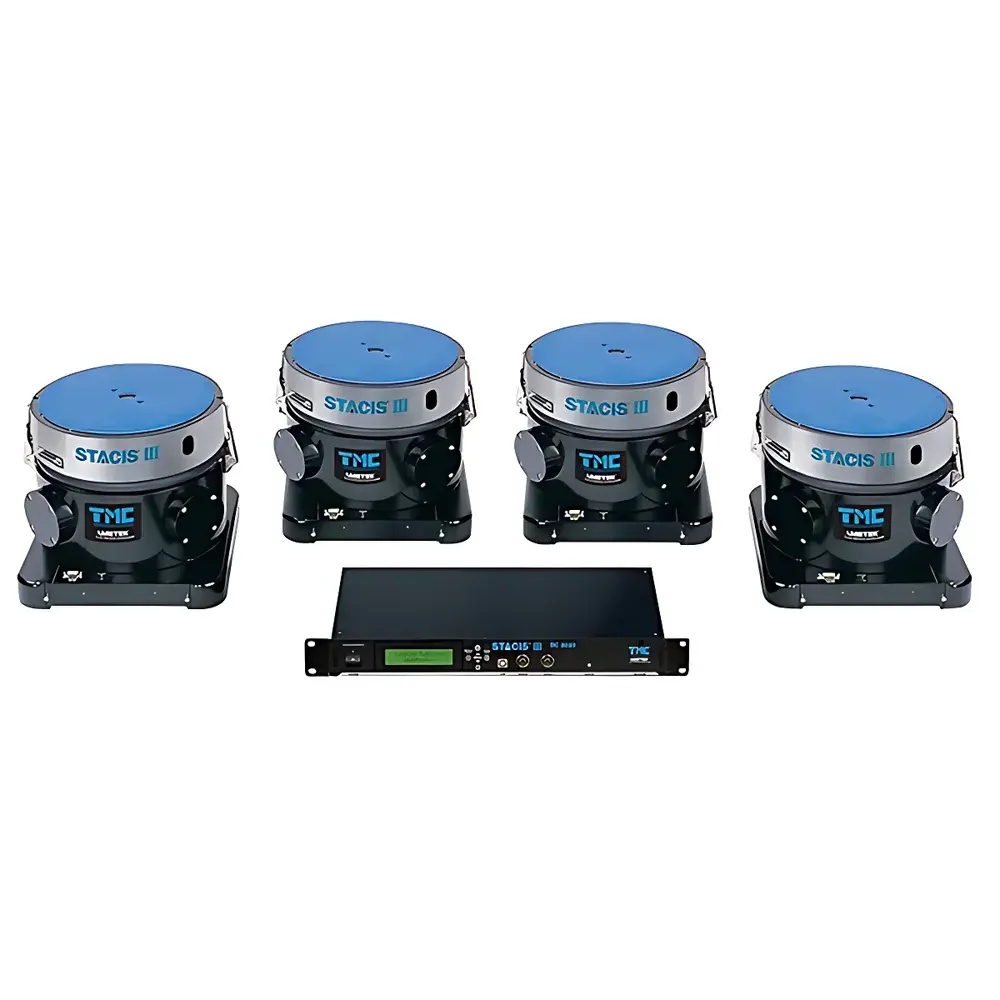
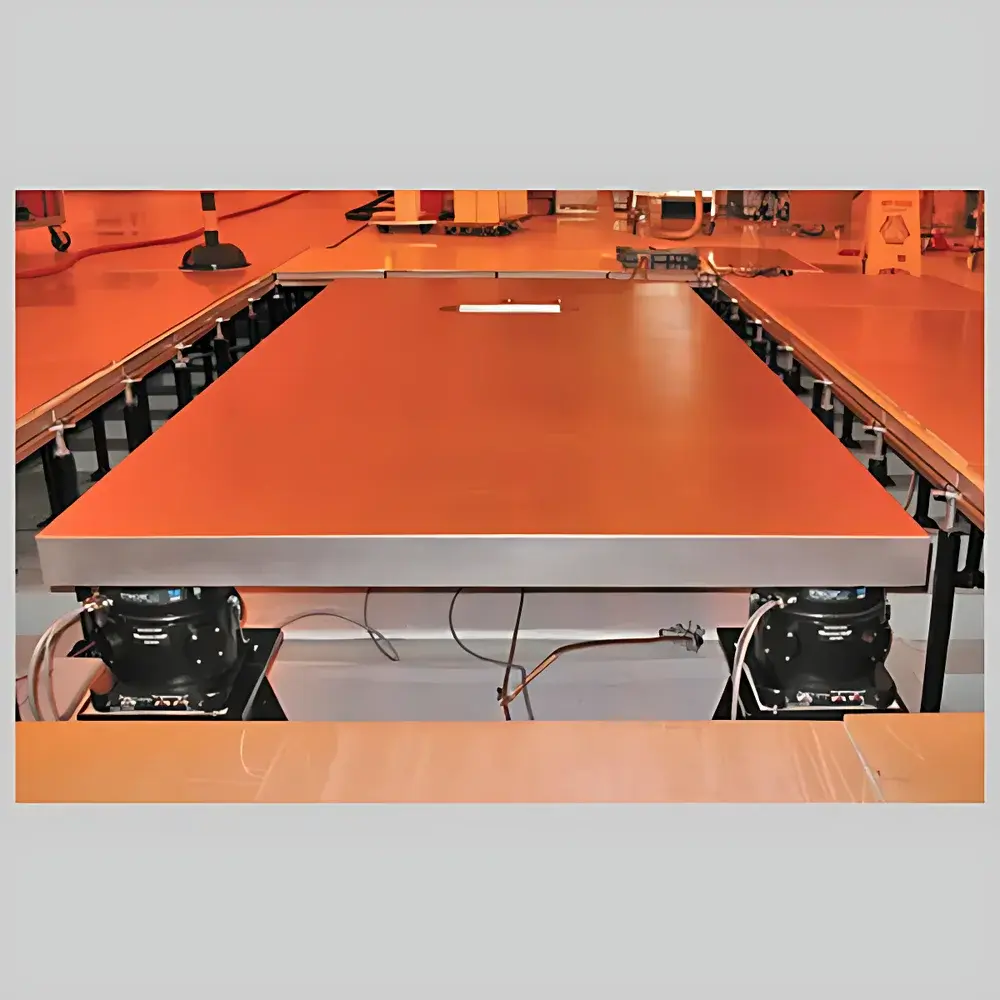
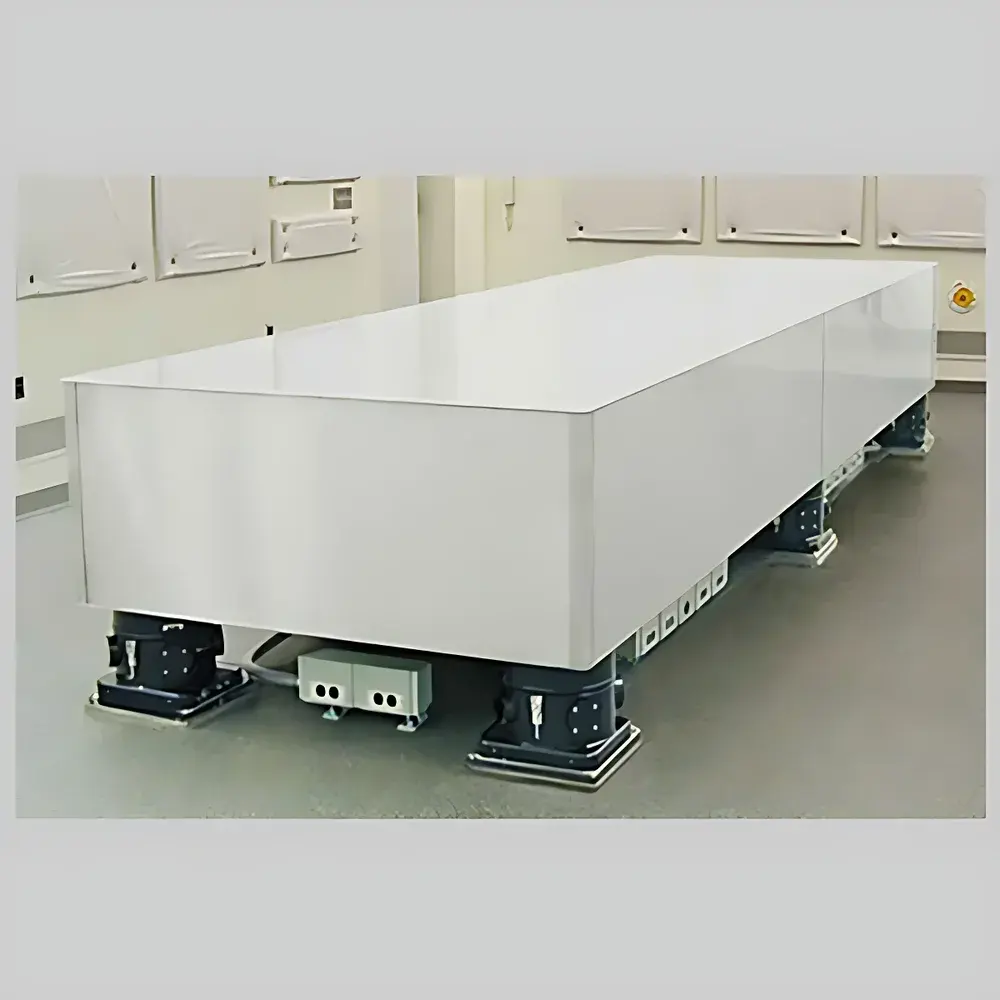
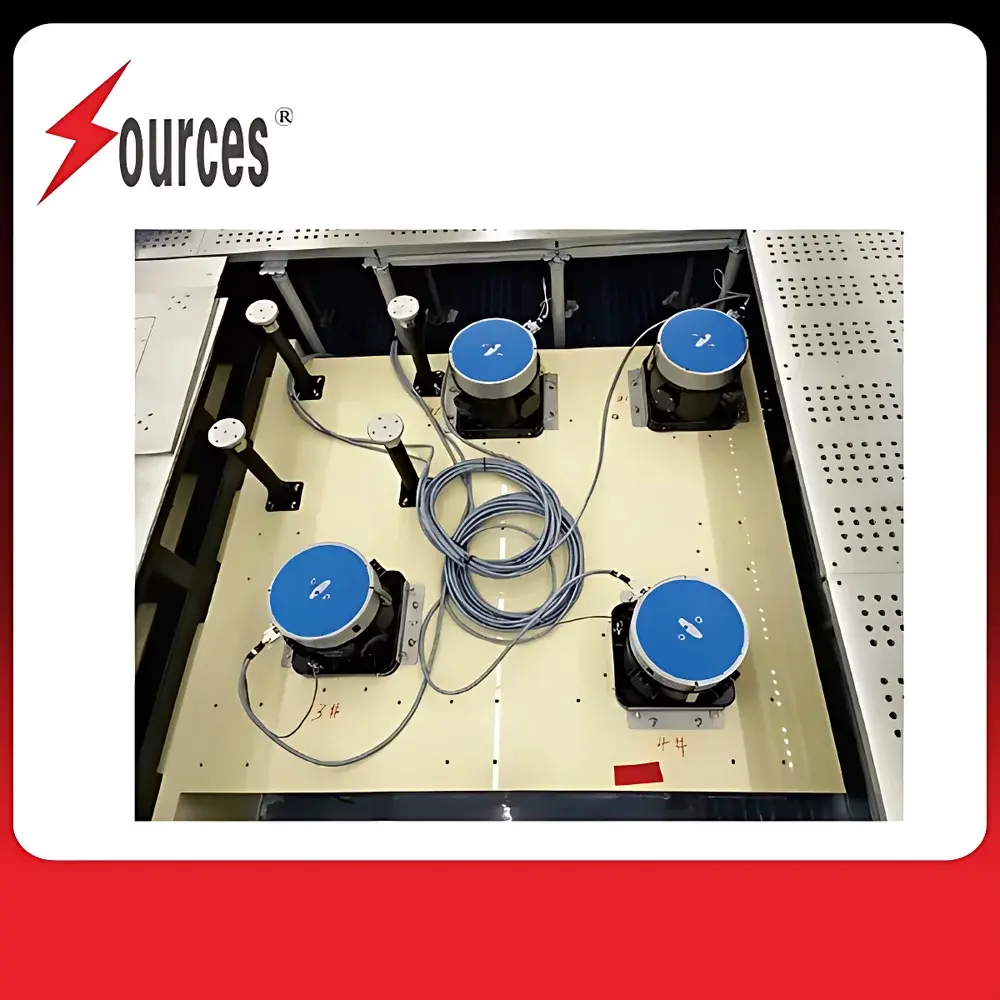
TMC STACIS III Active Vibration Isolation System with Optical Table Platform
| Brand | TMC |
|---|---|
| Origin | USA |
| Model | STACIS III |
| Active DOF | 6 |
| Active Bandwidth | 0.6–150 Hz |
| Passive Natural Frequency | 18 Hz (vertical & horizontal) |
| Effective Active Resonant Frequency | 0.5 Hz |
| Isolation at 1 Hz | 40–70% |
| Isolation ≥2 Hz | ≥90% |
| Settling Time (10 lb step, 10 | 1): 0.3 sec |
| Internal Noise | <0.1 nm RMS |
| Load Range per Isolator | Low (181–499 kg), Med (408–953 kg), Hi (862–2041 kg) |
| Static Lift Capacity | 4090 kg |
| Stiffness (Med isolator, 454 kg) | 73 × 10⁵ N/m |
| Magnetic Emission (<102 mm) | <0.02 µG broadband RMS |
| Environmental Compliance | CE, RoHS |
| Operating Temp | 10–32 °C |
| Humidity | 30–60% RH |
| Power | 100–240 VAC, 50/60 Hz, <600 W |
| Isolator Dimensions | 300 × 320 × 275 mm |
| Isolator Weight | 34 kg |
| DC-2020 Controller | Dual-core 150/75 MHz, 10 kHz sampling, 16 AI/AO channels, Ethernet + USB + RS-232, embedded GUI |
Overview
The TMC STACIS III Active Vibration Isolation System is an engineered solution for ultra-sensitive optical and metrology instrumentation operating in high-noise environments. Built upon the proven STACIS platform architecture, STACIS III integrates real-time, six-degree-of-freedom (6-DOF) active vibration control with a high-stiffness passive elastomeric base—eliminating reliance on compressed air while delivering sub-nanometer stability. Its core principle leverages downward-facing geophone-type inertial sensors to continuously monitor floor velocity below each isolator. This signal is digitized at 10 kHz by the DC-2020 dual-core controller, processed via adaptive feedback algorithms, and used to drive high-force piezoelectric actuators (operating up to 800 VDC) that dynamically counteract incoming vibrational energy. The result is an effective active resonant frequency of just 0.5 Hz and isolation performance exceeding 90% above 2 Hz—critical for applications such as electron beam lithography, atomic force microscopy (AFM), scanning tunneling microscopy (STM), and interferometric optical testing where floor-induced micro-motion directly limits resolution and measurement repeatability.
Key Features
- Six-axis active vibration cancellation with continuous real-time feedback loop—no manual tuning required
- Hybrid design: stiff isotropic elastomer base (passive) combined with high-bandwidth piezoelectric actuation (active), enabling robust performance without pneumatic infrastructure
- DC-2020 digital controller featuring dual 150/75 MHz processors, embedded Ethernet GUI, and full Windows-compatible extended interface for remote monitoring and configuration
- Low intrinsic noise floor: <0.1 nm RMS internal displacement—essential for long-duration, low-drift measurements
- Scalable modular architecture: systems deploy with a minimum of three isolators; compatible with custom laminated stainless steel optical tables, height-adjustable frames, seismic restraints, and lift hoods
- CE and RoHS compliant; designed for GLP/GMP-aligned laboratories requiring audit-ready operational records and traceable system status
Sample Compatibility & Compliance
STACIS III supports payloads ranging from 181 kg (low-capacity) to 2041 kg (high-capacity) per isolator, with static lift capacity up to 4090 kg—making it suitable for large-format optical tables, multi-axis metrology stages, and integrated semiconductor inspection tools. Its passive natural frequency of 18 Hz ensures mechanical compatibility with standard optical breadboards and vacuum chambers, while its magnetic emission (<0.02 µG at 102 mm) meets stringent requirements for electron-optical systems including TEM, SEM, and e-beam writers. The system complies with ISO 2631-1 (human exposure), VC-C vibration criteria (12.5 µm/s RMS), and is routinely validated in facilities adhering to SEMI S2, ISO 14644-1 Class 5 cleanroom standards, and FDA 21 CFR Part 11–governed analytical instrument qualification protocols.
Software & Data Management
The DC-2020 controller provides comprehensive data acquisition and system diagnostics through multiple interfaces: front-panel LCD with character-based menu navigation, HyperTerminal-compatible serial access, and a fully featured embedded web server accessible via Ethernet. The Windows-based Extended GUI enables time-domain waveform capture, spectral analysis (FFT), real-time Bode plot generation, and automated logging of sensor outputs, actuator commands, and thermal status. All controller operations—including firmware updates, calibration file loading, and alarm threshold configuration—are logged with timestamped entries supporting 21 CFR Part 11 compliance when deployed with network authentication and role-based access controls. Analog I/O (16 channels each) allows integration with external environmental monitors or motion control systems for synchronized multi-instrument workflows.
Applications
- Advanced semiconductor manufacturing: mask alignment, wafer inspection, and nanoimprint lithography in high-vibration fab environments
- Nanotechnology research: AFM/STM imaging, nanoindentation, and single-molecule force spectroscopy requiring sub-angstrom positional stability
- Optical metrology: laser interferometry, Fizeau cavity testing, and gravitational wave detector prototype development
- Failing analysis labs: cross-sectioning, focused ion beam (FIB) milling, and transmission electron microscopy (TEM) sample preparation
- Photonics R&D: quantum optics experiments, cavity ring-down spectroscopy, and ultrafast laser pulse characterization
- Standards laboratories: NIST-traceable dimensional calibration and primary reference instrument stabilization
FAQ
What distinguishes STACIS III from passive or pneumatic isolation platforms?
STACIS III uniquely combines broadband active cancellation (0.6–150 Hz) with a stiff passive base—achieving deep sub-Hz resonance suppression unattainable with air tables alone, and eliminating air compressors, leveling valves, and associated maintenance overhead.
Can STACIS III be retrofitted to existing optical tables?
Yes—modular isolators integrate with standard M6 or 1/4″-20 mounting patterns. TMC offers custom adapter plates and structural analysis support for legacy table integration.
Is the DC-2020 controller compatible with legacy STACIS 2100 hardware?
Yes—the rear-panel RS-232 port maintains backward compatibility with STACIS 2100 isolators, enabling phased system upgrades without full replacement.
How is system performance validated post-installation?
TMC provides ISO 10816-compliant vibration assessment reports, including floor spectrum acquisition, closed-loop transfer function measurement, and VC-C compliance verification under representative payload conditions.
Does STACIS III support integration into facility-wide building management systems (BMS)?
Via Modbus TCP over Ethernet or analog voltage outputs, the DC-2020 can relay operational status, temperature, power consumption, and fault codes to centralized SCADA or BMS platforms.




