
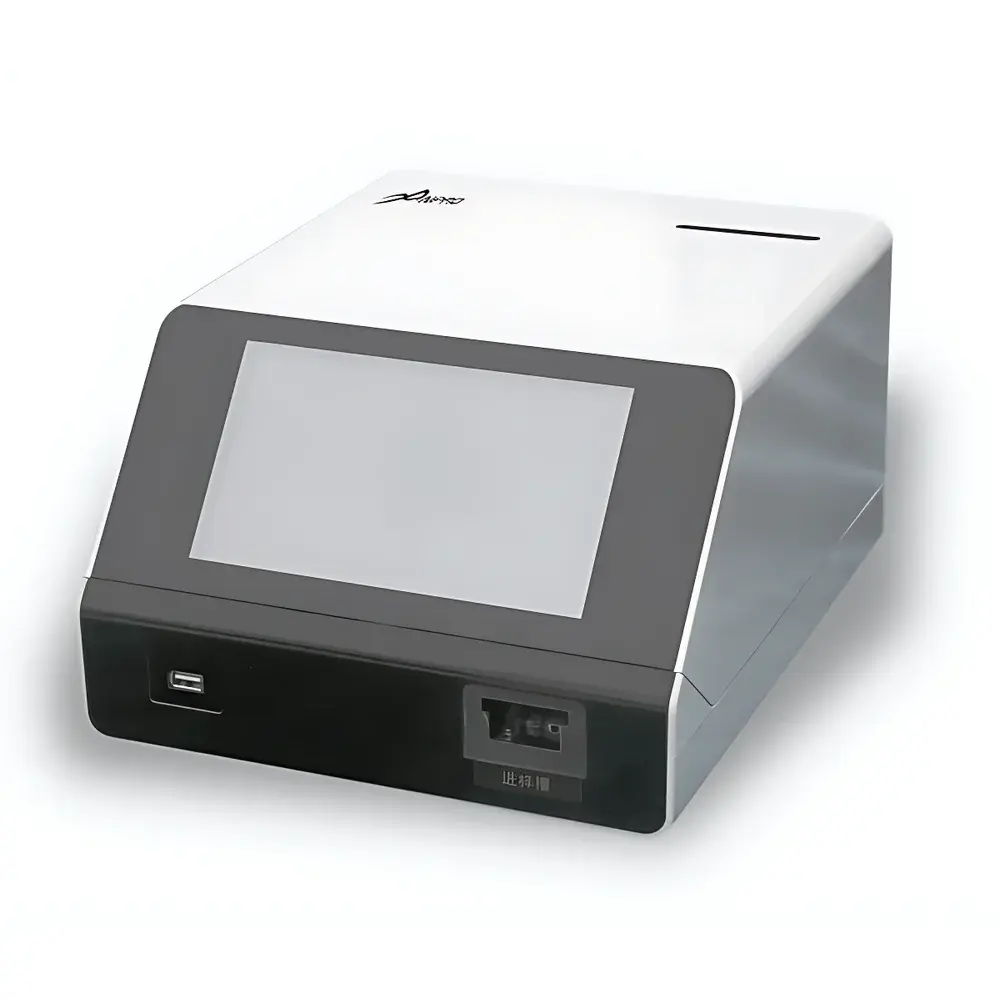
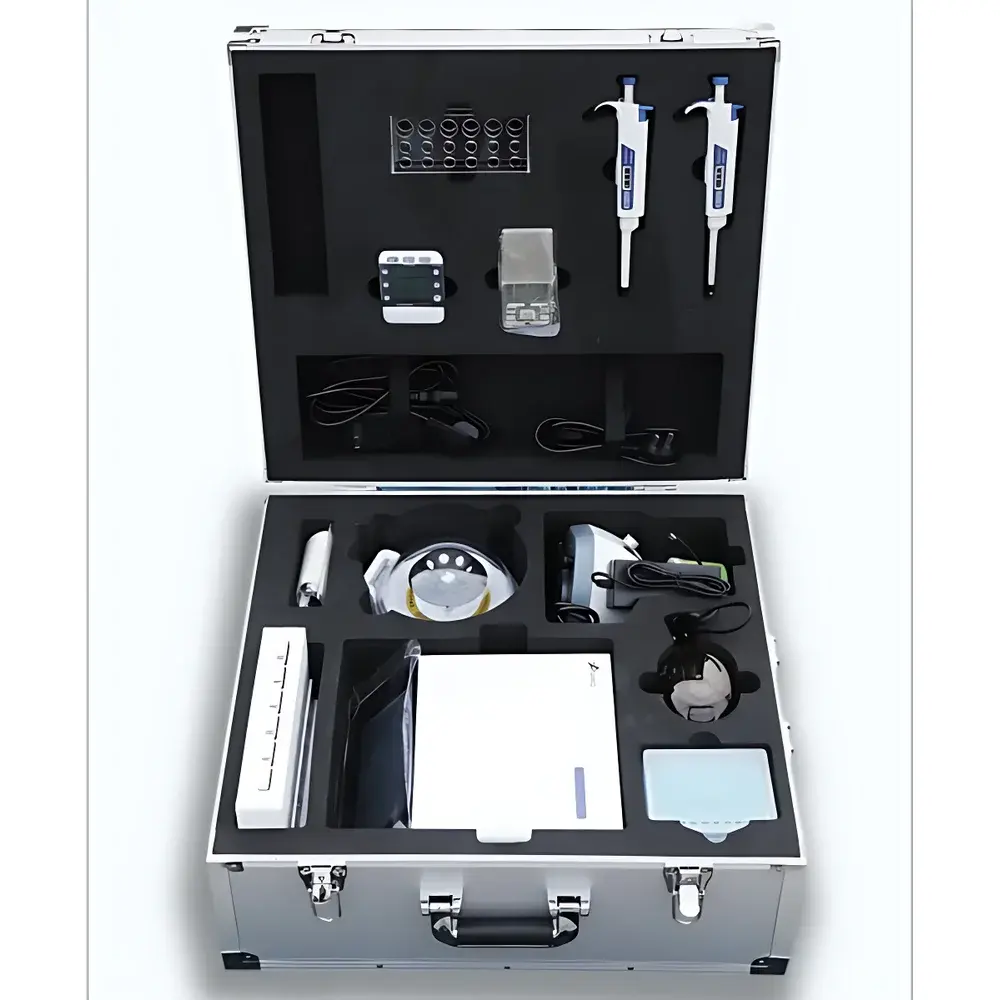
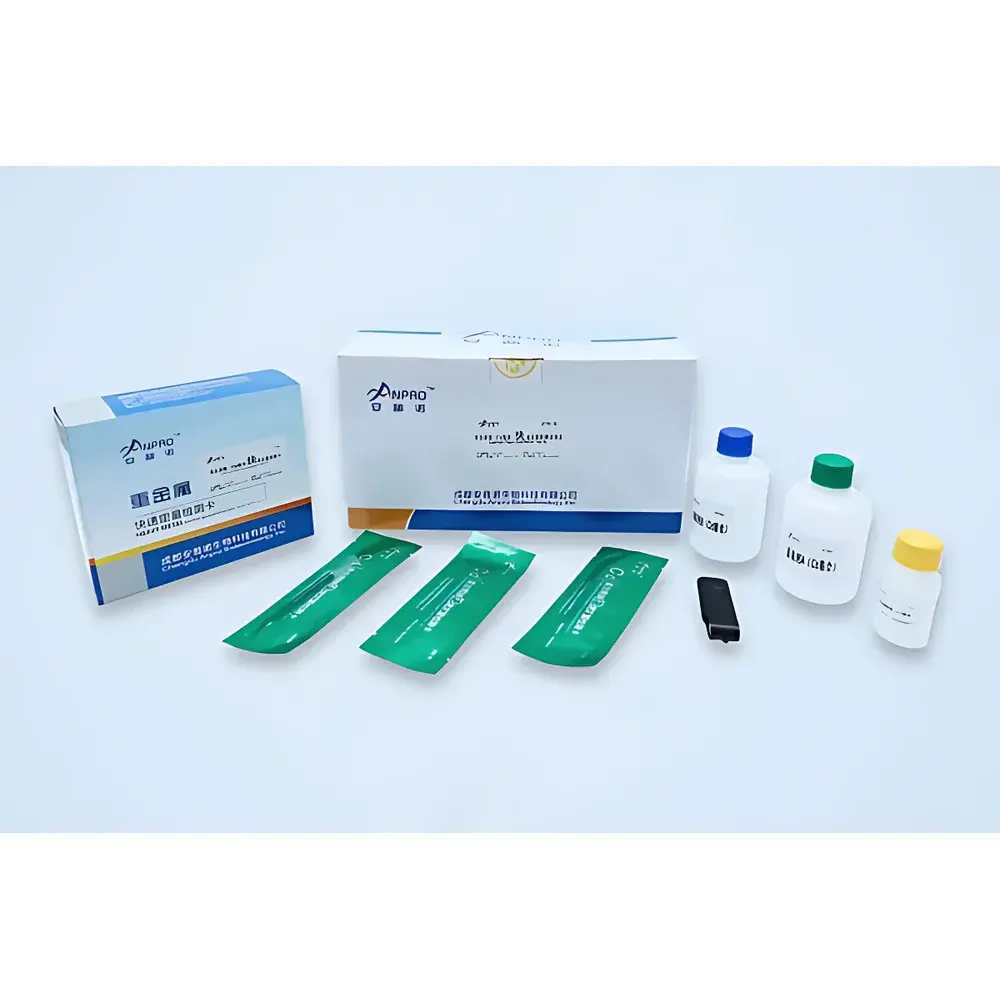
ANPRO SKJ-IA-03 Immunoquantitative Heavy Metal Analyzer for Cadmium and Lead in Food Commodities
| Brand | ANPRO |
|---|---|
| Origin | Sichuan, China |
| Manufacturer Type | Direct Manufacturer |
| Regional Classification | Domestic (PRC) |
| Model | SKJ-IA-03 |
| Price Range | USD 7,000 – 14,000 |
| Detection Principle | Competitive Enzyme-Linked Immunosorbent Assay (ELISA) with Quantitative Lateral Flow Readout |
| Sample Throughput | 6 samples per run |
| Analysis Time | ≤10 minutes per sample |
| Target Analytes | Cd, Pb, Cu, Hg |
| Detection Ranges | Cd: 0–1 ppm |
| Pb | 0–1 ppm |
| Cu | 0–20 ppm |
| Hg | 0–0.3 ppm |
| Sample Types | Raw grains (rice, wheat, corn, barley), milled grain products, animal feed, feed ingredients, botanical herbal materials |
| Display | Color resistive touchscreen (≥7″) |
| Data Output | Onboard thermal printer, GPS-tagged CSV export via Wi-Fi/4G, API-compatible JSON upload to LIMS or cloud platforms |
| Regulatory Alignment | Compliant with GB 5009.15–2014 (Cd), GB 5009.12–2023 (Pb), and aligned with AOAC Official Method 2019.02 for immunoassay-based heavy metal screening in cereals |
Overview
The ANPRO SKJ-IA-03 Immunoquantitative Heavy Metal Analyzer is a field-deployable, ELISA-based analytical platform engineered for rapid, quantitative determination of cadmium (Cd), lead (Pb), copper (Cu), and mercury (Hg) in food-grade commodities—including paddy rice, milled rice, wheat, maize, soybean meal, compound feed, and botanical raw materials. Unlike conventional atomic spectroscopy methods requiring centralized laboratories and trained personnel, the SKJ-IA-03 implements a patented competitive immunoassay format coupled with high-sensitivity lateral flow strip readout and integrated optical densitometry. This architecture enables trace-level quantification without acid digestion, graphite furnace operation, or hazardous reagent handling. The system operates on the principle of antigen–antibody competition: sample-extracted metal ions bind competitively with immobilized metal–protein conjugates on the test line, generating an inverse optical signal proportional to analyte concentration. Calibration curves are preloaded and validated against reference standards traceable to NIM (National Institute of Metrology, China), ensuring metrological continuity across field units.
Key Features
- Quantitative multi-analyte capability: Simultaneous detection of Cd, Pb, Cu, and Hg within a single 10-minute assay cycle—no instrument reconfiguration required.
- High-throughput parallel processing: Six independent test channels accommodate batch analysis without cross-contamination; each channel features dedicated optical path isolation and auto-zeroing.
- Field-hardened mobility: Integrated telescopic handle, shock-absorbing chassis, and dual-mode power (100–240 V AC / 12 V DC vehicle adapter) support mobile lab, port-of-entry, or silo-side deployment.
- Regulatory-grade data integrity: Full audit trail generation—including operator ID, GPS coordinates, timestamp, environmental temperature/humidity logs, and raw optical density values—meets GLP documentation requirements.
- Zero-standard-handling workflow: Pre-programmed calibration curves eliminate manual standard dilution, reducing analyst exposure risk and inter-laboratory variability.
- Self-diagnostic firmware: Real-time validation of strip lot compatibility, reader optical stability, and reagent expiration alerts ensure consistent measurement fidelity across >500 consecutive assays.
Sample Compatibility & Compliance
The SKJ-IA-03 is validated for use with homogenized, aqueous extracts prepared from cereal grains (brown rice, polished rice, wheat kernels, dent corn), processed feed matrices (poultry mash, aquafeed pellets), and dried plant tissues (ginseng root, licorice, goji berry). Extraction protocols follow GB/T 5009.15–2014 (for Cd) and GB 5009.12–2023 (for Pb), with optional integration of AOAC 2019.02-compliant buffer systems. All test kits carry CNAS-accredited verification reports issued by the National Grain Quality Supervision and Inspection Center (China National Grain Reserves Corporation). Instrument output complies with ISO/IEC 17025:2017 clause 7.7 (reporting of results) and supports FDA 21 CFR Part 11–ready electronic signatures when deployed with authorized identity management modules.
Software & Data Management
Embedded firmware (v3.2+) provides localized multilingual UI (English, Spanish, Vietnamese, Arabic) and structured data export in CSV and JSON formats. GPS-tagged measurement records include georeferenced metadata compliant with ISO 19115-1:2014. The device supports secure HTTPS-based push transmission to third-party LIMS (e.g., LabWare, Thermo Fisher SampleManager) or custom cloud platforms via RESTful API endpoints. Audit logs retain full traceability for ≥18 months onboard storage; external SD card backup extends retention indefinitely. Firmware updates are delivered over-the-air with SHA-256 signature verification to prevent unauthorized modification.
Applications
- Pre-harvest surveillance: Rapid assessment of Cd/Pb accumulation in paddy fields prior to milling.
- Feed safety gatekeeping: In-line screening of soybean meal, fishmeal, and mineral premixes at feed mill receiving docks.
- Import inspection: Border control verification of rice shipments against EU Commission Regulation (EC) No 1881/2006 maximum levels.
- GMP-aligned QC: Routine testing of herbal raw materials per Chinese Pharmacopoeia 2020 Edition Vol. IV Section 9302.
- Research applications: High-volume phenotyping of low-accumulation crop varieties under controlled agronomic trials.
FAQ
What regulatory standards does the SKJ-IA-03 meet for food testing?
It aligns with GB 5009.15–2014 (Cd), GB 5009.12–2023 (Pb), and AOAC Official Method 2019.02; test kit performance is verified by CNAS-accredited national grain testing centers.
Can the instrument be used for official compliance reporting?
Yes—when operated under documented SOPs with traceable reference materials and calibrated strips, output meets ISO/IEC 17025 reporting requirements for screening-level determinations.
Is method validation support available for laboratory accreditation?
ANPRO provides full validation packages including LOD/LOQ studies, precision (within-lab repeatability RSD <12%), spike recovery (85–115% across matrix types), and inter-instrument reproducibility data.
How is data security ensured during cloud transmission?
All transmissions use TLS 1.2+ encryption; API keys are rotated quarterly, and payload signing follows HMAC-SHA256 protocols per NIST SP 800-175B guidelines.
Does the system support third-party reagent integration?
No—only ANPRO-certified lateral flow strips are supported to maintain metrological equivalence and avoid calibration drift due to lot-to-lot antibody affinity variance.




