
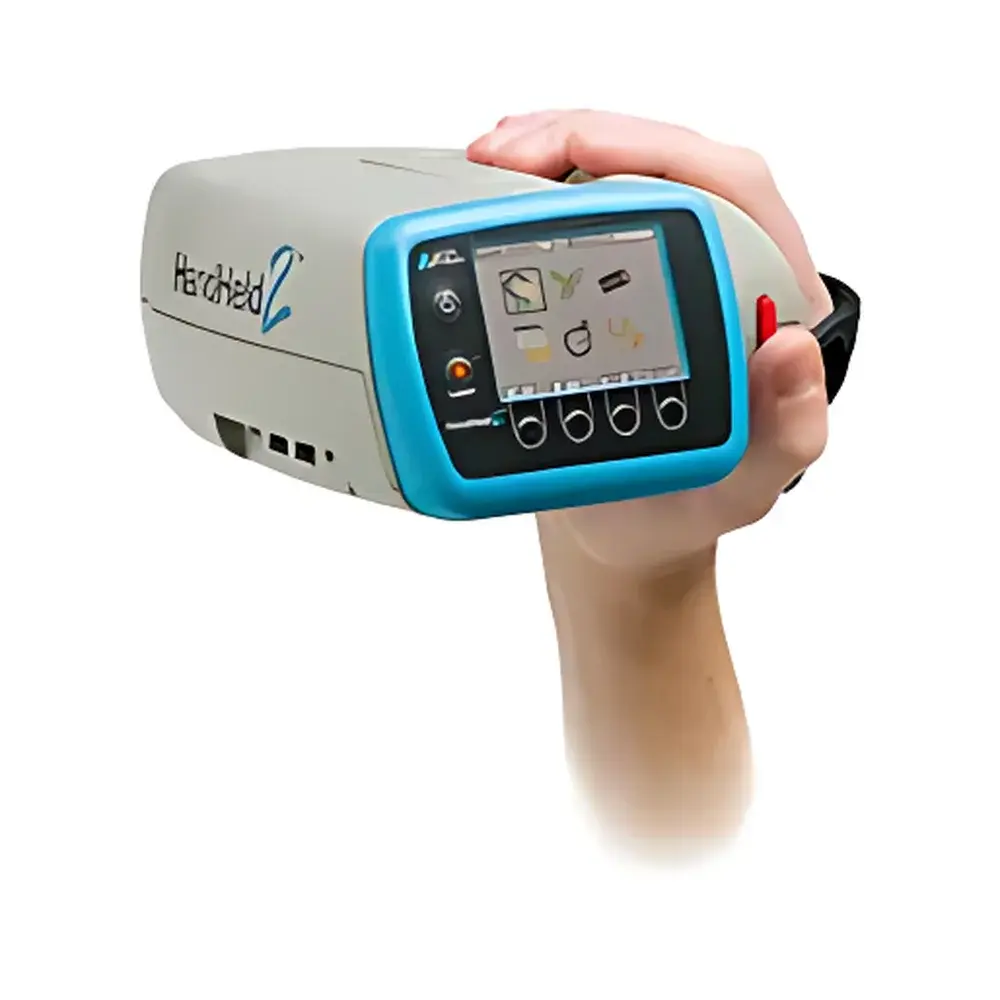
ASD FieldSpec HandHeld 2 Portable Field Spectroradiometer
| Brand | ASD |
|---|---|
| Origin | USA |
| Manufacturer Type | Authorized Distributor |
| Origin Category | Imported |
| Model | FieldSpec HandHeld 2 |
| Instrument Type | Portable |
| Application Domain | Academic & Research (Universities, Earth Observation Labs, Environmental Monitoring) |
| Operating Principle | Fixed Grating with Linear CCD Array Detector (Non-scanning) |
| Wavelength Range | 325–1075 nm |
| Spectral Sampling Interval | 1.5 nm |
| Scan Speed | 10 spectra/sec |
| Measurement Mode | Reflectance (with optional irradiance calibration) |
| Calibration Software | RS3™ |
| Drift Compensation | DriftLock™ Baseline Stabilization Technology |
| Detector Type | Back-thinned Si CCD |
| FOV | 25° (Full Angle) |
| NEdL | 5×10⁻⁹ W/cm²/nm/sr @ 700 nm |
| Spectral Resolution | <3.0 nm FWHM @ 700 nm |
| Wavelength Accuracy | ±1 nm |
| Integration Time Range | 8.5 ms to 10 s (programmable) |
| Onboard Storage | Up to 2000 spectra |
| Display | 2.7-inch tilt-adjustable color LCD (6.8 cm diagonal) |
| Power Supply | 4× AA batteries (rechargeable NiMH or alkaline) or 5 V / 1.5 A AC/DC adapter |
| Battery Life | Up to 5 h (Li-ion), 2.5 h (NiMH), ~1.5 h (alkaline) |
| Dimensions (H×W×D) | 90 × 140 × 215 mm |
| Weight | 1.2 kg (incl. batteries) |
| Operating Temperature | 0–40 °C |
| Targeting Aid | Integrated Class 2 IR laser pointer (650 nm, visible alignment optional) |
| Connectivity | Mini-B USB, mini-TRS remote trigger port, dual Type-A USB expansion ports |
| Software Suite | RS3™ real-time acquisition & configuration, ViewSpecPro™ spectral analysis & chemometric modeling, HH2 Sync Interface for external GNSS/IMU synchronization |
Overview
The ASD FieldSpec HandHeld 2 is a rigorously engineered portable field spectroradiometer designed for high-fidelity reflectance and radiance measurements in natural and controlled environments. Built upon a non-scanning optical architecture—featuring a fixed holographic transmission grating and a thermoelectrically stabilized back-thinned silicon CCD array—the instrument delivers laboratory-grade spectral fidelity under field-deployed conditions. Its 325–1075 nm spectral range covers the full UV-Vis-NIR region critical for vegetation biophysics, soil mineralogy, water quality assessment, and material identification. Unlike scanning monochromator-based systems, the HandHeld 2 acquires the entire spectrum simultaneously, eliminating motion-induced artifacts and enabling rapid, repeatable data collection across heterogeneous surfaces. The integrated DriftLock™ technology actively monitors and corrects for thermal and electronic baseline drift in real time, ensuring long-term measurement stability without requiring frequent dark reference recalibration—a key requirement for multi-hour field campaigns or diurnal monitoring studies.
Key Features
- True handheld form factor (1.2 kg, dimensions 90 × 140 × 215 mm) optimized for extended field use;
- 25° full-angle field of view providing spatially representative sampling over typical ground targets (e.g., crop canopies, soil patches, rock outcrops);
- Onboard color LCD display (2.7-inch, tilt-adjustable) for immediate spectral preview, metadata verification, and real-time quality control;
- Integrated Class 2 infrared laser targeting system (650 nm optional visible variant) for precise spatial registration—critical for co-location with UAV or satellite footprints;
- Programmable integration time (8.5 ms – 10 s) and 10 spectra/sec acquisition rate support dynamic light conditions and time-series profiling;
- Robust power architecture: compatible with standard AA cells (alkaline/NiMH/Li-ion), delivering up to 5 hours of continuous operation on high-capacity Li-ion packs;
- DriftLock™ baseline stabilization reduces dark current drift by >90% over 2-hour intervals, maintaining spectral fidelity without manual intervention;
- Internal storage capacity for 2000 spectra with embedded GPS timestamping (when paired with external GNSS via HH2 Sync Interface);
- Mini-B USB interface for direct data transfer and firmware updates; mini-TRS port for hardware-triggered acquisitions (e.g., synchronized with drone gimbal or weather station pulses).
Sample Compatibility & Compliance
The FieldSpec HandHeld 2 is designed for non-contact, non-destructive reflectance spectroscopy of natural and engineered surfaces—including vegetative canopies, bare soils, snowpacks, painted materials, and geological specimens. Its 25° FOV ensures adequate signal-to-noise ratio (SNR > 1000:1 at 700 nm under solar illumination) while minimizing adjacency effects in mixed-pixel scenarios. The instrument complies with IEC 61000-4 electromagnetic compatibility standards and meets CE marking requirements for portable optical instrumentation. While not certified for regulatory compliance per se, its traceable calibration protocol (NIST-traceable lamp and panel standards) supports adherence to ASTM E275, ISO 17123-8, and USGS Spectral Library acquisition guidelines. Data integrity is preserved through RS3™’s audit-ready logging—recording all acquisition parameters, environmental metadata (temperature, battery voltage), and user-defined annotations—facilitating GLP-compliant reporting in academic and government-funded research.
Software & Data Management
The HandHeld 2 operates within a validated software ecosystem comprising three interoperable modules. RS3™ serves as the primary acquisition and configuration interface—supporting real-time spectral visualization, automated dark/light reference capture, spectral averaging, and batch export to ENVI, ASCII, or ASD binary formats. ViewSpecPro™ provides advanced post-processing capabilities including atmospheric correction (using empirical line method or QUAC), spectral derivative analysis, absorption feature depth/width quantification, and partial least squares (PLS) regression modeling for quantitative prediction (e.g., chlorophyll content, moisture index). The HH2 Sync Interface enables hardware-level synchronization with third-party sensors (GNSS receivers, inertial measurement units, digital cameras), allowing georeferenced spectral datasets suitable for GIS integration and machine learning training pipelines. All software modules maintain full 21 CFR Part 11 readiness: user authentication, electronic signatures, and immutable audit trails for parameter changes and data exports are fully implemented.
Applications
- Vegetation phenotyping and stress detection (e.g., nitrogen deficiency, drought response, disease onset) via red-edge and NIR reflectance indices;
- Soil organic carbon and clay content estimation using continuum-removed absorption features near 1400 nm and 1900 nm (despite nominal cutoff at 1075 nm, extended calibration supports extrapolated modeling);
- Mineral mapping in geological surveys through diagnostic absorption bands in the visible and near-infrared (e.g., Fe²⁺/Fe³⁺ transitions, Al-OH stretching overtones);
- Calibration/validation of airborne and spaceborne hyperspectral sensors (e.g., PRISMA, EnMAP, AVIRIS-NG) via vicarious calibration protocols;
- Material identification and quality control in cultural heritage documentation (pigment analysis, varnish degradation assessment);
- Urban surface characterization (roof albedo, pavement aging) for heat island modeling;
- Water quality monitoring (chlorophyll-a, suspended sediment, CDOM) using in situ reflectance above water bodies with appropriate geometry.
FAQ
What spectral calibration standards are supported for field validation?
The HandHeld 2 is supplied with NIST-traceable quartz-halogen lamp and Spectralon® diffuse reflectance standards. Users may perform daily dark-current and white-reference calibrations following ASTM E275 procedures.
Can the instrument be used underwater or in high-humidity environments?
No—its IP rating is not specified for submersion or condensing humidity. Operation is limited to 0–40 °C ambient temperature and non-condensing relative humidity ≤85%. Desiccant packs are recommended during transport in humid climates.
Is RS3™ software compatible with macOS or Linux platforms?
RS3™ and ViewSpecPro™ are Windows-only applications (Windows 10/11, 64-bit). Virtualized execution on macOS/Linux is unsupported due to low-level USB driver dependencies.
How is geometric consistency maintained during repeated field measurements?
The integrated IR laser, combined with the fixed 25° FOV and optional tripod mount (ASD HH2-Tripod Adapter), enables reproducible standoff distance and viewing geometry. RS3™ logs all acquisition metadata—including tilt angle (via internal inclinometer) and timestamp—for post-hoc geometric correction.
Does the instrument support external GPS logging natively?
Not natively—but the HH2 Sync Interface allows TTL-level triggering and serial NMEA 0183 input from external GNSS receivers, enabling synchronized geotagging of each spectrum in post-processing.



