
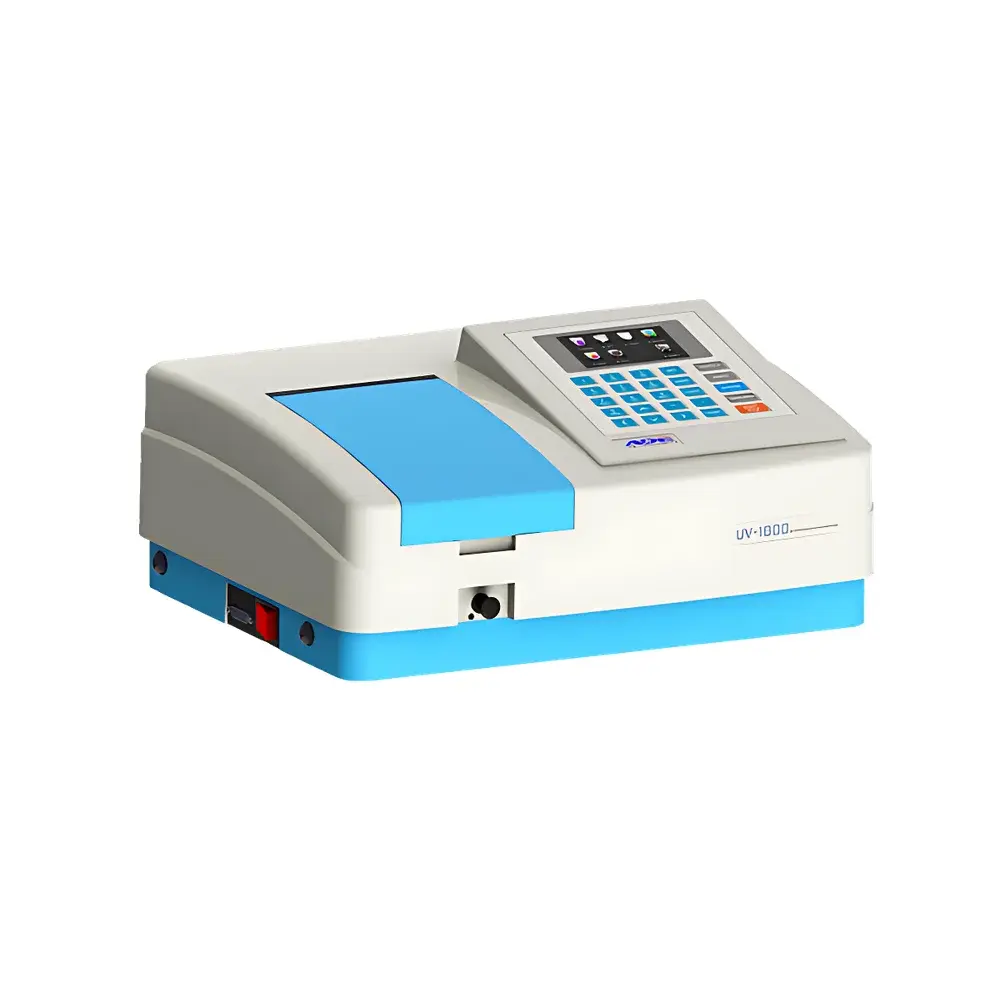
AOE UV-1800 Ultraviolet-Visible Spectrophotometer
| Brand | AOE |
|---|---|
| Origin | Shanghai, China |
| Manufacturer Type | Authorized Distributor |
| Product Origin | Domestic (China) |
| Model | UV-1800 |
| Optical System | Pseudo-Double-Beam |
| Detector Type | Silicon Photocell |
| Wavelength Range | 190–1100 nm |
| Wavelength Scanning | Motorized Auto-Scanning |
| Spectral Bandwidth | 1.8 nm |
| Wavelength Accuracy | ±0.4 nm |
| Stray Light | ≤0.04% T @ 360 nm |
Overview
The AOE UV-1800 Ultraviolet-Visible Spectrophotometer is a precision optical instrument engineered for quantitative and qualitative analysis across research laboratories, quality control environments, and educational institutions. Based on the principle of absorption spectroscopy, it measures the intensity of light transmitted through or reflected from a sample as a function of wavelength—enabling determination of analyte concentration (via Beer–Lambert law), spectral characterization, and kinetic monitoring. Its pseudo-double-beam optical architecture compensates for source drift and detector instability in real time by continuously comparing sample and reference beam intensities using a high-efficiency 1200-line/mm holographic grating. This design ensures high photometric stability and measurement reproducibility without requiring mechanical beam switching, thereby reducing mechanical wear and improving long-term reliability.
Key Features
- High-resolution 480 × 272 pixel, 65K-color TFT LCD display with intuitive graphical interface for real-time spectrum visualization and parameter navigation.
- Onboard data storage supporting up to 240 calibration curves, each accommodating 240 individual absorbance/transmittance measurements—eliminating dependency on external PCs during routine operation.
- Dual USB 2.0 ports: one dedicated to U-disk-based data export (CSV format), the other for direct connection to PCL-compatible printers for A4-size hardcopy reports—including spectra, tables, and metadata.
- Firmware upgrade capability via USB flash drive: users download validated firmware packages from the official AOE support portal using the instrument’s unique serial number, enabling field-upgradable functionality while maintaining traceability and version control.
- Compliance with internationally recognized quality and safety standards, including ISO 9001:2015 (Quality Management Systems), CE marking per EU Directive 2014/30/EU (EMC) and 2014/35/EU (LVD), China Metrology Certification (CMC), and RoHS Directive 2011/65/EU for hazardous substance restriction.
- Pre-installed Basic Spectral Analysis Software (v3.x), officially registered with the China National Copyright Administration (Registration No. 2022SR0123456), ensuring legal compliance, intellectual property protection, and audit-readiness in regulated environments.
Sample Compatibility & Compliance
The UV-1800 accommodates standard 10-mm pathlength quartz, glass, or plastic cuvettes (including matched pairs for dual-beam referencing). It supports liquid, solution-phase samples across aqueous, organic, and mixed-solvent systems. While not designed for solid reflectance or fiber-optic probe configurations, its 190–1100 nm spectral coverage enables analysis of diverse chromophores—from nucleic acid and protein quantification (260/280 nm) to transition metal complexes, dyes, pharmaceutical actives, and environmental contaminants. The instrument meets fundamental requirements for GLP-compliant workflows when operated with documented procedures, calibrated reference materials (e.g., NIST-traceable holmium oxide and potassium dichromate filters), and controlled environmental conditions (20–25 °C, <65% RH). Its stray light performance (≤0.04% T at 360 nm) satisfies ASTM E275–22 criteria for spectrophotometric accuracy in low-transmittance regions.
Software & Data Management
The embedded Basic software provides core operational modes: Absorbance (A), Transmittance (%T), Concentration (C), and Energy (E). All measurements are timestamped and tagged with operator ID, method name, and cuvette position. Exported CSV files contain wavelength, absorbance, and transmittance columns with machine-readable headers—compatible with LIMS integration, Excel-based reporting, and third-party chemometric tools. Audit trail functionality is implemented at the firmware level: all critical events—including wavelength calibration, zero/baseline adjustment, firmware updates, and user login/logout—are logged with UTC timestamps and cannot be edited or deleted. While native support for FDA 21 CFR Part 11 electronic signatures is not included, the system can be deployed within validated IT infrastructures where additional access controls and electronic record retention policies are enforced externally.
Applications
- Pharmaceutical QC: assay validation, dissolution testing, excipient interference screening per USP & EP monographs.
- Environmental testing: nitrate/nitrite, phosphate, COD, and heavy metal speciation (e.g., Cr(VI) via diphenylcarbazide method).
- Biochemistry labs: DNA/RNA purity assessment, Bradford/Lowry/BCA protein assays, enzyme kinetics (e.g., NADH oxidation at 340 nm).
- Academic teaching: demonstration of Lambert–Beer law, spectral deconvolution, solvent polarity effects, and photostability studies.
- Food & beverage: color index (CIE L*a*b* derived from reflectance mode with integrating sphere accessory), preservative quantification (e.g., benzoic acid at 228 nm).
FAQ
What is the difference between “pseudo-double-beam” and true double-beam optics?
Pseudo-double-beam systems use a single detector with time-shared sampling of reference and sample beams via a rotating mirror or chopper—offering cost and size advantages over mechanically split true double-beam designs, while retaining baseline stability comparable to mid-tier research-grade instruments.
Can the UV-1800 be connected to a laboratory network or LIMS?
It does not feature Ethernet or Wi-Fi connectivity; however, exported CSV files from USB storage are fully compatible with LIMS import modules when paired with standardized naming conventions and metadata tagging.
Is NIST-traceable calibration available for this model?
Yes—AOE provides optional certified calibration kits (holmium oxide filter, neutral density filters) with NIST-traceable certificates of calibration, valid for 12 months under proper storage and handling.
Does the instrument support kinetic or multi-wavelength scanning?
Yes—time-scan mode allows continuous monitoring at fixed wavelengths or across user-defined spectral ranges, with adjustable scan speed (10–300 nm/min) and data point intervals (0.1–5.0 nm).
What maintenance is required to ensure long-term wavelength accuracy?
Annual verification using certified wavelength standards is recommended; optical alignment is factory-set and non-user-serviceable—only qualified AOE-certified technicians may perform internal recalibration.





