
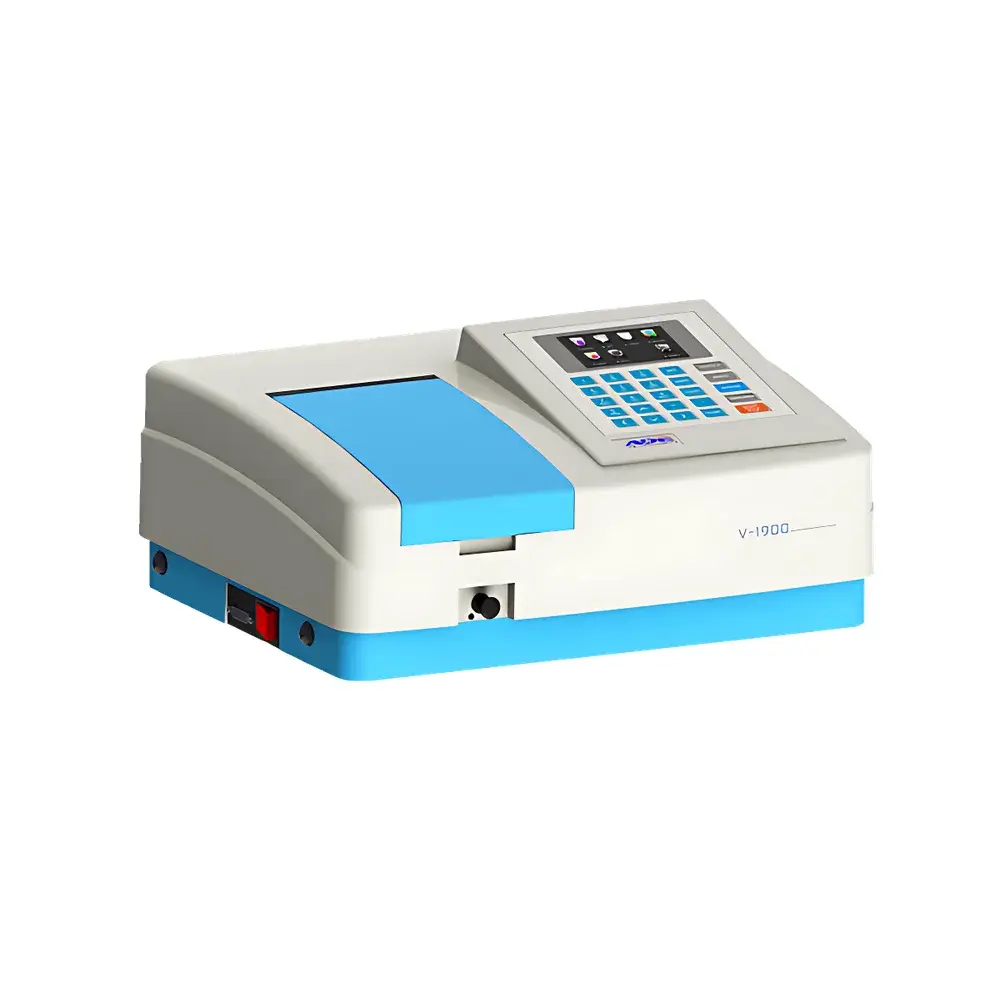
AOE V-1900PC Scanning Visible Spectrophotometer
| Brand | AOE |
|---|---|
| Origin | Shanghai, China |
| Manufacturer Type | Authorized Distributor |
| Product Origin | Domestic (China) |
| Model | V-1900PC |
| Optical System | Single-Beam with Dual-Beam Ratio Monitoring |
| Detector Type | Silicon Photocell |
| Wavelength Range | 320–1100 nm |
| Wavelength Accuracy | ±0.3 nm |
| Spectral Bandwidth | 1.8 nm |
| Stray Light | ≤0.04% T |
| Wavelength Scanning Mode | Automatic |
| Display | 480 × 272 pixel, 65K-color TFT LCD |
| Data Storage | 240 calibration curves (240 data points per curve) onboard |
| Interface | Dual USB 2.0 ports (data export & printer connection), USB 1.0 for PC communication |
| Software | AOE Basic Spectroscopy Software (certified under PRC Copyright Registration No. [redacted for privacy]) |
| Compliance | ISO 9001, CE, CMC, RoHS |
Overview
The AOE V-1900PC Scanning Visible Spectrophotometer is a precision single-beam spectrophotometric instrument engineered for routine quantitative and qualitative analysis in visible spectral regions. It employs a high-efficiency holographic grating (1200 lines/mm) coupled with dual-beam ratio monitoring to compensate for source intensity drift and detector response variation—effectively delivering the stability and reproducibility expected of mid-range laboratory-grade instrumentation without the complexity or cost of true double-beam optical architectures. Designed specifically for the 320–1100 nm wavelength range, the V-1900PC supports absorbance (A), transmittance (T), concentration (C), and energy (E) measurement modes, enabling standardized compliance with widely adopted analytical protocols including ASTM E380 (Standard Practice for Use of the International System of Units), ISO 6425 (spectrophotometric performance verification), and pharmacopeial methods requiring visible-range quantification (e.g., USP ).
Key Features
- True-color 480 × 272 pixel TFT LCD display with 65K-color rendering for intuitive graphical spectrum visualization and real-time baseline correction feedback
- Onboard memory supporting up to 240 independent calibration curves, each accommodating 240 absorbance or concentration data points—ideal for multi-analyte workflows in QC labs
- Dual USB 2.0 interfaces: one dedicated to direct U-disk data export (CSV format), the other configured for PCL-compatible A4 thermal or inkjet printers—eliminating dependency on external PCs for hardcopy reporting
- Firmware-upgradable architecture: authenticated firmware updates distributed via AOE’s official portal; installation performed via USB flash drive with checksum-verified integrity validation
- Optical train optimized for low stray light (<0.04% T at critical wavelengths such as 360 nm and 1000 nm), ensuring high dynamic range and reliable detection near absorption limits
- Compliance-certified software stack: AOE Basic Spectroscopy Software holds formal copyright registration with China’s National Copyright Administration, guaranteeing legal traceability and mitigating risks associated with unlicensed or modified firmware deployments
Sample Compatibility & Compliance
The V-1900PC accommodates standard 10 mm square quartz or glass cuvettes (pathlength: 10 mm), with optional holders available for 5 mm, 20 mm, and 50 mm pathlength cells. It supports liquid-phase transmission measurements only; no integrating sphere or solid-sample accessories are included in the base configuration. All electronic subsystems conform to IEC 61010-1:2010 (Safety Requirements for Electrical Equipment for Measurement, Control, and Laboratory Use), while electromagnetic compatibility meets EN 61326-1:2013 Class B specifications. Regulatory documentation—including CE Declaration of Conformity, CMC Metrological Certification (PRC), and RoHS 2011/65/EU compliance statements—is supplied with each unit and archived in AOE’s quality management system per ISO 9001:2015 clause 8.2.4.
Software & Data Management
AOE Basic Spectroscopy Software provides native support for method creation, kinetic scanning, time-based multi-wavelength tracking, and fixed-wavelength quantitation. Raw spectral data is stored in vendor-neutral CSV format, preserving wavelength (nm), absorbance (AU), and transmittance (%) columns with timestamp and instrument metadata. Audit trail functionality includes operator ID logging (via configurable user profiles), session start/stop timestamps, and change history for calibration parameters—all retained locally on the host PC and exportable for GLP/GMP-aligned review. While the software does not implement full 21 CFR Part 11 electronic signature controls, its design permits integration into validated laboratory information management systems (LIMS) via standardized file I/O and COM automation interfaces.
Applications
- Quantitative determination of transition metal ions (e.g., Fe²⁺/Fe³⁺, Cu²⁺, Cr⁶⁺) in environmental water samples per EPA Method 200.7 and ISO 11905-1
- Enzyme kinetics assays (e.g., NADH/NADPH oxidation at 340 nm) in academic and industrial biochemistry laboratories
- Colorimetric validation of dye concentrations in textile and pigment manufacturing QA processes
- Pharmaceutical excipient purity screening using compendial UV-Vis identification tests (e.g., Ph. Eur. 2.2.25)
- Educational use in undergraduate analytical chemistry curricula for Beer–Lambert law verification and spectral deconvolution exercises
FAQ
Is the V-1900PC compliant with FDA 21 CFR Part 11 requirements?
No—the instrument and its Basic Software do not include electronic signature, audit trail encryption, or role-based access control features required for full Part 11 compliance. However, exported CSV files may be incorporated into Part 11–validated LIMS environments.
Can the V-1900PC perform spectral scanning across the entire 320–1100 nm range in a single acquisition?
Yes—scan speed is adjustable (0.1–5.0 nm/s), with default resolution set to 1.0 nm step intervals; full-range scans require ≤15 minutes depending on smoothing and averaging settings.
What is the maximum allowable cuvette fill volume for accurate photometric measurement?
Cuvettes must be filled to at least 3.5 cm height (≥35 mm optical path) to ensure full beam illumination of the detection aperture; underfilling introduces significant edge-scatter error.
Does the instrument support external triggering or synchronization with third-party devices?
No—there is no TTL input/output port or LabVIEW driver support; all operations are initiated manually or via USB-hosted software commands.
How frequently should wavelength accuracy be verified according to manufacturer recommendations?
AOE recommends quarterly verification using NIST-traceable holmium oxide or didymium glass filters, with documented results retained for ISO/IEC 17025 internal audits.





