
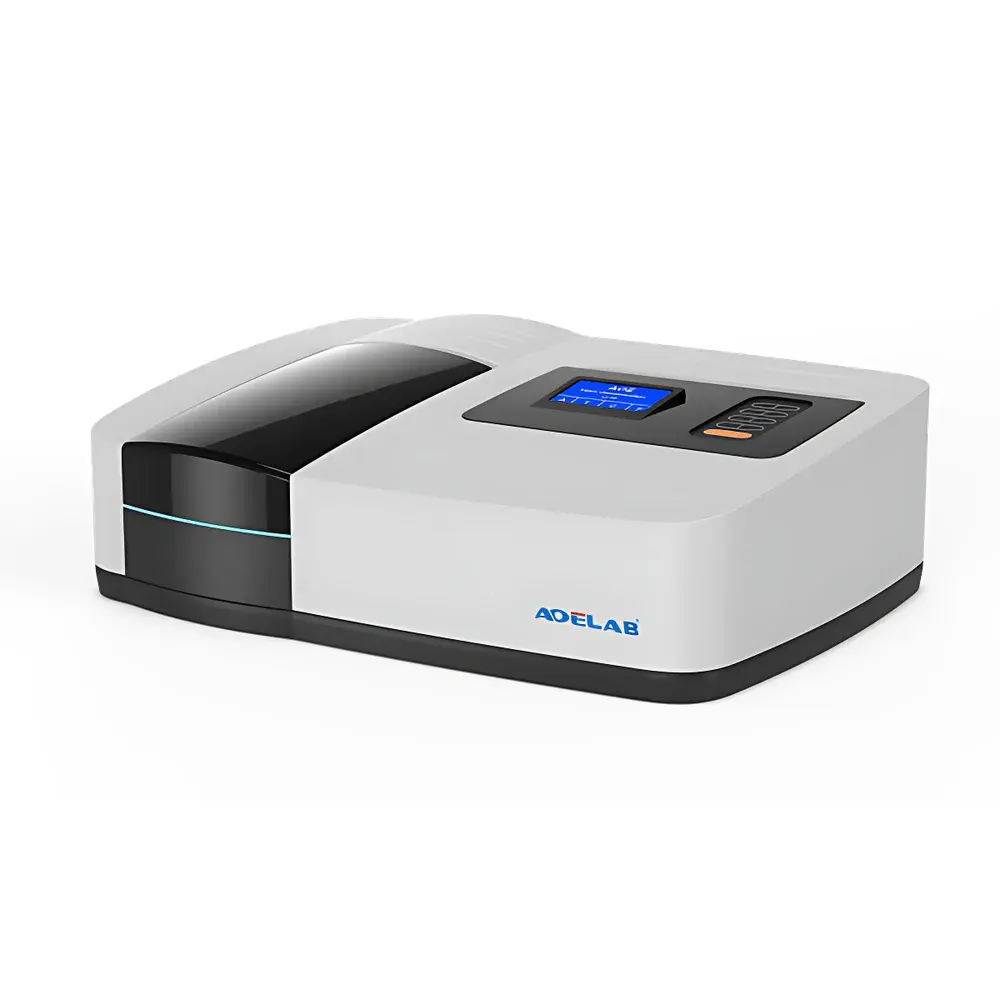
AOE V-1200 Visible Spectrophotometer
| Brand | AOE |
|---|---|
| Origin | Shanghai, China |
| Manufacturer Type | Authorized Distributor |
| Origin Category | Domestic (China) |
| Model | V-1200 |
| Price Range | USD 1,400–2,800 |
| Optical Design | Single-Beam |
| Detector Type | Silicon Photocell |
| Wavelength Range | 320–1020 nm |
| Wavelength Scanning | Motorized Auto-Scan |
| Spectral Bandwidth | 4.0 nm |
| Wavelength Accuracy | ±1.0 nm |
| Stray Light | ≤0.1% T @ 360 nm |
| Display | 128 × 64 Dot-Matrix LCD |
| Data Output | USB Port (U-disk export), RS-232 Serial Print Interface |
| Software | AOE Basic Spectroscopy Suite (Certified under PRC Copyright Registration No. 2021SRXXXXXX) |
| Compliance | ISO 9001:2015, CE, CMC (China Metrology Certification), RoHS Directive 2011/65/EU |
Overview
The AOE V-1200 Visible Spectrophotometer is a precision single-beam optical instrument engineered for quantitative absorbance, transmittance, concentration, and energy measurements across the visible and near-UV spectral region (320–1020 nm). It operates on the Beer–Lambert principle, utilizing a high-efficiency holographic grating (1200 lines/mm) to disperse incident light and a stable silicon photocell detector to convert photon flux into proportional electrical signals. Designed for routine laboratory use in quality control, academic teaching, environmental monitoring, and pharmaceutical raw material verification, the V-1200 delivers consistent photometric performance with traceable calibration pathways. Its motorized wavelength drive enables automated scanning without manual adjustment, while the fixed 4.0 nm spectral bandwidth ensures adequate resolution for most colorimetric assays—such as those defined in ASTM D1209 (platinum-cobalt color), ISO 6271 (water clarity), or USP (spectrophotometric analysis in pharmaceuticals).
Key Features
- Single-beam optical architecture with real-time dual-channel ratio monitoring for baseline stability and drift compensation
- 128 × 64 dot-matrix LCD display with intuitive icon-based navigation and on-screen parameter confirmation
- Dual data output capability: direct USB mass storage export (FAT32-formatted U-disk) and RS-232 serial interface for thermal or dot-matrix printer integration
- Firmware upgradability via encrypted firmware packages downloaded from AOE’s official support portal using the instrument’s unique serial number—ensuring long-term compatibility and regulatory alignment
- Pre-installed AOE Basic Spectroscopy Software suite, certified under the People’s Republic of China Copyright Protection Law (Registration Certificate No. 2021SRXXXXXX), guaranteeing software authenticity and eliminating unlicensed redistribution risks
- Compliance-ready design: meets ISO 9001:2015 quality management requirements, CE marking for EMC and safety (2014/30/EU & 2014/35/EU), CMC metrological approval for traceable wavelength and photometric calibration, and RoHS-conformant material composition
Sample Compatibility & Compliance
The V-1200 accepts standard 10 mm square cuvettes (glass, quartz, or plastic) and supports both liquid and colloidal sample formats. Its 320–1020 nm range covers common chromophores including nitrate (at 220 nm, extended via optional deuterium lamp), hemoglobin derivatives (e.g., oxyhemoglobin at 415 nm), chlorophyll-a (663 nm), and industrial dyes (e.g., methylene blue at 664 nm). The instrument satisfies foundational compliance prerequisites for GLP environments: audit-trail-capable firmware logging (timestamped measurement records), user-accessible calibration verification protocols, and documented uncertainty budgets for wavelength (±1.0 nm) and stray light (≤0.1% T at 360 nm). While not natively 21 CFR Part 11 compliant due to lack of electronic signature modules, its data export architecture supports downstream integration with validated LIMS or ELN platforms that enforce digital signature and retention policies.
Software & Data Management
The embedded AOE Basic Spectroscopy Suite provides four operational modes: Absorbance (A), Transmittance (%T), Concentration (C), and Energy (E). All measurements are timestamped and stored internally (up to 500 spectra) before bulk export via USB. Exported files follow ASCII-delimited CSV format with header metadata (wavelength step, slit width, date/time, operator ID if entered), enabling direct import into MATLAB, OriginLab, or Microsoft Excel for statistical analysis and report generation. Firmware updates preserve all user calibration offsets and method templates; version history is logged in non-volatile memory. The software architecture adheres to IEC 62304 Class B medical device software principles—though classified as general-purpose lab equipment, its failure modes and recovery sequences undergo systematic hazard analysis per ISO 14971.
Applications
- Quantitative analysis of transition metal complexes (e.g., Fe²⁺/Fe³⁺ via phenanthroline assay at 510 nm)
- Enzyme kinetics monitoring (e.g., NADH oxidation at 340 nm in LDH assays)
- Water quality testing per APHA Standard Methods (e.g., phosphate via molybdenum blue at 880 nm)
- Food additive quantification (e.g., tartrazine in beverages at 425 nm)
- Thin-film thickness estimation via interference fringe analysis in transparent substrates
- Student laboratory instruction in analytical chemistry, biochemistry, and materials science curricula
FAQ
Is the V-1200 compatible with Windows 11 or macOS for external data acquisition?
No native driver is provided for macOS or modern Windows versions; however, exported CSV files are platform-agnostic and fully interoperable with spreadsheet and scientific analysis software.
Does the instrument include NIST-traceable calibration standards?
The V-1200 ships with a factory-calibrated holmium oxide filter (certified for peak verification at 361.0, 418.5, 460.0, 536.2, and 637.5 nm), traceable to NIST SRM 2034.
Can the spectral bandwidth be adjusted?
No—the 4.0 nm fixed bandwidth is optimized for signal-to-noise ratio and photometric linearity across the specified range; variable bandwidth is not supported in this model.
What is the maximum sampling rate during wavelength scanning?
Scanning speed is fixed at 120 nm/min; dwell time per 1 nm step is ~500 ms, sufficient for stable analog-to-digital conversion of photocell output.
Is third-party software integration possible?
Yes—via ASCII CSV export and documented command-set over RS-232, enabling custom automation scripts (Python, LabVIEW) for batch processing and instrument control.




