
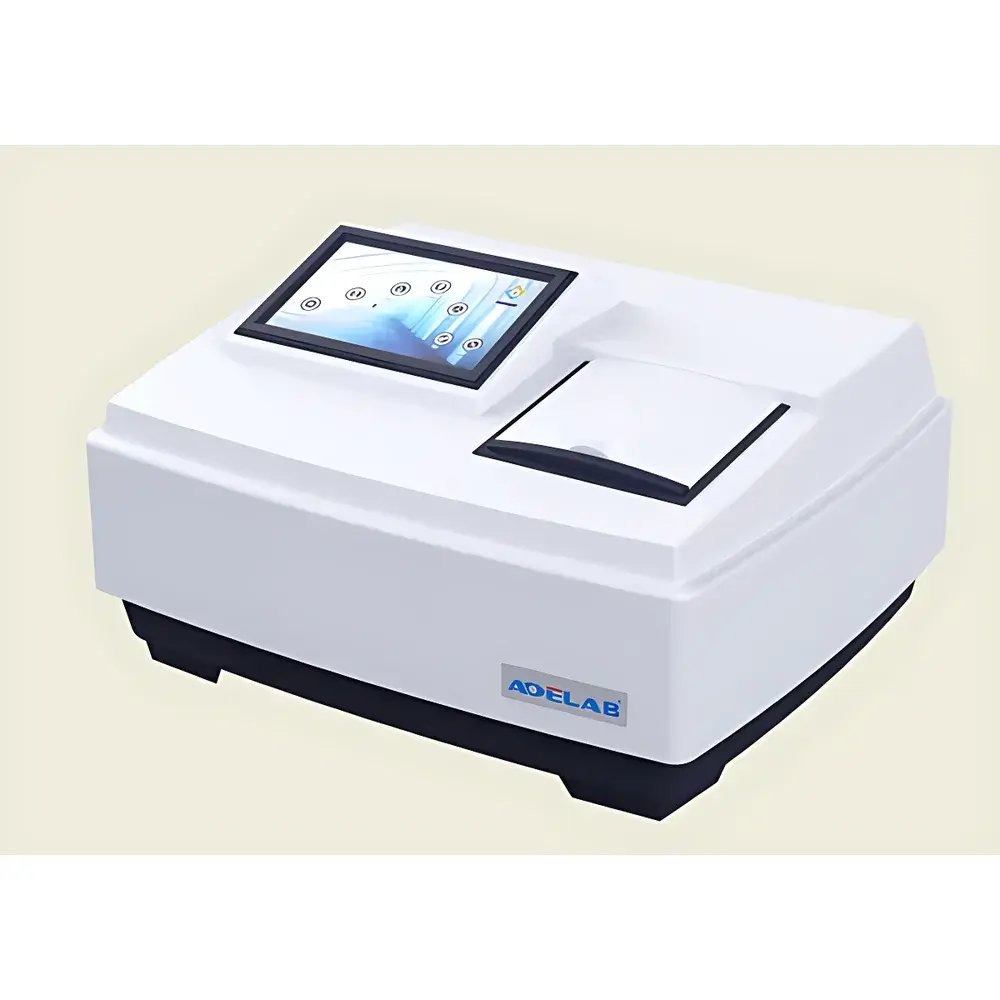
AOE X-200/X200S/X-201 Xenon-Pulsed UV-Vis Spectrophotometer
| Brand | AOE |
|---|---|
| Origin | Shanghai, China |
| Model | X-200 / X200S / X-201 |
| Optical System | Pseudo-Double-Beam |
| Detector | Photodiode Array (PDA) |
| Wavelength Range | 190–1100 nm |
| Wavelength Accuracy | ±0.2 nm |
| Spectral Bandwidth | 1.0 nm (X-200), 1.8 nm (X-201), 1.0/2.0/3.0/5.0 nm (X200S) |
| Stray Light | ≤0.01%T @ 220 nm & 360 nm |
| Photometric Accuracy | ±0.2%T |
| Photometric Repeatability | ≤0.08%T |
| Baseline Flatness | ±0.0005 Abs |
| Drift | 0.0004 Abs/h @ 500 nm |
| Noise | ±0.00008 Abs |
| Wavelength Scanning Speed | 31,800 nm/min |
| Data Point Resolution | 0.1–10 nm (selectable) |
| Display | 8-inch backlit capacitive touchscreen LCD |
| Operating System | WinCE 6.6 |
| Sample Holder | Standard automatic 6-cell rotating cuvette changer |
| Interface | USB, Ethernet, RS-232, Printer port |
| Connectivity | Wired LAN & optional Wi-Fi module |
| Firmware Update | USB-based one-click upgrade via instrument serial number |
Overview
The AOE X-200/X200S/X-201 is a high-performance, xenon-pulsed ultraviolet-visible spectrophotometer engineered for precision quantitative and qualitative analysis across academic, pharmaceutical, environmental, and industrial laboratories. Unlike conventional tungsten-halogen/deuterium lamp-based instruments, this system employs a solid-state pulsed xenon lamp as its broadband light source—eliminating warm-up time, minimizing thermal drift, and delivering stable spectral output over an extended operational lifetime (>10 years). Its pseudo-double-beam optical architecture incorporates an integrated reference photodetector to continuously monitor source intensity, enabling real-time compensation for lamp fluctuations and ensuring exceptional photometric stability. The instrument operates on the Seya-Namioka monochromator design—a proven, high-efficiency optical configuration optimized for signal-to-noise ratio and wavelength linearity across the full 190–1100 nm range.
Key Features
- Xenon Pulse Source Technology: No preheating required; consistent spectral irradiance from 190 nm (deep UV) to 1100 nm (NIR); low heat load on samples and optics.
- High-Resolution Touch Interface: 8-inch capacitive touchscreen LCD with intuitive WinCE 6.6 OS; supports multilingual input (including Unicode-compliant Chinese/English filenames) for direct UBS data export.
- Flexible Spectral Acquisition: Adjustable spectral bandwidth (1.0–5.0 nm), selectable data point resolution (0.1–10 nm), and rapid scanning speed up to 31,800 nm/min enable method optimization for kinetics, spectral deconvolution, or high-throughput screening.
- Robust Hardware Architecture: Automatic 6-position rotating sample holder with precise motorized positioning; dual-channel detection (sample + built-in reference) for enhanced baseline fidelity and long-term reproducibility.
- Enterprise-Ready Connectivity: Native support for USB host/device, Ethernet (TCP/IP), RS-232, and parallel printer interfaces; optional Wi-Fi module enables remote monitoring and integration into LIMS environments.
- Maintainable Firmware Ecosystem: Field-upgradable firmware via encrypted USB key using instrument-specific serial number authentication—ensuring compliance with internal software change control procedures.
Sample Compatibility & Compliance
The X-200 series accommodates standard 10-mm pathlength quartz, glass, or plastic cuvettes (including matched pairs for reference/sample dual-beam validation). Optional accessories include micro-volume adapters (down to 50 µL), integrating sphere modules for diffuse reflectance, and temperature-controlled cell holders (±0.1 °C). All models comply with ISO 9001 manufacturing standards and meet core performance criteria outlined in ASTM E275 (Standard Practices for Describing and Measuring Performance of UV-Vis Spectrophotometers) and ISO/IEC 17025 (General Requirements for the Competence of Testing and Calibration Laboratories). The embedded audit trail functionality—including user login timestamps, parameter modification logs, and raw data versioning—supports alignment with FDA 21 CFR Part 11 requirements when deployed in regulated QC/QA workflows under GLP or GMP frameworks.
Software & Data Management
Bundled AOE SpectraSuite software provides full instrument control, spectral acquisition, kinetic profiling, multi-wavelength quantitation, and custom calibration curve generation (linear, quadratic, cubic, or 4PL logistic). Data files are stored in vendor-neutral CSV and XML formats, ensuring interoperability with third-party analysis platforms such as MATLAB, Python (NumPy/Pandas), or JMP. Each exported dataset includes embedded metadata: instrument ID, operator name, date/time stamp, measurement mode, slit width, scan speed, and photometric scale. Internal memory is expandable via USB mass storage devices (up to 2 TB), with file naming governed by configurable templates supporting alphanumeric, Unicode, and timestamp variables. All firmware updates undergo SHA-256 signature verification prior to installation.
Applications
- Pharmaceutical assay development and release testing per USP <851> and EP 2.2.25
- Enzyme kinetics (e.g., NADH/NADPH oxidation at 340 nm) and protein quantification (Bradford, BCA, Lowry)
- Water quality analysis: nitrate (220 nm), phosphate (880 nm), COD (600 nm), and heavy metal chelates
- Nanoparticle characterization: gold/silver colloid size estimation via surface plasmon resonance peak analysis
- Food & beverage QA: colorimetric determination of anthocyanins, chlorophyll, carotenoids, and preservative concentrations
- Academic research: ligand-binding studies, equilibrium constant determination, and spectral library construction
FAQ
Does the instrument require lamp alignment or routine optical recalibration?
No—xenon pulse lamps emit stable, spatially uniform plasma arcs; the Seya-Namioka optical train is factory-aligned and sealed against mechanical drift. Wavelength accuracy is maintained via onboard holmium oxide and didymium glass reference filters (optional accessory).
Can the system be validated for use in regulated environments?
Yes—full IQ/OQ documentation packages are available upon request, including traceable calibration certificates (NIST-traceable standards), performance qualification protocols, and electronic record retention guidance compliant with ALCOA+ principles.
Is it possible to integrate the spectrophotometer with laboratory information management systems (LIMS)?
Yes—via Ethernet or RS-232, the instrument supports ASTM E1384 and HL7-compatible ASCII command sets for bidirectional data exchange, including auto-push of absorbance spectra and concentration results to central databases.
What maintenance is required beyond routine cleaning of the sample compartment and cuvette holder?
Annual preventive maintenance (PM) is recommended, focusing on detector dark-current verification, grating drive belt tension check, and optical bench dust inspection—no consumables or lamp replacements are needed within the first decade of operation.




