
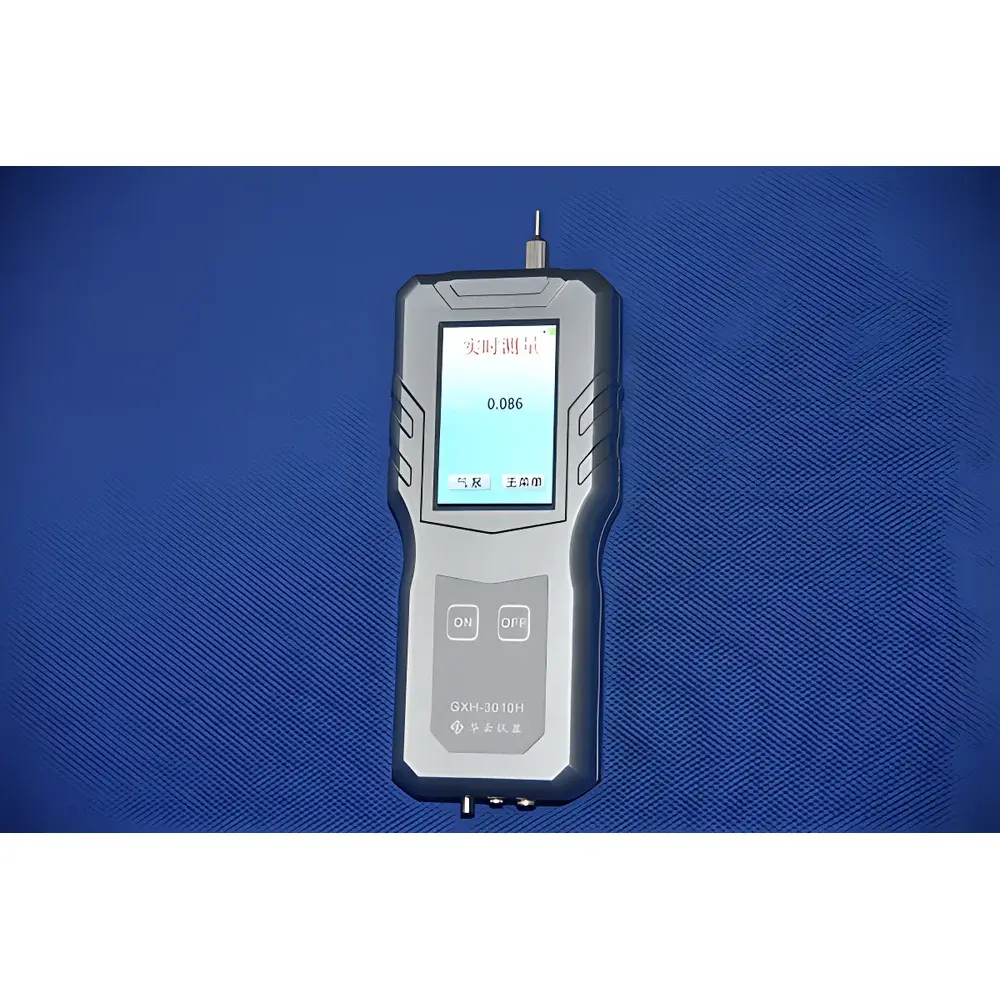
Huayun GXH-3010H Portable NDIR Carbon Dioxide Analyzer
| Brand | Huayun Instruments |
|---|---|
| Origin | Beijing, China |
| Manufacturer Type | Direct Manufacturer |
| Product Category | Domestic |
| Model | GXH-3010H (Latest Version) |
| Instrument Type | Portable |
| Detection Target | Single-component (CO₂) |
| Measurement Range | 0–0.500% CO₂ (v/v) |
| Repeatability | ≤1% FS |
| Resolution | 0.001% CO₂ |
| Response Time (t₀–t₉₀) | ≤15 s |
| Zero Drift | ≤±2% FS/h |
| Span Drift | ≤±2% FS/3 h |
| Linearity Error | ≤±2% FS |
| Operating Temperature Range | 10–45 °C |
| CO Interference Tolerance | ≤±0.3% FS at 1250 mg/m³ CO |
| Warm-up Time | ≤10 min |
| Sample Flow Rate | 0.5–1.0 L/min |
| Power Supply | Rechargeable Li-ion battery + AC adapter (220 VAC ±10%) |
| Dimensions | 200 × 95 × 35 mm |
| Weight | ≤500 g |
Overview
The Huayun GXH-3010H is a handheld, battery-powered carbon dioxide (CO₂) analyzer engineered for field-deployable, high-fidelity concentration measurement in ambient air and indoor environments. It employs non-dispersive infrared (NDIR) spectroscopy—the industry-standard optical method for selective, interference-resistant CO₂ quantification—based on the fundamental absorption band of CO₂ near 4.26 µm. Unlike electrochemical or metal-oxide sensors, NDIR detection delivers inherent stability, minimal cross-sensitivity, and long-term calibration integrity without consumable components. The instrument is designed to meet rigorous metrological requirements for environmental and occupational health applications, including compliance with GB/T 18204.2–2014 (Public Health Inspection Methods – Part 2: Chemical Pollutants), GBZ/T 300.37–2017 (Workplace Air Toxic Substances Determination – Part 37: CO and CO₂), and JJG 635–2011 (National Verification Regulation for Infrared CO/CO₂ Gas Analyzers). Its performance aligns with Class II accuracy specifications per Chinese national metrological standards, enabling traceable verification by provincial metrology institutes or the National Institute of Metrology (NIM).
Key Features
- Integrated zero-calibration filter and one-touch automatic zeroing function for rapid field recalibration without external gas standards
- High-resolution 3.5-inch color capacitive touchscreen interface with intuitive icon-driven navigation and real-time waveform display
- Onboard rechargeable lithium-ion battery supporting ≥8 hours of continuous operation; dual power mode (AC adapter + internal battery)
- Internal sampling pump with adjustable flow control (0.5–1.0 L/min) ensuring consistent draw-through measurement kinetics
- Ruggedized housing (200 × 95 × 35 mm, ≤500 g) optimized for handheld ergonomics and drop resistance in field use
- Temperature-compensated NDIR optical path with built-in thermal stabilization, limiting temperature-induced error to ≤±2% FS per 10 °C across 10–45 °C operating range
- Low CO interference specification: ≤±0.3% full scale under 1250 mg/m³ CO exposure—critical for combustion-related site assessments
Sample Compatibility & Compliance
The GXH-3010H is validated for direct measurement of CO₂ in unfiltered ambient air, indoor workplace air, ventilation ducts, greenhouses, and confined spaces. It is not intended for corrosive, condensing, or particulate-laden gas streams without optional particulate pre-filtration. All hardware and firmware comply with GB/T 18204.2–2014 Annex B (sampling and analysis protocol for CO₂ in public places) and GBZ/T 300.37–2017 Method A (direct-reading NDIR method for workplace CO₂). The device carries CPA (China Metrology Accreditation) certification, confirming conformity to national type-approval requirements for legal metrology. While not certified to ISO/IEC 17025 or FDA 21 CFR Part 11 out-of-the-box, its data logging architecture supports GLP/GMP-aligned documentation when paired with auditable external record-keeping protocols.
Software & Data Management
Data output is available via on-device storage (≥10,000 records) and USB-C export in CSV format. Timestamped readings include CO₂ concentration (% v/v), internal temperature, battery voltage, and pump status flags. No proprietary software is required for basic data retrieval; files are natively readable in Excel, Python (pandas), or LabVIEW. Firmware supports user-defined averaging intervals (1–60 s) and configurable alarm thresholds (audible + visual). Although the unit does not feature Bluetooth or Wi-Fi connectivity, its USB-C interface enables seamless integration into QA/QC workflows requiring raw data traceability. Calibration logs—including date, operator ID (manual entry), and zero/span verification results—are retained separately and exportable.
Applications
- Indoor air quality (IAQ) assessment in offices, schools, hospitals, and residential buildings per ASHRAE Standard 62.1 and China’s GB 50325–2020
- Occupational exposure monitoring in breweries, fermentation facilities, cold storage rooms, and welding zones
- Real-time validation of HVAC system performance and demand-controlled ventilation (DCV) logic
- Field verification of CO₂ scrubber efficiency and carbon capture pilot systems
- Educational demonstrations of gas laws, respiration physiology, and photosynthetic CO₂ uptake
- Pre-commissioning checks for cleanrooms and controlled-environment laboratories
FAQ
Does the GXH-3010H require external calibration gases?
No—zero calibration is performed internally using the integrated CO₂-scrubbing filter. Span calibration requires certified CO₂-in-N₂ standard gas (e.g., 0.250% or 0.500% v/v); recommended annually or after mechanical shock.
Can it measure CO₂ in high-humidity environments?
Yes—condensation is mitigated by heated sample path design and hydrophobic inlet filter (included); however, prolonged exposure to >90% RH may affect long-term zero stability.
Is the instrument suitable for outdoor ambient air monitoring?
Yes—its IP54-rated enclosure protects against dust and light splashing water; however, extended solar exposure above 45 °C may trigger thermal shutdown.
What is the expected service life of the NDIR sensor?
The pyroelectric detector and IR source are rated for ≥5 years under normal usage conditions; no routine replacement parts are specified in the design.
How is measurement uncertainty determined for regulatory reporting?
Total expanded uncertainty (k=2) is ≤±3.5% FS when combined with documented calibration uncertainty (±0.5% FS from NIM-traceable standard), temperature effects, and repeatability—fully compliant with GBZ/T 300.37–2017 reporting requirements.







