
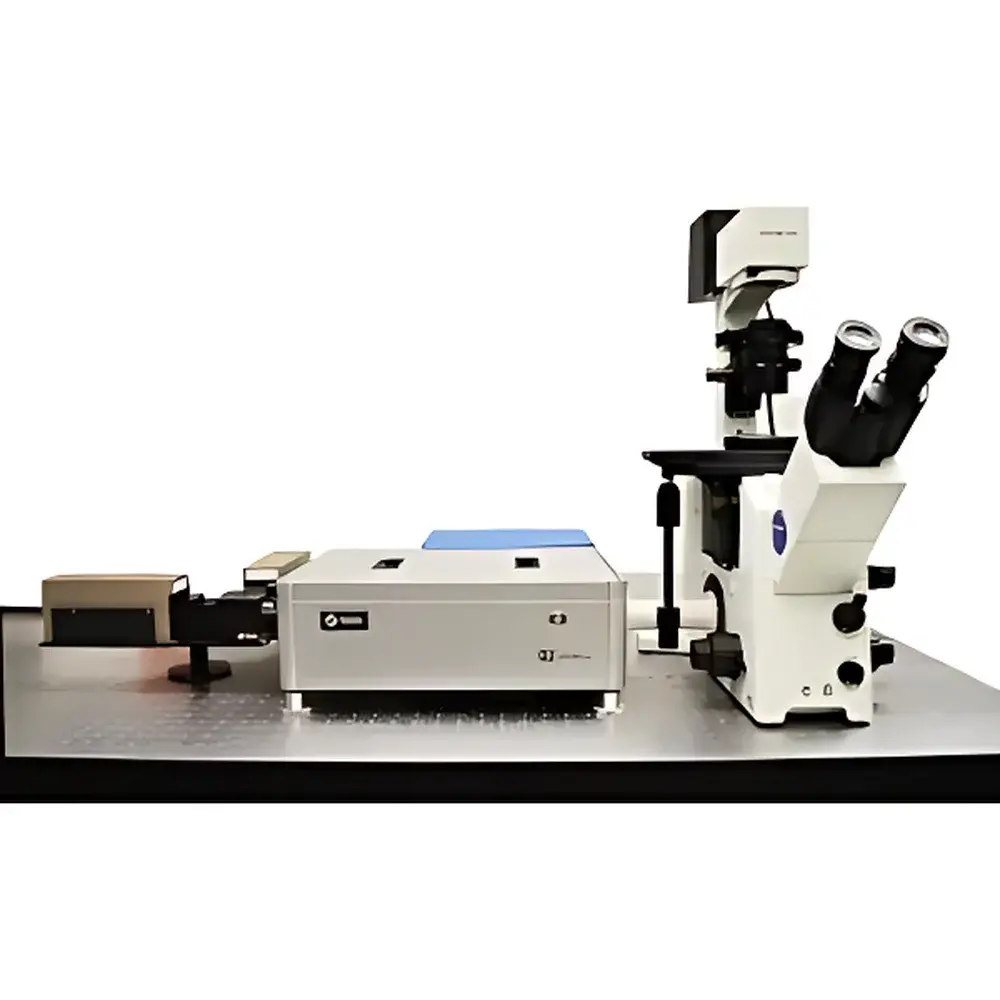
ISS Q2 Laser Scanning Confocal FLIM/FCS Microscopy System
| Brand | ISS |
|---|---|
| Origin | USA |
| Model | Q2 |
| Fluorescence Lifetime Range | 100 ps – 100 ms |
| Time Resolution | ≤1 ps |
| Counting Rate | 65 MHz/channel |
| Detection Channels | up to 8 |
| Scan Mode | Galvo-based XY scanning (5 kHz) with closed-loop motorized stage |
| Spatial Resolution | configurable from 1×1 to 4096×4096 pixels |
| Frame Rate | up to 20 fps @ 256×256 |
| Spectral Range (detection) | 350–1100 nm & 900–1700 nm |
| Excitation Options | UV–Vis–NIR lasers, supercontinuum source, single- or two-photon excitation |
| Temperature Control | 77 K – 500 K |
| Compliance | GLP/GMP-ready data audit trail, FDA 21 CFR Part 11–compatible software architecture |
Overview
The ISS Q2 Laser Scanning Confocal FLIM/FCS Microscopy System is a high-performance, time-resolved optical imaging platform engineered for quantitative fluorescence lifetime imaging microscopy (FLIM), phosphorescence lifetime imaging (PLIM), and fluorescence correlation spectroscopy (FCS)-based fluctuation analysis. Built upon a modular confocal architecture integrating galvanometric scanning, precision pinhole optics, and time-correlated single-photon counting (TCSPC), the system delivers sub-nanosecond temporal resolution across the full biologically and materially relevant lifetime domain—from 100 picoseconds to 100 milliseconds. Its core measurement principle relies on pulsed laser excitation combined with high-bandwidth photon timing electronics, enabling direct extraction of decay kinetics without iterative fitting in many cases via phasor plot transformation. Designed for rigorous research environments, the Q2 supports both single-photon and two-photon excitation modalities, deep-UV (down to 266 nm), NIR-II (up to 1700 nm), and upconversion luminescence detection—making it uniquely suited for studies of lanthanide-doped nanoparticles, quantum dots, organic semiconductors, and live-cell metabolic reporters.
Key Features
- Ultrafast TCSPC acquisition engine with ≤1 ps instrument response function (IRF) and 65 MHz per-channel counting capability
- Configurable multi-channel detection (up to 8 channels) with spectral separation across 350–1100 nm and extended NIR-II range (900–1700 nm)
- Galvo-based XY scanning at 5 kHz, synchronized with closed-loop motorized stage for seamless large-area mosaic imaging (e.g., tissue sections or multiwell plates)
- Real-time phasor plot generation enabling intuitive, fit-free visualization of lifetime heterogeneity and FRET efficiency distributions
- Integrated FCS/FFS module supporting autocorrelation (FCS), cross-correlation (FCCS), photon counting histogram (PCH), number & brightness (N&B), raster image correlation spectroscopy (RICS), fluorescence lifetime correlation spectroscopy (FLCS), and scan-FCS
- Modular excitation flexibility: selectable UV–Vis–NIR lasers, supercontinuum sources, and dual-beam alternating excitation (PIE) for smFRET
- Native compatibility with cryogenic (77 K) and elevated temperature (up to 500 K) stages, AFM integration (top- or inverted configuration), and live-cell incubation systems
Sample Compatibility & Compliance
The Q2 accommodates diverse sample formats—including single molecules immobilized on coverslips, live adherent or suspension cells in μ-Slide chambers or 96-well plates, thin tissue sections, nanomaterial dispersions, and solid-state optoelectronic thin films. Its optical design minimizes photodamage through optimized pulse energy delivery and gated detection, preserving viability during long-term FLIM-FRET or PLIM time-lapse experiments. From a regulatory standpoint, the system’s software framework conforms to GLP and GMP documentation requirements, featuring electronic signatures, full audit trails, and 21 CFR Part 11–compliant user access control and data integrity safeguards. All calibration routines—including IRF characterization, channel crosstalk correction, and spectral response normalization—are traceable to NIST-maintained standards and documented within the system log.
Software & Data Management
Acquisition and analysis are unified under ISS VistaVision™ software—a MATLAB-based, script-extensible platform supporting batch processing, ROI-based lifetime mapping, global decay fitting, and automated phasor clustering. Raw TCSPC histograms are stored in industry-standard .ptu format (PicoQuant), ensuring interoperability with third-party tools such as SymPhoTime, SPCImage, or custom Python workflows. The software includes built-in modules for FLIM-FRET quantification (including donor-only and acceptor-photobleaching controls), microenvironment polarity mapping via lifetime-ratiometric analysis, and spectral unmixing of multi-component emitters. Data export supports TIFF (with embedded metadata), CSV, HDF5, and MRC formats for structural biology pipelines. All processing steps are logged with timestamps, operator ID, and parameter sets to satisfy reproducibility and audit requirements.
Applications
- Live-cell protein–protein interaction dynamics via FLIM-FRET and PIE-smFRET
- Metabolic state mapping using NAD(P)H and FAD autofluorescence lifetimes
- Energy transfer mechanisms in perovskite solar cells and quantum dot heterostructures
- Upconversion nanoparticle biodistribution and intracellular trafficking
- Temperature- and pH-sensitive lifetime probes in microfluidic organ-on-chip devices
- Defect-state imaging in 2D materials (e.g., MoS₂, WS₂) via time-resolved photoluminescence
- Simultaneous topography–lifetime correlation in AFM-FLIM hybrid measurements
- Diffusion coefficient profiling and oligomerization state analysis via FCS in membrane nanodomains
FAQ
What lifetime ranges can the Q2 resolve, and how is accuracy ensured across this span?
The system achieves calibrated lifetime quantification from 100 ps to 100 ms using adaptive gate width adjustment, IRF deconvolution algorithms, and reference standard fluorophores (e.g., Rhodamine B, Coumarin 153). Accuracy is maintained via daily IRF validation and lifetime standard verification protocols.
Is the system compatible with existing inverted or upright microscopes?
Yes—the Q2 is delivered as a turnkey scanning unit with C-mount and RMS-thread interfaces, enabling straightforward integration onto Nikon Ti, Olympus IX, Zeiss Axio, or Leica DM series frames.
Can the software support automated analysis for high-throughput screening applications?
VistaVision™ includes macro scripting (via MATLAB API) and batch-mode operation for plate-based FLIM assays, including auto-focus, well-centering, and ROI-based lifetime histogram generation.
Does the system support spectral FLIM (i.e., wavelength-resolved lifetime mapping)?
Yes—integrated spectrograph coupling enables simultaneous acquisition of lifetime decay curves across 400–1100 nm with 2 nm spectral resolution, facilitating ratiometric lifetime analysis and component decomposition.
What service and calibration support is provided post-installation?
ISS offers annual performance verification, on-site IRF recalibration, software updates, and remote diagnostics under optional Platinum Support contracts aligned with ISO/IEC 17025 traceability requirements.




