
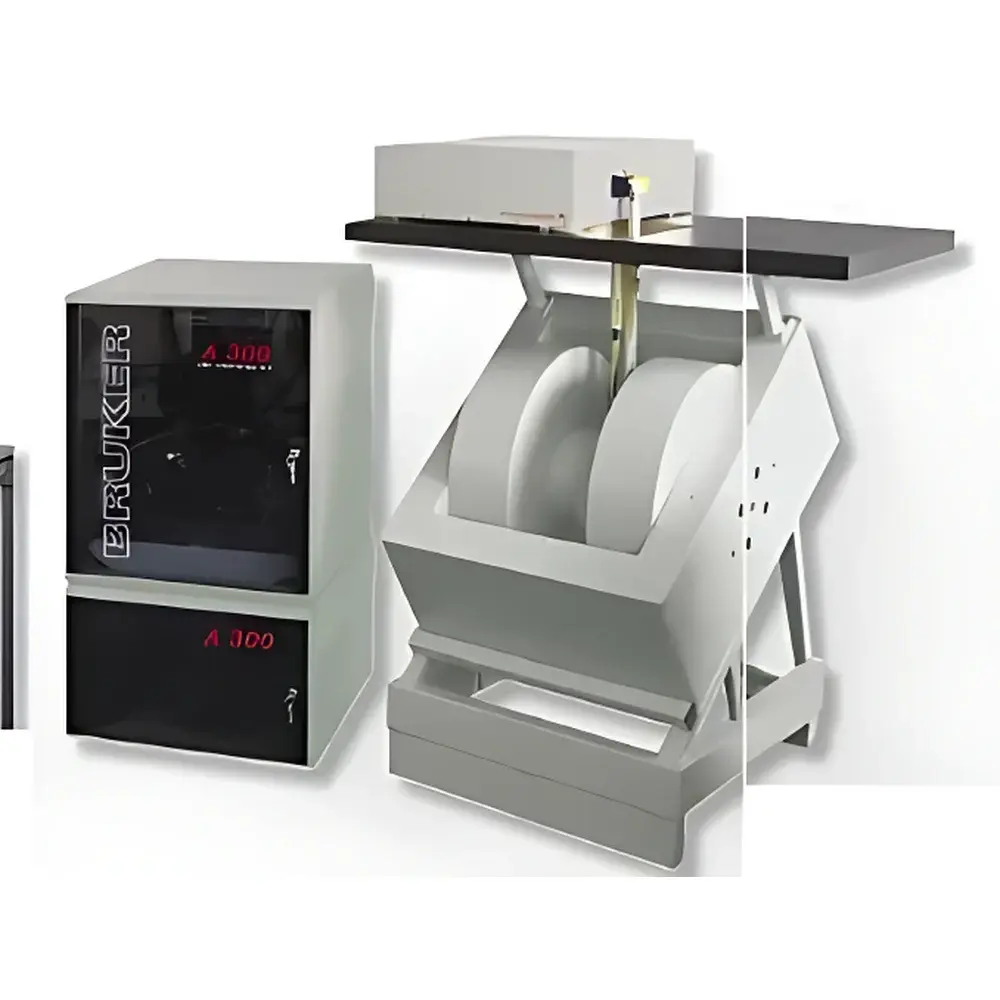
Bruker A300/A200 Continuous-Wave Electron Paramagnetic Resonance (EPR) Spectrometer
| Brand | Bruker |
|---|---|
| Origin | Germany |
| Model | A300/A200 |
| Instrument Type | Continuous-Wave (CW) EPR |
| Design Architecture | A300 – Modular Benchtop System |
| Regulatory Compliance | Designed for GLP/GMP-aligned laboratories |
| Software Framework | Bruker Xenon™ EPR Software Suite |
| Hardware Interface | Digital Signal Processing (DSP) Architecture with Real-Time Data Acquisition |
Overview
The Bruker A300/A200 Continuous-Wave Electron Paramagnetic Resonance (EPR) Spectrometer represents the latest generation of benchtop EPR instrumentation engineered for rigorous academic research, industrial quality control, and applied materials characterization. Based on the well-established cavity-based CW-EPR detection principle—where unpaired electrons in paramagnetic species absorb microwave radiation under a static magnetic field—the A-series delivers quantitative spin detection with high signal-to-noise ratio and reproducible field calibration. Developed by Bruker’s EPR division—the team responsible for establishing the foundational hardware and software standards in modern EPR over the past 25 years—the A300 and A200 are purpose-built to bridge accessibility and performance. The A300 adopts a modular architecture, allowing users to configure resonators, magnet systems, temperature controllers, and accessories according to evolving experimental needs. In contrast, the A200 integrates core components—including superconducting magnet, microwave bridge, and cavity—into a space-efficient, factory-aligned platform ideal for routine analysis and teaching laboratories where footprint and operational simplicity are prioritized.
Key Features
- Digital signal processing (DSP) engine enabling real-time spectral averaging, phase-sensitive detection, and baseline correction without external lock-in amplifiers
- High-stability X-band (9–10 GHz) microwave system with automatic frequency tuning and cavity Q-factor optimization
- Integrated electromagnet with field homogeneity better than 0.01 mT over 10 mm DSV (Diameter Spherical Volume)
- Modular resonator options including standard rectangular TE102, high-sensitivity cylindrical TE011, and low-volume capillary cells for limited sample quantities
- Temperature control compatibility from 80 K to 500 K via liquid nitrogen cryostat or variable-temperature insert (VTI), supporting kinetic and thermodynamic EPR studies
- Bruker Xenon™ software platform with intuitive workflow-driven interface, automated parameter optimization, and built-in simulation tools based on Spin Hamiltonian formalism
Sample Compatibility & Compliance
The A300/A200 supports a broad range of physical states: aqueous and organic solutions, frozen glasses, powders, thin films, catalysts, polymers, and biological macromolecules—including spin-labeled proteins and membrane-bound radicals. Sample formats include standard quartz EPR tubes (3 mm and 4 mm OD), flat cells, and custom holders for in situ electrochemical or gas-phase experiments. All hardware modules comply with IEC 61000-6-3 (EMC emission standards) and IEC 61010-1 (safety requirements for laboratory equipment). Data acquisition workflows support audit-trail generation and electronic signatures per FDA 21 CFR Part 11 when deployed in regulated environments. Instrument qualification documentation—including IQ/OQ templates—is available to facilitate compliance with ISO/IEC 17025, ASTM E1226 (standard test method for determination of g-values), and USP (Electron Paramagnetic Resonance Spectroscopy).
Software & Data Management
Xenon™ provides a unified environment for instrument control, spectral acquisition, post-processing, and reporting. Core capabilities include multi-scan accumulation with drift correction, derivative spectrum generation, peak integration, lineshape deconvolution (Lorentzian/Gaussian mixing), and g-value mapping across spatially resolved measurements. Raw data is stored in Bruker’s proprietary binary format (.DTA/.SPE) with embedded metadata (field sweep parameters, microwave power, modulation amplitude, time stamps). Export options include ASCII, CSV, and JCAMP-DX for interoperability with third-party analysis tools such as EasySpin (MATLAB) and SimFonia. The software architecture supports networked deployment, remote monitoring via secure HTTPS, and integration into LIMS environments through standardized API endpoints.
Applications
- Free radical identification and quantification in pharmaceutical stability testing and oxidative degradation pathways
- Transition metal speciation (e.g., Cu2+, Mn2+, Fe3+) in catalytic materials and battery electrode interfaces
- Spin trapping studies of short-lived reactive oxygen species (ROS) in biological and environmental matrices
- Defect characterization in semiconductors, glasses, and irradiated polymers
- Time-resolved EPR for photoinduced electron transfer processes in solar cell materials
- Quality assurance of paramagnetic impurities in high-purity chemicals and excipients
FAQ
What is the difference between the A300 and A200 configurations?
The A300 is a modular system permitting flexible expansion with optional resonators, temperature units, and auxiliary detectors; the A200 is a pre-integrated platform optimized for rapid setup and minimal maintenance.
Does the system support pulsed EPR experiments?
No—the A300/A200 is designed exclusively for continuous-wave (CW) EPR operation. Pulsed EPR capabilities require Bruker’s EMXplus or ELEXSYS platforms.
Can the instrument be upgraded for in situ reaction monitoring?
Yes—both models support gas-handling modules, electrochemical cells, and flow-through sample holders compatible with real-time kinetic EPR studies.
Is Xenon™ software compatible with Windows 11 and 64-bit architectures?
Yes—Xenon™ v5.0 and later versions are validated on Windows 10/11 (64-bit), with support for multi-core CPU utilization and GPU-accelerated spectral rendering.
What level of technical support and service coverage is provided?
Bruker offers global service contracts including preventive maintenance, remote diagnostics, application consulting, and on-site engineer dispatch—aligned with ISO 9001-certified service delivery protocols.





