
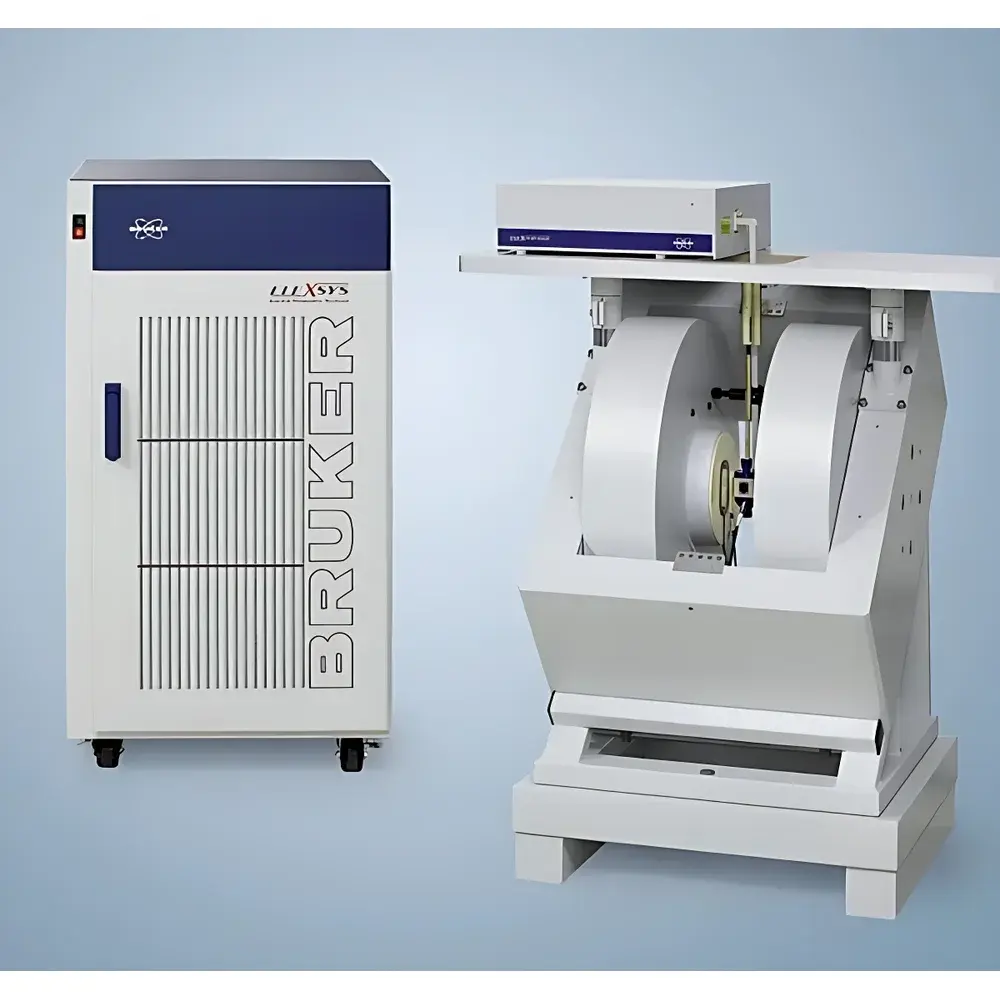
Bruker ELEXSYS II Series Electron Spin Resonance (EPR) Spectrometer
| Brand | Bruker |
|---|---|
| Origin | Germany |
| Manufacturer Type | Authorized Distributor |
| Product Origin | Imported |
| Model | ELEXSYS II |
| Pricing | Upon Request |
| Instrument Type | Continuous-Wave (CW) |
| Frequency Range Capability | 1 GHz to 263 GHz (CW and/or FT modes) |
| Optional Modules | DICE-II ENDOR, EPR Imaging, Pulsed FT-EPR, Multi-Frequency Resonators |
| Software Architecture | Open, Network-Enabled Client/Server Platform |
| Compliance Framework | Designed for GLP/GMP-aligned workflows |
Overview
The Bruker ELEXSYS II Series Electron Spin Resonance (EPR) Spectrometer is a high-performance, modular research platform engineered for quantitative detection and characterization of paramagnetic species—including transition metal ions, organic radicals, radiation-induced defects, and triplet states—in solid, liquid, frozen solution, and gas-phase samples. Based on the fundamental principles of magnetic resonance—where unpaired electrons absorb microwave radiation under a precisely controlled static magnetic field—the ELEXSYS II delivers exceptional spectral resolution, sensitivity, and experimental flexibility across both continuous-wave (CW) and pulsed Fourier-transform (FT) modalities. Its architecture supports operation from L-band (1–2 GHz) up to sub-millimeter W-band (94 GHz) and high-field G-band (263 GHz), enabling advanced studies of g-anisotropy, hyperfine coupling, zero-field splitting, and relaxation dynamics. Designed for academic, pharmaceutical, and industrial R&D laboratories, the system provides a foundation for mechanistic studies in catalysis, materials science, radiation chemistry, structural biology, and oxidative stress research.
Key Features
- Modular frequency scalability: Native CW operation from 1 GHz to 263 GHz; optional upgrade paths to pulsed FT-EPR, ENDOR, and EPR imaging.
- DICE-II ENDOR interface: Enables high-resolution electron-nuclear double resonance experiments with digital pulse control and phase cycling for artifact suppression.
- Open software architecture: Xepr software suite features fully scriptable acquisition, real-time data processing, and vendor-neutral data export (e.g., ASCII, HDF5).
- Client/server network deployment: Supports concurrent multi-user access with role-based permissions (e.g., operator, method developer, administrator), ensuring workflow integrity in shared-core facilities.
- Advanced resonator portfolio: Includes dielectric, split-ring, cylindrical, and surface coil geometries optimized for sensitivity, sample volume constraints, and temperature range (3.5 K to 500 K).
- Real-time instrument control: Hardware abstraction layer enables synchronized microwave, magnetic field, and temperature modulation with sub-millisecond timing precision.
Sample Compatibility & Compliance
The ELEXSYS II accommodates diverse sample formats—including capillaries, quartz tubes, flat cells, and custom holders—with compatibility across cryogenic (liquid He/Ne), variable-temperature (VT), and in situ electrochemical or gas-flow environments. All hardware and firmware components comply with IEC 61000-6-3 (EMC) and IEC 61010-1 (safety) standards. When configured with validated software modules, electronic signatures, and audit trail logging, the system supports compliance with Good Laboratory Practice (GLP) and current Good Manufacturing Practice (cGMP) frameworks. Integration with laboratory information management systems (LIMS) is achievable via standard APIs and OPC UA protocols, facilitating traceability in regulated environments governed by FDA 21 CFR Part 11 or EU Annex 11.
Software & Data Management
Xepr software serves as the unified control and analysis environment for the ELEXSYS II platform. It implements a hierarchical permission model aligned with ISO/IEC 27001-informed IT governance practices. Acquisition scripts support automated parameter sweeps (e.g., field, power, modulation amplitude), while post-processing tools include spectral simulation (via SpinCount and EasySpin), time-domain fitting (for relaxation analysis), and multivariate decomposition (e.g., MCR-ALS). Raw data are stored in vendor-agnostic formats with embedded metadata (instrument settings, calibration history, user annotations), ensuring long-term interpretability and FAIR (Findable, Accessible, Interoperable, Reusable) data principles.
Applications
- Catalysis: Identification and quantification of active paramagnetic sites in heterogeneous catalysts under operando conditions.
- Pharmaceutical stability: Detection of radical intermediates in photolytic or thermal degradation pathways of APIs.
- Materials science: Defect characterization in semiconductors, batteries, and quantum materials (e.g., NV centers, Si vacancies).
- Structural biology: Distance measurements via DEER/PELDOR at Q-/W-band for membrane protein conformational analysis.
- Radiation dosimetry: Quantitative EPR signal integration in alanine or tooth enamel for retrospective dose reconstruction.
- Environmental chemistry: Speciation of Mn(II), Fe(III), and Cu(II) complexes in soil and aqueous matrices.
FAQ
What frequency bands does the ELEXSYS II support natively?
The base ELEXSYS II platform operates in CW mode across L-, S-, X-, Q-, W-, and G-bands (1–263 GHz); pulsed FT capability requires optional module installation and resonator-specific configuration.
Can the system be upgraded from CW-only to pulsed EPR after purchase?
Yes—hardware and software upgrades for FT-EPR, ENDOR, and imaging are available as field-installable kits, subject to magnet and microwave bridge compatibility assessment.
Is Xepr software compatible with Windows Server and Linux-based HPC clusters?
Xepr acquisition runs exclusively on Windows 10/11 (64-bit); however, batch processing, simulation, and data analysis modules support Linux via command-line interfaces and Docker containers.
Does the system meet regulatory requirements for quality-controlled environments?
When deployed with documented validation protocols, electronic signature modules, and audit-trail-enabling configurations, the ELEXSYS II meets technical prerequisites for FDA 21 CFR Part 11 and EU GMP Annex 11 compliance.
What level of technical support is provided for method development?
Bruker offers application-specific training, remote method optimization sessions, and collaborative project support through its global network of EPR Application Scientists and regional Support Centers.




