

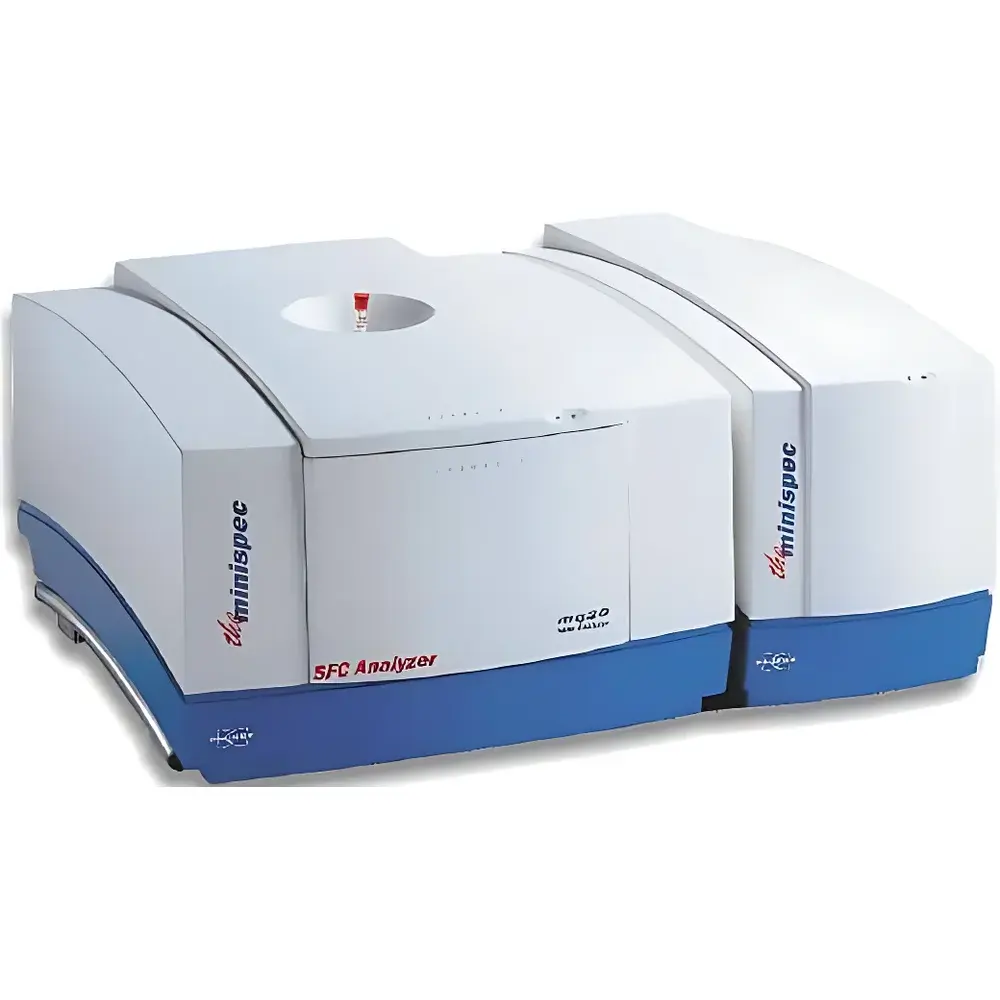
Bruker minispec TD-NMR Analyzer for Oil and Moisture Content in Seeds, Nuts & Oilseeds
| Brand | Bruker |
|---|---|
| Origin | Germany |
| Model | minispec (mq-series platform) |
| Measurement Principle | Time-Domain Nuclear Magnetic Resonance (TD-NMR) |
| Sample Tube Options | 10 mm (mq40), 40 mm (mq-one), 50 mm (mq7.5) |
| Compliance | ASTM D8139, ISO 10565, AOAC 994.01, USP <1210> |
| Data Integrity | Audit trail-enabled software compliant with FDA 21 CFR Part 11 requirements for regulated QC/QA environments |
| Calibration | Minimal reference sample calibration |
Overview
The Bruker minispec TD-NMR Analyzer is a benchtop time-domain nuclear magnetic resonance instrument engineered for rapid, non-destructive quantification of oil and moisture content in intact seeds, nuts, oilseeds, and processed feedstocks such as soybean meal and rapeseed cake. Unlike wet chemistry or solvent extraction methods, the minispec relies on the intrinsic physical property of nuclear spin relaxation—specifically, the distinct transverse relaxation times (T₂) of hydrogen protons bound in water versus those in triglyceride oil molecules. This fundamental contrast enables precise spectral deconvolution and independent quantification without sample homogenization, drying, or chemical digestion. The system operates at a fixed Larmor frequency of 23.5 MHz (0.55 T magnetic field), optimized for high signal-to-noise ratio in heterogeneous biological matrices. Its robust permanent magnet architecture ensures long-term field stability, minimal maintenance, and insensitivity to ambient temperature fluctuations—critical for routine laboratory and production-floor deployment.
Key Features
- Non-invasive measurement: Analyzes whole, unground samples—including thick-shelled nuts (e.g., walnuts, macadamias) and intact oilseeds (e.g., sunflower, castor)—without physical preparation or mass loss.
- Multi-tube platform flexibility: Configurable with three standardized probe geometries—mq40 (10 mm tube, ideal for single-seed analysis in breeding programs), mq-one (40 mm tube, optimized for bulk seed screening), and mq7.5 (50 mm tube, designed for high-throughput industrial QA).
- Calibration efficiency: Requires only 3–5 reference samples per material type; calibration models are transferable across instruments within the minispec family using Bruker’s proprietary QuantTools™ algorithm suite.
- Regulatory-ready operation: Software includes electronic signatures, user access levels, change control logs, and full audit trails—fully aligned with GLP, GMP, and FDA 21 CFR Part 11 data integrity requirements.
- Reproducibility: Typical coefficient of variation (CV) < 1.2% for oil content in homogeneous seed lots; < 2.0% for heterogeneous nut batches under standard operating conditions.
Sample Compatibility & Compliance
The minispec accommodates natural variability in size, shape, color, and surface morphology—eliminating bias introduced by optical or near-infrared methods. It is validated for use with raw and roasted peanuts, almonds, cashews, sesame, flaxseed, hemp seed, soybean meal, cottonseed cake, and castor beans. Method equivalence has been demonstrated against reference standards including AOAC Official Method 994.01 (oil in oilseeds), ISO 10565 (oil and water in oilseeds), and ASTM D8139 (TD-NMR determination of oil content in oilseeds). All mq-series configurations meet IEC 61000-6-3 EMC emission standards and carry CE marking for European Union conformity.
Software & Data Management
Controlled via Bruker’s minispec Analysis Studio v4.x, the system provides intuitive workflow management—from pulse sequence selection (CPMG, inversion recovery) to automated T₂ distribution fitting and component-specific integration. Raw FID data, relaxation spectra, and quantitative reports are stored in vendor-neutral HDF5 format. Integrated export modules support direct transfer to LIMS platforms (e.g., LabWare, Thermo Fisher SampleManager) via ODBC or REST API. Batch reporting includes statistical summaries (mean, SD, CV, min/max), trend charts over time, and outlier detection based on Mahalanobis distance scoring.
Applications
- Quality control in edible oil processing: Real-time verification of oil yield pre- and post-expelling; monitoring moisture ingress during storage.
- Breeding program support: High-sensitivity phenotyping of single castor or linseed embryos using the mq40 configuration.
- Feed formulation: Rapid assessment of energy density (via oil content) and spoilage risk (via moisture) in soybean and canola meals.
- Regulatory compliance testing: Submission-ready reports for USDA, EFSA, and CFIA audits—traceable to certified reference materials (CRMs) from NIST and IRMM.
- Research applications: Investigation of lipid oxidation kinetics through longitudinal T₂ decay profiling under accelerated aging conditions.
FAQ
Does the minispec require cryogens or external cooling?
No. The permanent magnet design operates at ambient temperature with no liquid helium or nitrogen consumption.
Can it distinguish between free water and bound water?
Yes—multi-exponential T₂ analysis resolves at least three relaxation components, enabling differentiation of free water, hydration-layer water, and oil-bound protons.
Is method validation support available from Bruker?
Yes. Bruker provides IQ/OQ/PQ documentation templates, validation protocols aligned with ISO/IEC 17025, and on-site qualification services.
What is the typical analysis time per sample?
Ranging from 30 seconds (screening mode) to 3 minutes (high-precision mode), depending on signal averaging and required precision.
How often does the system require recalibration?
Calibration stability exceeds 12 months under routine use; annual verification with traceable CRMs is recommended for regulated environments.



