
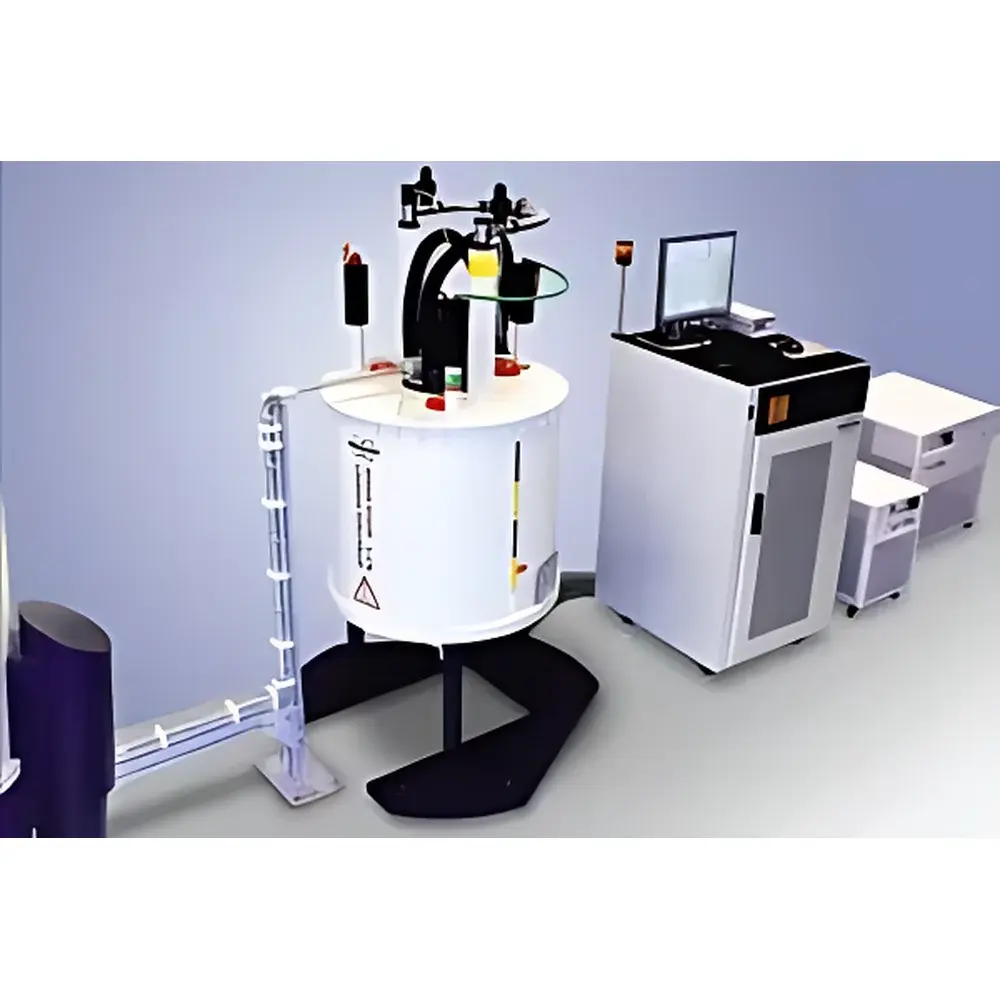
Bruker DNP-NMR System for Solid-State NMR Spectroscopy
| Brand | Bruker |
|---|---|
| Origin | Switzerland |
| Model | DNP-NMR |
| Field Strength Options | 263 GHz / 395 GHz (corresponding to ~9.4 T and ~14.1 T for ¹H, respectively) |
| Sample Type | Solid-state and semi-solid biological macromolecules |
| Operating Temperature | ~100 K |
| Microwave Power Source | High-power gyrotron |
| Sensitivity Enhancement | 20–80× over conventional ssNMR |
| Probe Type | Cryogenic Magic Angle Spinning (MAS) probe |
| Compliance | Designed for GLP/GMP-aligned workflows with audit-trail-capable data acquisition |
Overview
The Bruker DNP-NMR System represents the world’s first commercially deployed dynamic nuclear polarization (DNP) platform engineered specifically for solid-state nuclear magnetic resonance (ssNMR) spectroscopy. Built upon Bruker’s high-field superconducting magnet infrastructure and integrated with proprietary gyrotron-based microwave excitation at 263 GHz and 395 GHz, this system enables unprecedented signal-to-noise ratio (SNR) gains—routinely delivering 20× to 80× sensitivity enhancement over conventional ssNMR experiments. The core principle relies on transferring electron spin polarization from a stable biradical polarizing agent (e.g., AMUPol or TEKPol) to nearby nuclear spins (primarily 1H, 13C, 15N) via microwave irradiation under cryogenic MAS conditions (~100 K). This polarization transfer dramatically shortens experiment time—reducing acquisition from days to hours—and unlocks structural and dynamic characterization of previously intractable biomolecular systems, including membrane proteins, amyloid fibrils, and large protein complexes.
Key Features
- Integrated high-power gyrotron sources operating at 263 GHz and 395 GHz, delivering stable, tunable, and low-noise microwave irradiation with active thermal management for continuous-duty DNP operation
- Cryogenic MAS probe architecture featuring helium-cooled sample spinning at 10–15 kHz, optimized for thermal stability and minimal microwave-induced heating
- Full compatibility with Bruker’s AVANCE-IV and NEO console platforms, supporting advanced pulse sequences such as DARR, PDSD, RFDR, and DNP-enhanced 3D/4D correlation experiments
- Automated temperature control (70–120 K range) with real-time monitoring and closed-loop regulation for reproducible polarization buildup kinetics
- Modular design allowing seamless integration with existing 400–1000 MHz NMR spectrometers and field-cycling accessories
- Electron paramagnetic resonance (EPR) monitoring capability for in situ optimization of microwave frequency and power during polarization build-up
Sample Compatibility & Compliance
The DNP-NMR System is validated for heterogeneous, non-crystalline, and isotopically labeled biological samples—including insoluble membrane proteins reconstituted in lipid bilayers, fibrillar aggregates, and native cellular extracts. Sample preparation follows established protocols for radical doping (0.5–20 mM), rapid freezing, and cryogenic handling. All hardware and software components comply with IEC 61000-6-3 (EMC) and IEC 61000-6-4 (industrial emission) standards. Data acquisition supports ALCOA+ principles (Attributable, Legible, Contemporaneous, Original, Accurate, Complete, Consistent, Enduring, Available) and is compatible with FDA 21 CFR Part 11-compliant electronic signature and audit trail configurations when deployed with Bruker TopSpin 4.2+ and LabSolutions LIMS interfaces. System validation documentation aligns with ISO/IEC 17025 and ASTM E2872 guidance for analytical instrument qualification.
Software & Data Management
Control and data processing are executed through Bruker’s TopSpin 4.2+ environment, extended with the DNP Toolkit module. This includes automated calibration routines for microwave frequency sweep, power ramping, and polarization time constant (TB) mapping. Real-time SNR monitoring, spectral preview during acquisition, and on-the-fly spectral subtraction enable rapid experimental iteration. Processed datasets export natively in Bruker format (.fid, .ser) and standard NMR-STAR (v3.2) for deposition in BMRB or PDB. Batch processing pipelines support parallelized reconstruction of multi-dimensional DNP-enhanced spectra using CPU/GPU-accelerated algorithms. Raw data integrity is preserved via checksummed archive generation and optional integration with Bruker’s DataStore server for centralized, version-controlled storage compliant with institutional data governance policies.
Applications
- Atomic-resolution structure determination of integral membrane proteins without crystallization
- Time-resolved studies of conformational dynamics in amyloidogenic peptides under physiological hydration
- In-cell NMR of overexpressed protein domains in frozen bacterial lysates
- Quantitative analysis of ligand binding interfaces in large molecular assemblies (e.g., ribosomes, viral capsids)
- Metabolite profiling in intact tissue biopsies via DNP-enhanced 13C ssNMR with natural abundance detection
- Materials science applications including surface functionalization analysis of MOFs and battery electrode interfaces
FAQ
What is the minimum sample quantity required for a typical DNP-enhanced ssNMR experiment?
Typical experiments require 1–5 µmol of uniformly 13C/15N-labeled protein (≈ 5–20 mg), depending on molecular weight and radical efficiency.
Can the system operate without DNP for conventional ssNMR measurements?
Yes—the platform functions as a full-featured high-field ssNMR spectrometer; the DNP module is fully decoupled and can be disabled or bypassed.
Is cryogenic MAS mandatory for DNP enhancement?
Yes—efficient polarization transfer requires temperatures ≤ 110 K to suppress electron spin relaxation and maximize the Overhauser enhancement factor.
Which polarizing agents are supported out-of-the-box?
AMUPol, TEKPol, bCTbK, and DOTOPA-TEMPO derivatives are pre-validated; custom radical screening is supported via the EPR tuning interface.
Does the system support quantitative DNP efficiency calibration?
Yes—integrated EPR monitoring and built-in 1H saturation recovery sequences allow direct measurement of εDNP = (SNRDNP/SNRno-DNP) × (√tno-DNP/tDNP).
Related Products





