
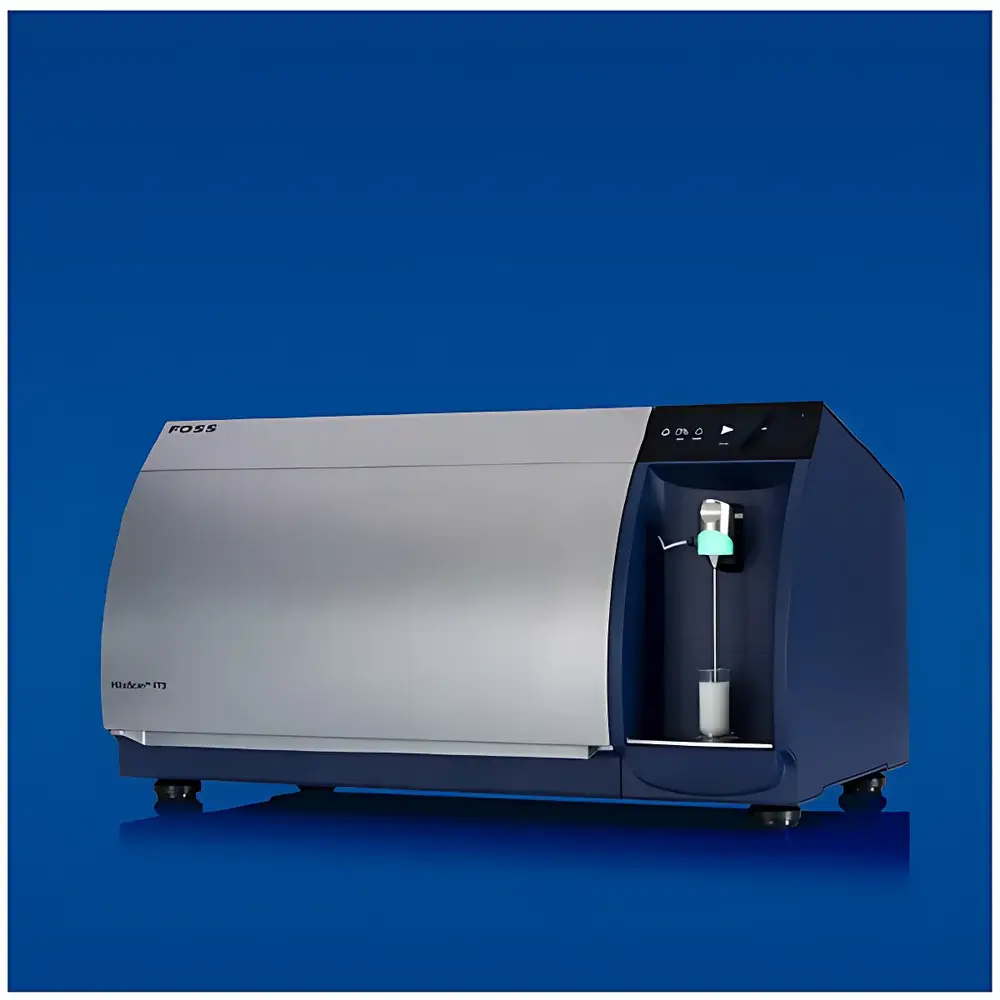
FOSS MilkoScan FT3 Dairy Analyzer
| Brand | FOSS |
|---|---|
| Country of Origin | Denmark |
| Model | MilkoScan FT3 |
| Detection Parameters | Fat, Protein, Lactose, Total Solids, Non-Fat Solids, Freezing Point, Titration Acidity, Density, Free Fatty Acids, Citric Acid, Casein, Urea, Sucrose, Glucose, Fructose, Galactose |
| Automation Level | Fully Automatic |
| Analysis Time | 30 seconds per sample |
| Precision (CV) | < 0.25% (Fat, Protein, Lactose), < 0.20% (Total Solids), < 1 m°C (Freezing Point) |
| Sample Volume | < 8.0 mL |
| Flow System | Fully Automated Cleaning & Zeroing with Adaptive Adjustment |
| Connectivity | LIMS, FossManager™ Software |
| Dimensions | 750 × 450 × 408 mm |
| Weight | 43 kg |
Overview
The FOSS MilkoScan FT3 Dairy Analyzer is a fully automated, Fourier Transform Infrared (FTIR) spectrometer engineered for high-throughput, precise compositional analysis of raw and processed dairy products. Leveraging decades of domain-specific expertise in milk science and metrology, the MilkoScan FT3 implements AOAC- and IDF-validated FTIR methodology to deliver traceable, repeatable quantification of up to 16 key parameters—including fat, protein, lactose, total solids, non-fat solids, freezing point, titratable acidity, density, free fatty acids, citric acid, casein, urea, sucrose, glucose, fructose, and galactose—without chemical reagents or manual sample preparation. Its optical architecture is calibrated against primary reference standards traceable to national metrology institutes, ensuring compliance with international dairy testing protocols defined by ISO 9622, IDF 141, and AOAC Official Method 972.16. Designed for continuous operation in laboratory, receiving bay, and production-line environments, the instrument operates on the principle of mid-infrared absorption spectroscopy, where molecular vibrations of functional groups (e.g., C=O, N–H, O–H) generate characteristic spectral signatures that are deconvoluted via multivariate calibration models.
Key Features
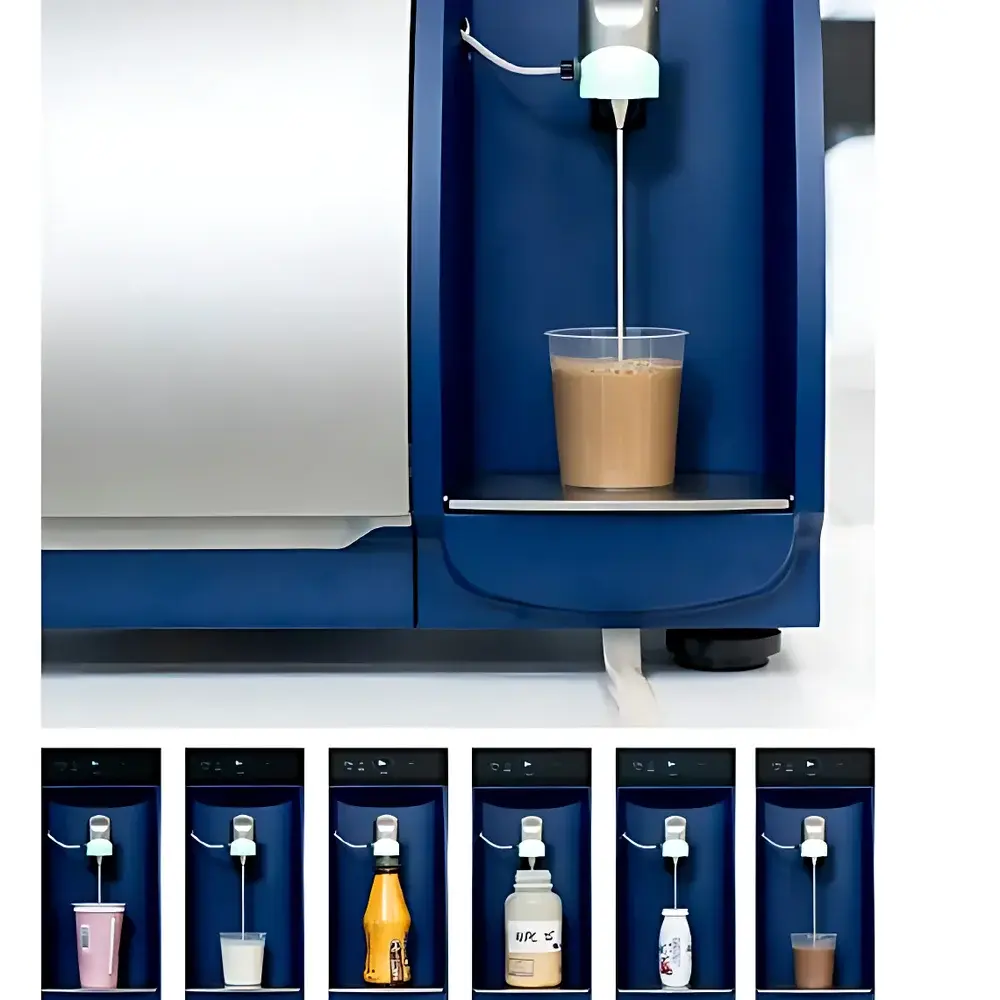
- Fully automated FTIR analysis with adaptive flow system capable of direct measurement of liquid, viscous, and semi-solid dairy matrices—including raw milk, pasteurized milk, flavored milks, yogurts, cream, ice cream mixes, whey, condensed milk, acid whey protein concentrates, soy milk, and plant-based dairy alternatives—without dilution or homogenization.
- Patented AutoStandardization technology continuously corrects for instrumental drift and environmental fluctuations, enabling stable calibrations across instruments and laboratories; inter-instrument calibration transfer reduces standardization effort by up to 80% in multi-unit deployments.
- Robust mechanical architecture with only three scheduled maintenance components, significantly lowering lifecycle cost of ownership and minimizing operational downtime.
- Intelligent self-diagnostic subsystem monitors optical path integrity, detector stability, temperature gradients, and fluidic performance in real time, logging diagnostic events with timestamped metadata for GLP/GMP audit readiness.
- Integrated thermal stabilization ensures <±0.05°C temperature control of the flow cell during measurement, critical for reproducible freezing point and density determination.
Sample Compatibility & Compliance
The MilkoScan FT3 accepts samples ranging from low-viscosity raw milk to high-viscosity Greek yogurt and concentrated whey protein solutions. Its adaptive flow path dynamically adjusts pump pressure, valve timing, and rinse volume based on real-time viscosity estimation derived from backpressure monitoring. All reported results comply with regulatory frameworks governing dairy quality assurance, including EU Regulation (EC) No 853/2004, FDA Grade “A” Pasteurized Milk Ordinance (PMO), and Codex Alimentarius Standard 206-1999. Calibration models are developed and validated in accordance with ISO/IEC 17025 requirements and support full traceability to certified reference materials (CRMs) such as NIST SRM 1549a (Whole Milk Powder) and IRMM-804 (Skim Milk Powder). The instrument meets electromagnetic compatibility (EMC) standards EN 61326-1 and safety requirements EN 61010-1.
Software & Data Management
Controlled via FossManager™ software, the MilkoScan FT3 supports role-based user access, electronic signature workflows, and full 21 CFR Part 11 compliance—including audit trails, data integrity validation, and secure archiving of raw spectra, calibration files, and result reports. Integration with Laboratory Information Management Systems (LIMS) is achieved through ASTM E1384-compliant HL7 and ASTM E2500-07 data exchange protocols. Batch reporting includes statistical summaries (mean, SD, CV%, min/max), trend charts, and deviation alerts triggered against configurable specification limits. All spectral data are stored in vendor-neutral JCAMP-DX format, enabling third-party chemometric reprocessing and model refinement.
Applications
- Raw milk pricing and supplier grading based on fat, protein, and freezing point measurements aligned with national payment formulas.
- In-process quality control during pasteurization, homogenization, fermentation, and concentration steps to maintain target composition windows.
- Finished product release testing for nutritional labeling compliance (e.g., FDA 21 CFR 101.9, EU Regulation 1169/2011).
- Detection of adulteration indicators—including added water (via freezing point depression), urea supplementation, or sucrose fortification—using multivariate outlier detection algorithms.
- Monitoring shelf-life stability through longitudinal tracking of free fatty acid development and citric acid degradation kinetics.
- Supporting R&D in dairy alternative formulation by quantifying macronutrient profiles and detecting non-bovine carbohydrate markers (e.g., fructose, galactose).
FAQ
What regulatory standards does the MilkoScan FT3 meet for routine dairy testing?
It complies with AOAC Official Method 972.16, IDF Standard 141, ISO 9622, and supports validation under ISO/IEC 17025 for accredited testing laboratories.
Can the instrument analyze plant-based milk alternatives without method redevelopment?
Yes—pre-installed calibration models cover soy, almond, oat, and coconut beverages; additional models may be developed using Foss’s Chemometrics Suite and validated per ISO 12099.
Is freezing point measurement performed in real time during the same FTIR scan?
No—freezing point is determined via independent thermistor-based cryoscopic analysis in a dedicated module, synchronized with FTIR data acquisition within the same sample run.
How frequently must calibration be verified in a high-volume dairy lab?
With AutoStandardization enabled, daily verification using a single control sample is sufficient; full recalibration is typically required only after major maintenance or relocation.
Does the system support remote diagnostics and firmware updates?
Yes—FossRemoteConnect enables secure, encrypted remote access for technical support, performance diagnostics, and over-the-air firmware upgrades compliant with IEC 62443-3-3 cybersecurity standards.




