
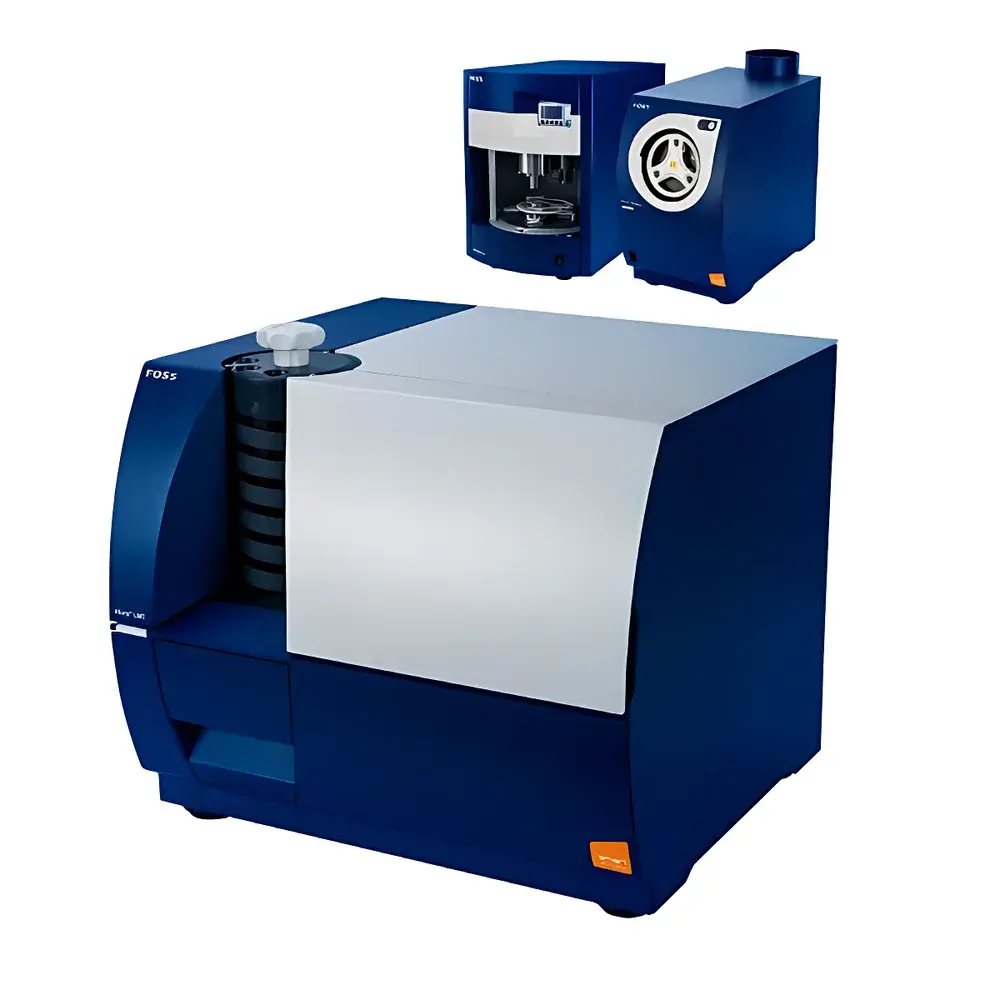
FOSS Micral™ Laser-Induced Breakdown Spectroscopy (LIBS) Mineral Analyzer
| Brand | FOSS |
|---|---|
| Origin | Denmark |
| Instrument Type | Benchtop |
| Design | Modular |
| Sample Throughput | 60 samples per auto-sampler tray |
| Core Technology | Laser-Induced Breakdown Spectroscopy (LIBS) |
| Target Elements | Ca, Mg, P, K, Na, S (macronutrients) |
| Sample Forms | Fresh grass, silage (maize, barley, sorghum), alfalfa/legumes, hay, semi-dry forage, straw, clover, mixed hay |
| Reagent-Free Operation | Yes |
| Compliance Context | Designed for agricultural QA/QC workflows aligned with ISO 17025–accredited laboratory practices and feed industry GLP requirements |
Overview
The FOSS Micral™ Laser-Induced Breakdown Spectroscopy (LIBS) Mineral Analyzer is a benchtop elemental analysis system engineered for rapid, reagent-free quantification of mineral composition in agricultural forage and feed materials. Utilizing pulsed laser ablation to generate transient micro-plasmas on sample surfaces, the instrument captures time-resolved atomic emission spectra across the UV–VIS–NIR range (190–900 nm). Spectral signatures are resolved via high-resolution echelle spectrometry coupled with intensified CCD detection, enabling simultaneous identification and semi-quantitative to quantitative determination of up to 12 key elements—six macronutrients (Ca, Mg, P, K, Na, S) and six micronutrients (Al, B, Cu, Fe, Mn, Zn)—in under 60 seconds per sample. Unlike wet-chemistry or ICP-based methods, Micral requires no acid digestion, no calibration standards per batch, and no hazardous reagents, making it suitable for routine use in feed mills, dairy nutrition labs, and agronomy extension facilities where speed, safety, and operational simplicity are critical.
Key Features
- Automated 60-position sample carousel with integrated sample presentation and laser targeting—enabling unattended sequential analysis without manual intervention.
- Modular architecture supports field-upgradable firmware, spectral library expansion, and optional integration with LIMS or farm management software via OPC UA or RESTful API.
- Robust optical path design with sealed spectrometer chamber and active thermal stabilization ensures long-term wavelength fidelity and signal reproducibility (<2% RSD for Ca in homogenized alfalfa over 8-hour operation).
- Pre-validated spectral calibration models for major forage matrices—including maize silage, alfalfa hay, and grass silage—reduce method development time and support immediate deployment.
- Embedded spectral preprocessing algorithms (background subtraction, plasma decay correction, peak deconvolution) enhance signal-to-noise ratio and mitigate matrix-induced spectral interferences.
Sample Compatibility & Compliance
The Micral™ analyzer accepts heterogeneous, minimally prepared forage samples: fresh-cut grass, wilted hay, chopped silage, ground straw, and pelleted blends. Samples require only size reduction to ≤2 mm particle diameter and moisture equilibration to 40–65% w/w—no drying, ashing, or digestion. This aligns with AOAC Official Method 2020.01 (for rapid forage screening) and supports compliance with EU Regulation (EC) No 767/2009 on feed labeling accuracy. The system’s audit trail functionality logs operator ID, timestamp, sample ID, laser energy, spectral acquisition parameters, and raw + processed spectra—meeting traceability requirements under ISO/IEC 17025:2017 Clause 7.11 and facilitating internal GLP audits.
Software & Data Management
MicralControl™ software provides intuitive workflow management—from sample registration and method selection to real-time spectral visualization and report generation. All spectra are stored in HDF5 format with embedded metadata (instrument configuration, environmental conditions, operator notes). Quantitative results export as CSV or PDF with customizable templates compliant with feed formulation databases (e.g., NRC, CNCPS). Software supports 21 CFR Part 11–ready user authentication, electronic signatures, and immutable audit logs. Optional cloud synchronization enables centralized data aggregation across multi-site operations while preserving local data sovereignty.
Applications
- Routine mineral profiling of incoming forage lots to adjust ration formulations in real time—reducing over-supplementation of Ca, P, or trace minerals by up to 18% (based on peer-reviewed field trials in Nordic dairy cooperatives).
- Supporting precision feeding programs by tracking seasonal variation in K and Na content of pasture grasses—critical for preventing hypomagnesaemia in lactating cattle.
- Validating efficacy of soil amendment strategies (e.g., boron or zinc foliar sprays) through longitudinal leaf-tissue screening without destructive harvesting.
- Enabling feed mill QC teams to verify mineral premix uniformity in compound feeds prior to packaging—replacing slower, offline ICP-OES checks.
- Facilitating research-grade studies on mineral bioavailability in novel forage species, with spectral libraries extensible via supervised machine learning (PLS-R, SVM).
FAQ
Does Micral require daily recalibration with certified reference materials?
No—factory-calibrated spectral models are matrix-specific and drift-compensated via internal reference lines (e.g., Fe I at 371.99 nm). Routine verification uses a single NIST-traceable forage CRM every 24 hours.
Can Micral analyze frozen or high-moisture silage directly?
Yes—samples are analyzed in ambient air without vacuum or inert gas purge. Surface moisture is accommodated by adaptive plasma ignition delay and gated detection windows.
Is spectral data export compatible with third-party chemometrics platforms?
Yes—raw spectra (.h5), processed intensity tables (.csv), and metadata (.json) are fully accessible for import into MATLAB, Python (scikit-learn), or Unscrambler.
What maintenance is required beyond routine lens cleaning?
Annual spectrometer wavelength validation and laser energy monitoring are recommended; no consumables (e.g., torches, nebulizers, or electrodes) are used.
How does Micral handle heterogeneity in chopped forage samples?
The auto-sampler rotates each sample during ablation, and the system acquires ≥5 independent micro-plasma spectra per sample—statistical averaging improves representativeness versus single-point techniques.




