
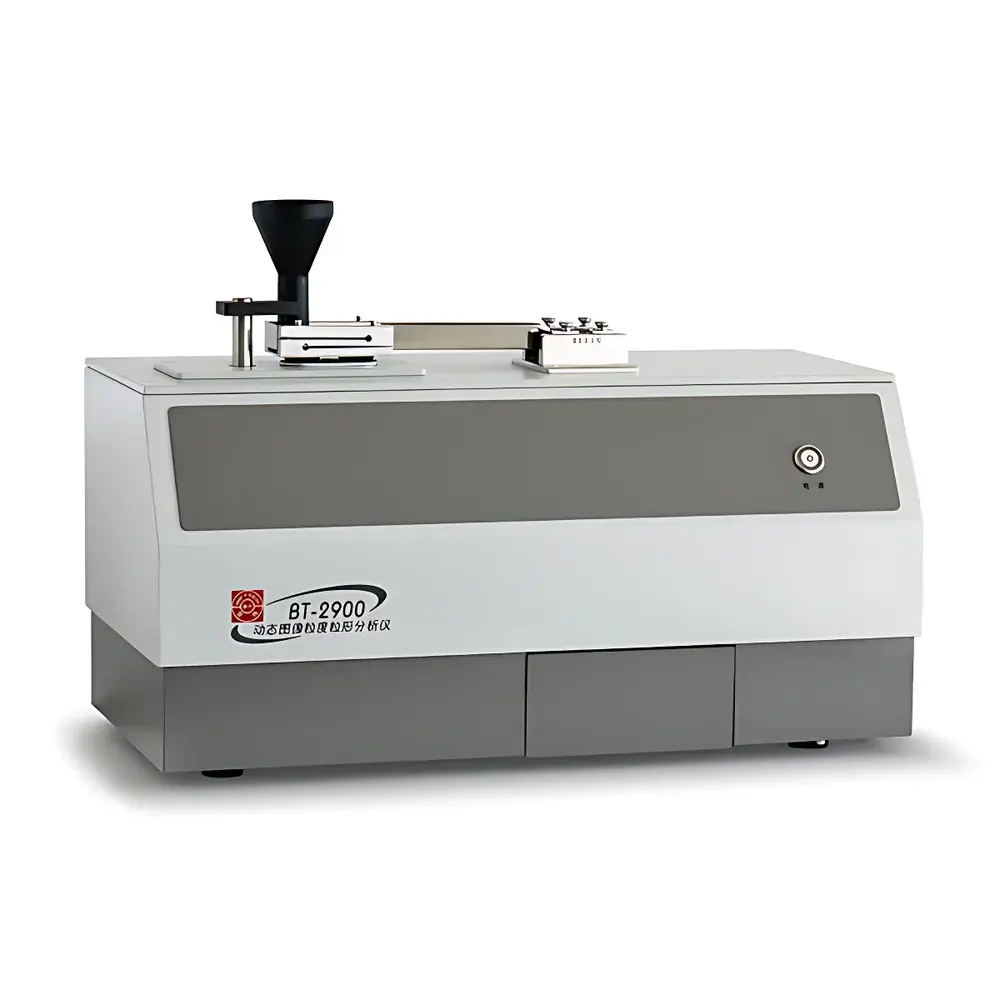
Bettersize BT-2900 Dynamic Image-Based Particle Size and Shape Analyzer
| Brand | Bettersize |
|---|---|
| Origin | Liaoning, China |
| Manufacturer Type | Direct Manufacturer |
| Region of Origin | Domestic (China) |
| Model | BT-2900 |
| Instrument Type | Dynamic |
| Measurement Range | 30–10,000 µm (dry dispersion) |
| Sample Dispersion Method | Dry & Wet |
| Magnification | 0.132×–10× (interchangeable lenses) |
| Repeatability Error | ≤1% (D50 deviation vs. national standard reference material) |
| Accuracy Error | ≤1% (D50 deviation vs. national standard reference material) |
| High-Speed Camera | 1.5 MP, 120 fps |
| Particle Recognition Speed | ≥10,000 particles/min |
| Power Supply | 220 VAC, 50/60 Hz, 4 A |
| Dimensions | 610 × 300 × 440 mm |
| Weight | 26 kg |
Overview
The Bettersize BT-2900 Dynamic Image-Based Particle Size and Shape Analyzer is an industrial-grade optical measurement system engineered for high-fidelity characterization of coarse and granular particulate materials. Unlike static image analyzers that capture immobilized particles on a glass slide, the BT-2900 employs a true dynamic imaging principle: particles are dispersed in free-fall (dry mode) or laminar suspension flow (wet mode), and imaged in real time using a synchronized high-speed CCD camera operating at 120 frames per second. This approach eliminates static agglomeration artifacts and enables statistically robust sampling—typically capturing and analyzing >10,000 particles per minute, with throughput scalable to hundreds of thousands per test cycle. The system operates on the fundamental principle of silhouette-based edge detection and geometric parameterization, delivering both size (equivalent circular diameter, maximum Feret, minimum bounding rectangle) and shape descriptors (circularity, aspect ratio, convexity, solidity, elongation) for each resolved particle. Its measurement range—30–10,000 µm in dry mode and 2–3,500 µm in wet mode—positions it uniquely for applications where laser diffraction lacks resolution at the coarse end and static microscopy suffers from poor sampling representativeness.
Key Features
- True dynamic imaging architecture: Particles analyzed during motion—either in gravity-driven free-fall (dry) or controlled centrifugal recirculation (wet)—ensuring natural dispersion state and eliminating static adhesion bias.
- Dual-mode dispersion system: Electromagnetic vibratory feeder + precision distribution trough for dry mode; adjustable-flow centrifugal pump loop with optional ultrasonic bath integration for wet mode—mode switching accomplished in <90 seconds without hardware reconfiguration.
- High-fidelity optical train: Interchangeable telecentric lenses (0.132×–10× magnification) optimized for depth-of-field consistency across the full measurement range; backlit LED illumination with uniformity >98%.
- Real-time image processing engine: Proprietary multi-threaded software leveraging sub-pixel edge detection and adaptive thresholding; capable of simultaneous acquisition, segmentation, feature extraction, and statistical reporting—no post-processing delay.
- Automated agglomerate deconvolution: Algorithmic separation of touching particles based on watershed segmentation and contour curvature analysis, validated against ISO 13322-2:2020 guidelines for image-based particle analysis.
- Robust mechanical design: Integrated vibration-damping chassis; IP20-rated enclosure; CE-compliant electrical architecture with EMI shielding for stable operation in industrial lab environments.
Sample Compatibility & Compliance
The BT-2900 accommodates a broad spectrum of particulate systems relevant to R&D, QC, and process engineering. Dry-mode applications include abrasive media (e.g., silicon carbide, aluminum oxide), construction aggregates (mechanical sand, river sand), catalyst supports, refractory granules, coal fragments, and food-grade crystals (salt, sugar). Wet-mode compatibility extends to fine mineral slurries (talc, kaolin, calcium carbonate), cement clinker fines, ion-exchange resins, pharmaceutical granules, and colloidal suspensions where air-sensitive or cohesive behavior precludes dry dispersion. The system adheres to core principles outlined in ISO 13322-1:2014 (static) and ISO 13322-2:2020 (dynamic) for image analysis methodology. While not certified for GMP production release, its audit-ready data structure—including timestamped raw image archives, metadata logs, and uneditable analysis history—supports GLP-compliant workflows. Optional 21 CFR Part 11 compliance packages (electronic signatures, audit trails, user access controls) are available upon configuration.
Software & Data Management
BT-2900’s proprietary ParticleSight™ software provides a deterministic, traceable analysis pipeline. All raw images are stored losslessly in TIFF format with embedded EXIF metadata (exposure time, lens ID, magnification, timestamp, operator ID). Each analysis session generates three standardized outputs: (1) Raw parameter export (CSV/Excel) containing per-particle metrics (diameter, circularity, aspect ratio, convexity, solidity, Feret X/Y, bounding box area); (2) Binned statistical reports (D10/D50/D90, span, skewness, kurtosis) with customizable interval definitions; (3) Publication-ready graphical exports (histograms, cumulative curves, scatter plots, shape correlation matrices) in SVG/PNG/PDF. Data integrity is enforced via SHA-256 hashing of all image and report files. Batch processing supports up to 99 sequential samples with automated naming, calibration recall, and pass/fail threshold logic. Export modules include ASTM E2457-compliant sieve-equivalent reporting and USP particulate matter overlay templates.
Applications
- Construction materials: Quantifying gradation and angularity of manufactured sand per ASTM C136/C78, enabling optimization of concrete workability and compressive strength.
- Abrasive manufacturing: Correlating grit shape parameters (circularity, convexity) with cutting efficiency and tool wear life in grinding wheel QC.
- Pharmaceutical excipients: Assessing granule sphericity and surface roughness as predictors of flowability and tablet compaction behavior.
- Mineral processing: Monitoring liberation degree and fragmentation morphology in comminution circuits—feeding predictive models for energy consumption and downstream separation efficiency.
- Food science: Characterizing crystal habit evolution during sugar crystallization or fat bloom development in chocolate, supporting texture and shelf-life modeling.
- Environmental analysis: Classifying sediment grain morphology for fluvial transport modeling and erosion potential assessment.
FAQ
What distinguishes dynamic image analysis from static image analysis?
Dynamic analysis captures particles in motion—eliminating static agglomeration and providing statistically representative sampling of bulk behavior. Static methods require manual or automated slide preparation, introducing bias from settling, drying, or compression artifacts.
Can the BT-2900 measure particles smaller than 2 µm?
No. Its optical resolution and depth-of-field constraints limit reliable wet-mode detection to ≥2 µm and dry-mode to ≥30 µm. Submicron analysis requires laser diffraction (e.g., BT-9300ST) or electron microscopy.
Is calibration traceable to NIST or other national standards?
Yes. System calibration uses NIST-traceable stage micrometers and certified particle reference standards (e.g., NIST SRM 1980, ISO 11171 latex spheres) following ISO 21507:2019 procedures.
How is data security handled for regulated industries?
With the optional Compliance Edition, the software implements role-based access control, immutable audit trails, electronic signatures, and encrypted local storage—all configurable to meet FDA 21 CFR Part 11, EU Annex 11, and ISO 17025 requirements.
Does the system support third-party software integration?
Yes. A documented COM/ActiveX API enables bidirectional communication with LIMS platforms (e.g., LabWare, Thermo SampleManager), MES systems, and custom Python/MATLAB analysis pipelines via TCP/IP or file-watch triggers.



