
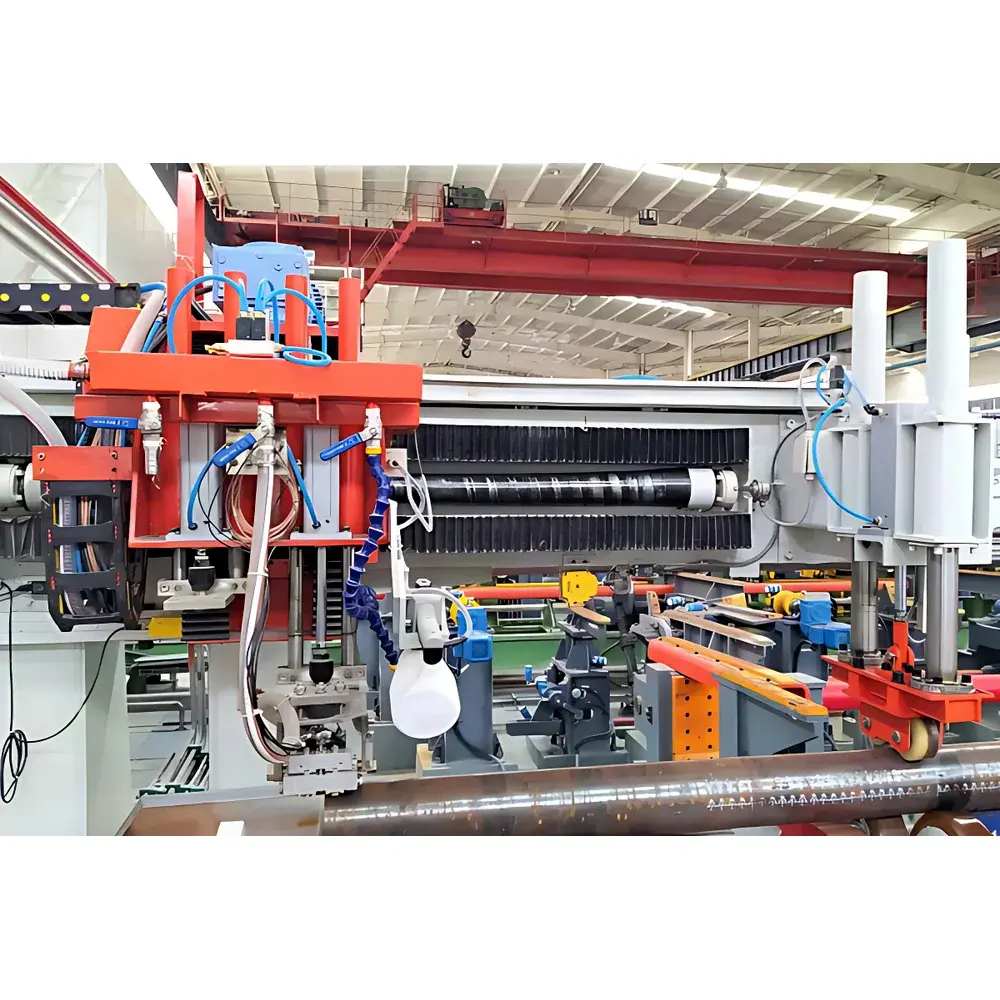
NC-DUT Series End-Section Ultrasonic Testing System by NCS (China Steel Research Institute)
| Brand | NCS (China Steel Research Institute) |
|---|---|
| Origin | Beijing, China |
| Manufacturer Type | Direct Manufacturer |
| Regional Origin | Domestic (China) |
| Model | NC-DUT Series |
| Pricing | Available Upon Request |
Overview
The NC-DUT Series End-Section Ultrasonic Testing System is a dedicated high-reliability ultrasonic inspection platform engineered for the non-destructive evaluation (NDE) of pipe end sections—including beveled, threaded, grooved, and capped terminations—across seamless, welded, and ERW steel, aluminum, copper, and titanium tubing. Utilizing pulse-echo and through-transmission ultrasonic techniques with adjustable frequency transducers (typically 2–10 MHz), the system detects volumetric and planar discontinuities—including lack of fusion, cracks, porosity, inclusions, and machining-induced defects—in the critical transition zone between pipe body and end geometry. Unlike full-length UT systems, the NC-DUT is optimized for localized high-resolution scanning of the first 150 mm from the pipe end—a region where conventional immersion or manual UT often exhibits reduced coupling stability and beam distortion. Its modular probe carriage, programmable scan path control, and real-time A-scan/B-scan synthesis enable repeatable, traceable inspections compliant with industrial pipeline integrity management frameworks.
Key Features
- End-specific scanning architecture with motorized radial and axial positioning modules for precise coverage of bevel angles (0°–45°), thread roots, and internal/external chamfers
- Dual-channel ultrasonic acquisition supporting simultaneous longitudinal (L-wave) and shear (S-wave) mode interrogation via interchangeable focused or angle-beam probes
- Real-time digital signal processing (DSP) with variable gain, gate positioning, and threshold-based defect alarm logic
- Integrated water-coupling system with temperature-stabilized recirculation and automatic nozzle alignment to maintain consistent acoustic impedance at curved end surfaces
- Ruggedized mechanical frame designed for integration into production line environments—capable of continuous operation under ambient temperatures from 5 °C to 40 °C and relative humidity ≤85% RH (non-condensing)
- Compliance-ready hardware architecture supporting audit trails, user access levels (operator, supervisor, administrator), and calibration lockout protocols
Sample Compatibility & Compliance
The NC-DUT Series accommodates pipe diameters from 21.3 mm (½ inch) to 660 mm (26 inches) and wall thicknesses ranging from 2.0 mm to 40 mm. It supports both ferrous (carbon steel, stainless steel, duplex grades) and non-ferrous (Al 6061/7075, Cu C10200, Ti Gr2/Gr5) materials with surface roughness up to Ra 12.5 µm. Inspection procedures are validated per ASME Section V, Article 4 (Manual UT) and Article 5 (Automated UT), and fully aligned with the acceptance criteria and scanning requirements defined in API RP 5L, DEP 31.40.20.37 (Shell), ASTM A578/A578M (Straight-Beam UT of Forged Steel Plates), ASTM A53/A500 (Pipe Standards), JIS G3444 (Carbon Steel Pipes), GB/T 3091 (Galvanized Steel Pipes), Q/SY GJX101 (CNPC Pipeline Specification), GB/T 5777 (UT of Stainless Steel Tubes), and YB/T 4082 (UT of Titanium Alloy Tubes). System documentation includes traceable calibration records per ISO/IEC 17025 and verification reports for probe delay, sensitivity, and resolution per EN 12668-1.
Software & Data Management
The NC-DUT Control Suite is a Windows-based application built on .NET Framework 4.8 with native support for 64-bit architectures. It provides synchronized multi-view display (A-scan waveform, B-scan cross-section, C-scan topography, and 3D depth-encoded rendering) with configurable color mapping and defect annotation tools. All inspection data—including raw RF signals, gated amplitude values, time-of-flight measurements, and positional metadata—are stored in vendor-neutral HDF5 format with embedded XML headers describing instrument configuration, operator ID, date/time stamps, and calibration status. The software enforces FDA 21 CFR Part 11 compliance through electronic signatures, audit trail logging (with immutable timestamps and action descriptors), and role-based data export restrictions. Export options include CSV (for statistical process control), PDF inspection reports (with embedded images and pass/fail summary), and DICOM-RT compatible files for integration with enterprise NDE asset management platforms.
Applications
- Pre-shipment inspection of OCTG (Oil Country Tubular Goods) and line pipe ends prior to threading or welding
- In-process verification of machined end geometry integrity in seamless tube finishing lines
- Periodic in-service assessment of pipe end condition in aging infrastructure (e.g., refinery manifolds, offshore risers)
- Qualification testing of new pipe grades under extreme service conditions (e.g., sour service per NACE MR0175/ISO 15156)
- Research-grade characterization of end-zone microstructure effects on ultrasonic attenuation and backscatter behavior
FAQ
What pipe end geometries can the NC-DUT Series inspect?
It supports beveled ends (single/double V-groove), threaded connections (API 5CT, ISO 10423), plain ends with internal/external chamfers, and capped or welded closures—provided dimensional tolerances fall within specified mechanical limits.
Does the system support automated defect sizing per ASTM E273?
Yes—the software implements distance-amplitude correction (DAC) and area-amplitude correction (AAC) curves, enabling equivalent reflector sizing (ERS) and length estimation per ASTM E273 Annex A1 for planar indications.
Can the NC-DUT integrate with existing factory MES or SAP QA modules?
Via OPC UA 1.04 interface and configurable RESTful API endpoints, the system supports bi-directional data exchange including inspection IDs, material lot numbers, pass/fail status, and timestamped defect coordinates.
Is operator certification required to run the system?
Personnel must hold Level II UT certification per SNT-TC-1A or ISO 9712; however, the system’s guided workflow minimizes procedural variability and reduces reliance on subjective interpretation during routine end inspections.



