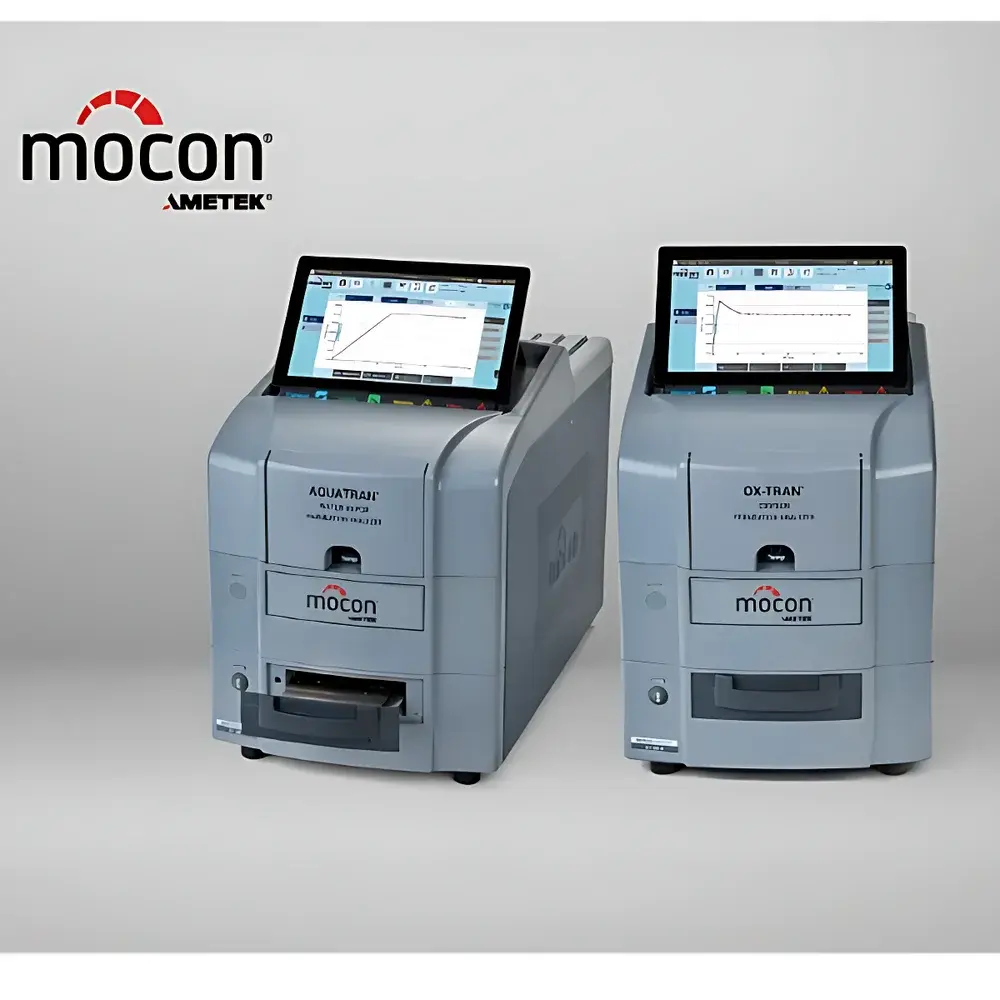
MOCON OX-TRAN® 2/22 Single-Chamber Oxygen Transmission Rate Analyzer
| Brand | MOCON |
|---|---|
| Origin | USA |
| Model | OX-TRAN® 2/22 |
| Detection Principle | Coulometric (COULOX®) Sensor-Based OTR Measurement |
| Compliance | ASTM D3985, ISO 15105-2, FDA 21 CFR Part 11 Ready (with optional software package) |
| Test Chamber | Horizontal, Interchangeable Sealed Test Cell with TruSeal® Dual-Gasket Design |
| Sample Handling | Manual single-sample loading per cycle |
| Typical OTR Range | 0.005–10,000 cm³/m²·day·atm (dependent on cell configuration and film barrier level) |
| Sensor Type | Absolute coulometric oxygen sensor (zero-calibration required) |
| Data Output | Real-time OTR curve, permeation onset time, steady-state slope calculation |
Overview
The MOCON OX-TRAN® 2/22 is a single-chamber, coulometric oxygen transmission rate (OTR) analyzer engineered for precision, reproducibility, and operational simplicity in barrier property evaluation of flexible packaging materials and thin-film substrates. Operating on the fundamental principle of coulometric oxygen detection—where oxygen molecules permeating through a test specimen are quantitatively reduced at a cathode and the resulting electrical current is measured as a direct function of molar oxygen flux—the instrument delivers absolute, calibration-free OTR values traceable to fundamental electrochemical constants. This measurement architecture forms the technical basis of ASTM D3985, the internationally recognized standard for oxygen permeability testing of plastic film and sheeting. Unlike optical or paramagnetic sensors requiring frequent zero/span verification, the COULOX® sensor provides inherent stability over extended operation, minimizing drift-related uncertainty and eliminating routine recalibration across daily use cycles.
Key Features
- Horizontal, modular test cell design with quick-release mechanism enabling one-handed opening/closing and automatic pneumatic clamping—ensuring consistent compressive force across variable sample thicknesses (from 12 µm polymer films to 2 mm laminated trays).
- TruSeal® dual-gasket sealing system: two concentric elastomeric seals with inert purge gas flowing between them, effectively isolating the test zone from ambient air ingress and reducing environmental interference by >99.7% (validated per ISO 15105-2 Annex B).
- Interchangeable test cells—including flat-film, pouch, and irregular-shape configurations—compatible across MOCON’s OX-TRAN® platform, enabling method transfer and application scalability without hardware duplication.
- COULOX® coulometric sensor certified by independent third-party validation (NIST-traceable interlaboratory study) to meet ASTM D3985 accuracy requirements: ±3.5% RSD for repeatability and ±5.0% bias versus reference standards.
- Integrated temperature and humidity control (optional RH module available) supporting standardized test conditions per ASTM F1249 (for high-barrier films) and ISO 15105-2 (23°C / 0% RH baseline).
Sample Compatibility & Compliance
The OX-TRAN® 2/22 accommodates a broad spectrum of planar and semi-rigid specimens: monolayer polyethylene (PE), ethylene-vinyl alcohol (EVOH) coextrusions, aluminum oxide (AlOx) and silicon oxide (SiOx) coated PET, metallized paperboard, pharmaceutical blister lidding, and medical device pouches. Its horizontal cell geometry eliminates gravitational sag effects common in vertical chambers, preserving uniform seal integrity across low-tensile-strength substrates. All test protocols align with regulatory expectations for barrier data generation in GMP-compliant environments: audit trail logging, user access controls, electronic signature support (when paired with Permatran-W® Suite v6.2+), and full compliance with FDA 21 CFR Part 11 requirements for electronic records and signatures. The system also supports GLP documentation workflows, including IQ/OQ/PQ templates and raw-data export in CSV and PDF/A-1b formats.
Software & Data Management
Controlled via MOCON’s Permatran-W® software platform, the OX-TRAN® 2/22 provides real-time permeation curve visualization, automated steady-state detection (using ISO 15105-2 defined slope convergence criteria), and customizable reporting templates aligned with internal SOPs or external submission requirements (e.g., ICH Q5C, USP ). Data integrity safeguards include immutable timestamped event logs, version-controlled method files, and encrypted database storage. Raw sensor output (nA vs. time) is retained at 10 Hz resolution for retrospective reanalysis, and all calculated OTR values include associated uncertainty budgets derived from sensor noise floor, temperature stability, and seal leak rate estimates.
Applications
This analyzer serves critical roles in packaging development laboratories evaluating shelf-life drivers for food, pharmaceutical, and electronics packaging; QC labs validating incoming film lots against supplier specifications; and academic research groups investigating novel barrier nanocomposites or biodegradable multilayers. Its cost-effective single-cell architecture makes it especially suited for labs with moderate throughput demands (<15 samples/day) where statistical robustness—not ultra-high speed—is the priority. Common use cases include accelerated aging correlation studies, coating adhesion impact assessment under humidity stress, and comparative analysis of plasma-treated vs. untreated substrates.
FAQ
Does the OX-TRAN® 2/22 require periodic sensor calibration?
No. The COULOX® coulometric sensor is an absolute measurement device based on Faraday’s law; it requires no zero or span calibration during normal operation.
Can the same test cell be used for both OTR and WVTR measurements?
No. OTR and WVTR require fundamentally different sensor technologies and chamber configurations; separate dedicated instruments (e.g., OX-TRAN® for OTR, PERMATRAN-W® for WVTR) are recommended for compliance with ASTM standards.
What is the minimum detectable OTR value with standard flat-film cell?
Using the 50 cm² test area cell under 0% RH and 23°C, the practical lower limit is 0.005 cm³/m²·day·atm (equivalent to ~0.1 cc/m²·24h·atm), validated per ASTM F1249 Annex A1.
Is TruSeal® performance verified during installation qualification?
Yes. Each system shipment includes a TruSeal® integrity verification kit with helium leak testing protocol and acceptance criteria per ISO 15105-2 Section 8.3.
How does the horizontal cell design improve measurement reproducibility compared to vertical alternatives?
By eliminating hydrostatic pressure gradients and ensuring uniform gasket compression across the entire seal perimeter—particularly critical for non-uniform or low-modulus samples such as foamed polymers or paper-based laminates.