
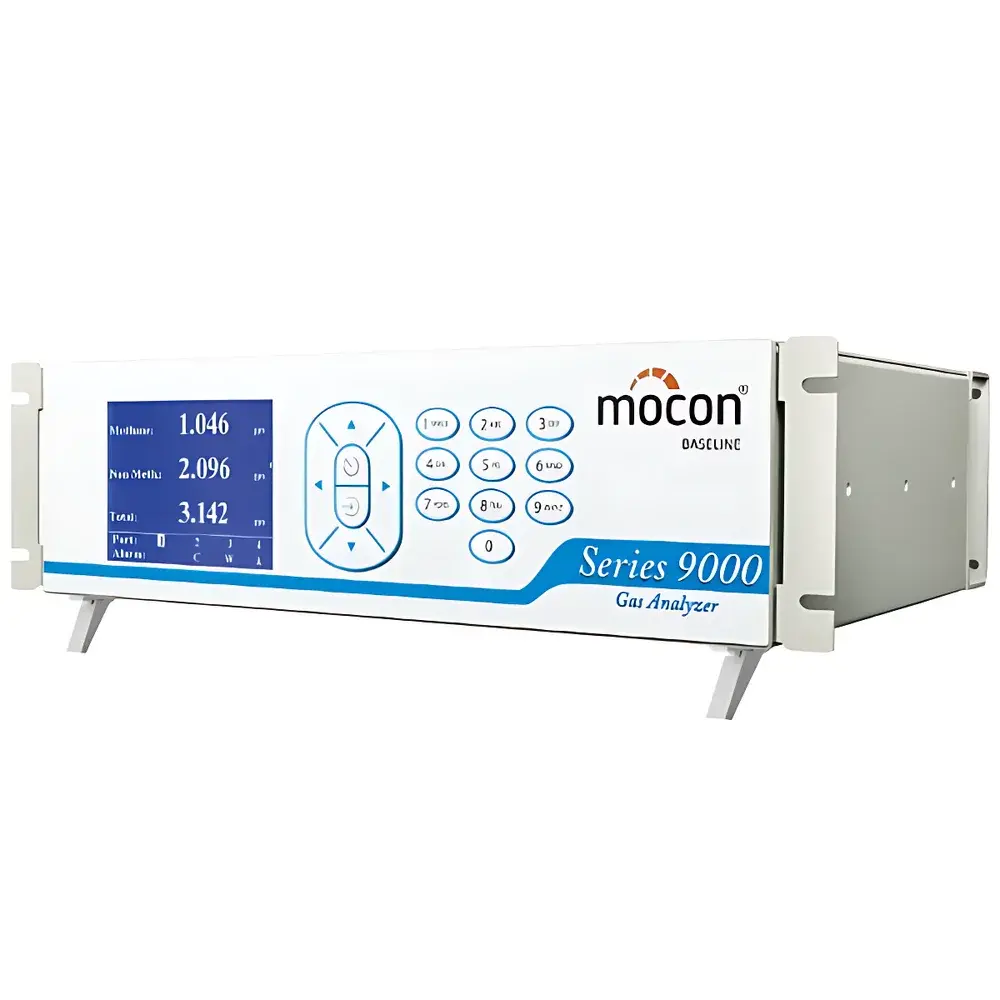
Baseline Baseline 9000 Hydrocarbon Analyzer
| Brand | Baseline |
|---|---|
| Origin | USA |
| Manufacturer Type | Authorized Distributor |
| Origin Category | Imported |
| Model | Baseline 9000 |
| Detection Principle | Flame Ionization Detection (FID) |
| Instrument Type | Benchtop Laboratory Analyzer |
| Configuration | Multi-Component VOC Analyzer |
| Detection Limit | <0.1 ppm (as propane) |
| Measuring Range | 10 ppm–10% (propane) or 10 ppm–50% (methane), factory-configurable per application |
| Operating Sample Temperature | Up to 191°C (376°F) |
| Sample Filtration Requirement | Pre-filtered, non-condensing, particle size <10 µm |
| Display | Graphical LCD with real-time parameter visualization |
| Communication Interfaces | RS-232/RS-485 serial, Ethernet, analog (4–20 mA / 0–10 V), digital I/O, relay outputs |
| Calibration | User-scheduled automatic zero/span calibration |
| Flow Control | Electronic FlowGuard™ system with integrated fuel/air/sample flow regulation, electronic back-pressure regulator, and sample bypass |
| Ignition | Automatic FID ignition sequence |
| Software | 9000 Keeper PC Utility for method storage, configuration upload/download, and firmware management |
| Mounting Options | Benchtop or 19-inch rack-mountable |
| Compliance | Designed for use in environments requiring EPA Method 25A, ASTM D6348, ISO 11843-2, and USP <467> compliant VOC monitoring workflows |
Overview
The Baseline Baseline 9000 Hydrocarbon Analyzer is a benchtop laboratory-grade flame ionization detector (FID)-based gas analyzer engineered for precise, continuous quantification of total hydrocarbons (THC) and volatile organic compounds (VOCs) in environmental, industrial hygiene, and process safety applications. Operating on the well-established principle of flame ionization detection—where organic molecules undergo pyrolysis and ionization in a hydrogen–air flame, generating a current proportional to carbon mass—the instrument delivers high sensitivity, linearity, and long-term stability. Its microprocessor-controlled architecture supports operation across a wide dynamic range (10 ppm to 10% v/v for propane; 10 ppm to 50% v/v for methane), with factory-configured calibration optimized for specific target analytes and matrix conditions. The system accommodates heated sample streams up to 191°C to prevent condensation of high-boiling-point VOCs, and requires only pre-filtration to <10 µm to ensure particulate-free introduction into the detector chamber. This design ensures robust performance in demanding applications such as stack emission monitoring, landfill gas analysis, solvent recovery verification, and cleanroom ambient air quality assessment.
Key Features
- Flame Ionization Detection (FID) with <0.1 ppm detection limit (as propane), offering superior sensitivity and carbon-mass response uniformity across aliphatic, aromatic, and olefinic compounds
- Electronic FlowGuard™ control system regulating hydrogen fuel, combustion air, and sample flow with closed-loop precision—enabling stable baseline, reduced drift, and consistent detector response
- Integrated electronic back-pressure regulator with sample bypass capability for pressure-sensitive or low-flow sampling scenarios
- Automated FID ignition sequence and user-programmable auto-calibration cycles (zero and span) to maintain measurement integrity over extended unattended operation
- High-resolution graphical LCD display showing real-time concentration, status flags, alarm states, diagnostic parameters (e.g., flame status, flow rates, detector temperature), and menu-driven navigation
- Benchtop or 19-inch rack-mount form factor with modular I/O: dual analog outputs (4–20 mA / 0–10 V), eight programmable relays (for alarm, event logging, or system interlock), and bidirectional serial (RS-232/RS-485) + Ethernet connectivity
Sample Compatibility & Compliance
The Baseline 9000 is designed for non-corrosive, non-condensing gas streams with particulate loading <10 µm. It accepts heated samples up to 191°C, making it suitable for hot-wet sampling in exhaust ducts, biogas lines, or thermal desorption effluents. While not intrinsically safe, it complies with electrical safety standards applicable to laboratory instrumentation (UL/CSA 61010-1). Its measurement methodology aligns with regulatory frameworks including U.S. EPA Method 25A for THC determination, ASTM D6348 for gaseous VOC analysis, ISO 11843-2 for detection limit estimation, and USP for residual solvent testing in pharmaceutical manufacturing. When deployed in GLP or GMP environments, its 9000 Keeper software supports audit-trail-enabled configuration management and method versioning—facilitating compliance with FDA 21 CFR Part 11 requirements for electronic records and signatures.
Software & Data Management
The included 9000 Keeper PC utility provides full local control and data governance: users can store multiple analytical methods (including calibration curves, alarm thresholds, and output mapping), upload configurations directly to the analyzer, and retrieve historical operational logs. All communication occurs via ASCII protocol over serial or TCP/IP, enabling seamless integration with SCADA systems, PLCs, or third-party LIMS platforms without proprietary drivers. Analog and digital outputs support direct connection to DCS controllers or standalone data loggers. Firmware updates are performed through the same interface, ensuring traceability and version control. The system does not require cloud dependency or subscription-based licensing—configuration and diagnostics remain fully local and deterministic.
Applications
- Continuous emissions monitoring (CEM) of total hydrocarbons from industrial stacks and incinerators
- Landfill gas and anaerobic digester biogas composition profiling (CH₄/C₂H₆/C₃H₈ ratios)
- Verification of VOC abatement efficiency in thermal oxidizers and carbon adsorption units
- Ambient air quality monitoring in urban, industrial, and occupational settings per OSHA PEL or ACGIH TLV guidelines
- Pharmaceutical manufacturing: residual solvent analysis in purge gases and clean-in-place (CIP) vent streams
- Research laboratories conducting kinetic studies of hydrocarbon oxidation or catalytic reforming
FAQ
What detection principle does the Baseline 9000 employ?
It uses flame ionization detection (FID), a universal, carbon-selective technique sensitive to virtually all organic compounds containing C–H bonds.
Can the instrument measure individual VOCs or only total hydrocarbons?
The Baseline 9000 reports total hydrocarbon concentration (as propane or methane equivalent); compound-specific identification requires coupling with a gas chromatograph (GC-FID configuration is supported via external GC integration).
Is the analyzer suitable for field deployment or strictly for lab use?
It is a benchtop laboratory instrument rated for indoor, climate-controlled environments; it is not weatherproof or explosion-proof, and therefore not intended for direct outdoor or hazardous-area installation without appropriate enclosures.
How is calibration verified and maintained?
Users schedule automatic zero and span calibrations using certified gas standards; the system logs all calibration events, including date/time, reference value, measured response, and pass/fail status—supporting GLP/GMP documentation requirements.
Does the Baseline 9000 support remote diagnostics or firmware updates?
Yes—via Ethernet or serial link, technicians can access real-time diagnostics, download event logs, and perform secure firmware upgrades using the 9000 Keeper utility without physical instrument access.
Related Products







