
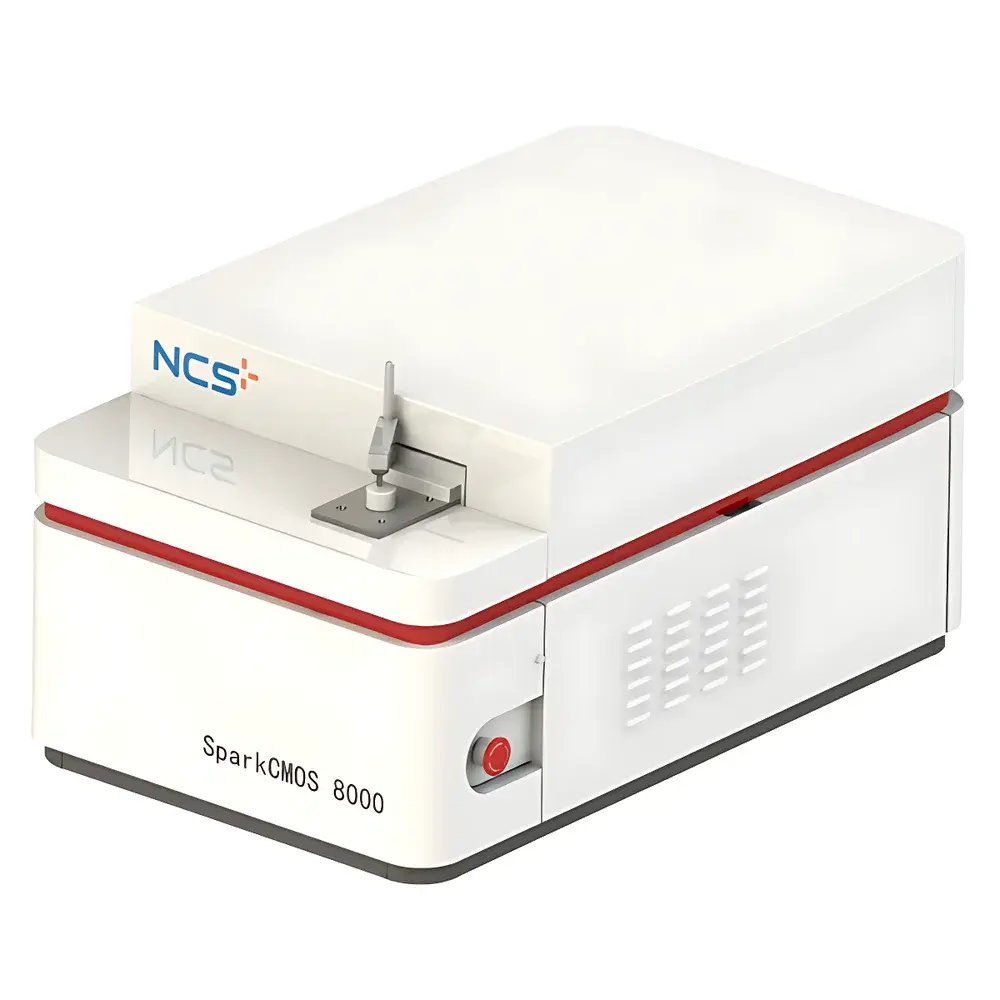
NCS SparkCMOS 8000 Full-Spectrum Spark Optical Emission Spectrometer
| Brand | NCS |
|---|---|
| Origin | Jiangsu, China |
| Manufacturer Type | Direct Manufacturer |
| Instrument Type | Benchtop |
| Excitation Method | Spark Discharge |
| Detector Type | CMOS Array |
| Focal Length | 500 mm |
| Grating Groove Density | 2700 lines/mm |
| Wavelength Range | 130–800 nm |
| Power Supply | 220 V ±10%, Single-Phase, 10 A, 2.5 kVA |
| Weight | 100 kg |
| Argon Consumption (Standby) | 60 mL/min |
| Optical System | Paschen-Runge Mount with Holographic Grating |
| Temperature Control Precision | ±0.1 °C |
| Startup Time (Cold) | 30 min |
| Startup Time (Hot) | 5 min |
Overview
The NCS SparkCMOS 8000 is a benchtop full-spectrum spark optical emission spectrometer engineered for high-precision elemental analysis of metallic alloys in industrial and laboratory environments. It operates on the principle of spark discharge atomic emission spectroscopy (AES), where a controlled electrical spark vaporizes and excites surface atoms of a solid metal sample; the resulting element-specific emission spectra are dispersed by a high-resolution holographic grating and captured simultaneously across the entire spectral range (130–800 nm) using a custom-designed CMOS array detector. Its Paschen-Runge optical architecture—featuring a 500 mm focal length and 2700 lines/mm groove density—ensures uniform spectral resolution (first-order linear dispersion: 0.7407 nm/mm), minimal optical aberration, and exceptional signal fidelity from vacuum UV to near-infrared regions. As the national standard drafting entity for GB/T 4336–2016 (determination of multi-element content in carbon and low-alloy steels by spark OES), the SparkCMOS 8000 meets rigorous metrological requirements for routine production control, incoming material verification, and R&D-grade compositional profiling.
Key Features
- High-sensitivity CMOS detector array with anti-reflective UV-enhanced coating, enabling sub-ppm detection limits for critical elements such as N, P, S, and C in steel matrices.
- Patented all-digital spark source with adjustable frequency up to 1000 Hz, optimized pulse shape, and real-time energy regulation per material type for stable ablation and reproducible excitation.
- Integrated thermal management system maintaining optical chamber temperature at ±0.1 °C via uniform heating and electromagnetic shielding—eliminating thermal drift-induced wavelength shift or intensity variation.
- Tidal-purge argon flow control reduces standby consumption to 60 mL/min; cold-start time is 30 minutes after 12-hour shutdown, while hot-start requires only 5 minutes—enabling rapid deployment in foundry and QA/QC workflows.
- Modular exposure control allows independent integration time assignment per CMOS segment during single spark event, enhancing signal-to-noise ratio for trace elements without compromising major constituent accuracy.
- Coaxial rotating gas delivery system ensures homogeneous plasma formation and complete electrode cleaning—supporting >1000 consecutive analyses without manual maintenance.
- Intelligent spectral line switching algorithm dynamically selects optimal analytical lines based on preliminary intensity ratios, expanding effective calibration range within a single program and improving long-term measurement robustness.
Sample Compatibility & Compliance
The SparkCMOS 8000 supports quantitative analysis of solid metallic samples across Fe-, Al-, Cu-, Ni-, Co-, Mg-, Ti-, Zn-, Pb-, and Sn-based alloy systems—including stainless steels, tool steels, aluminum die-castings, copper brazing alloys, nickel superalloys, and titanium aerospace grades. Sample preparation follows standardized flat-surface polishing per ISO 11577 and ASTM E407 guidelines. The instrument complies with GB/T 4336–2016, ISO 11577:2019, ASTM E1086, and EN 10315 for spark OES methodology. Its software architecture supports audit trail logging, user access control, electronic signatures, and data integrity features aligned with FDA 21 CFR Part 11 and GLP/GMP documentation requirements.
Software & Data Management
The embedded NCS SpectraSuite software provides intuitive workflow navigation, multi-language interface support (English, German, French, Spanish), and fully customizable report templates compliant with ISO/IEC 17025 reporting clauses. All raw spectral data, background-subtracted intensities, calibration coefficients, and QC statistics are stored in encrypted SQLite databases with timestamped revision history. Export options include CSV, PDF, XML, and LIMS-compatible ASTM E1382-compliant formats. Remote diagnostics, firmware updates, and method synchronization are enabled via secure TLS-encrypted Ethernet or Wi-Fi connection—facilitating centralized fleet management in multi-site manufacturing operations.
Applications
The SparkCMOS 8000 serves as a core analytical platform in metallurgical process control (e.g., ladle analysis, continuous casting monitoring), foundry quality assurance (incoming scrap verification, melt composition adjustment), automotive component certification (engine blocks, transmission housings), shipbuilding material compliance (ABS, DNV-GL grade validation), power generation equipment inspection (turbine blades, heat exchanger tubing), and academic research on phase transformation kinetics and microsegregation behavior. It is widely deployed in Tier-1 suppliers, national testing institutes, university metallurgy labs, and third-party certification bodies requiring traceable, repeatable, and standards-aligned elemental quantification.
FAQ
What is the minimum detectable concentration for nitrogen in low-alloy steel?
Detection limits are matrix- and condition-dependent; typical N LOD in Fe-base alloys under optimized conditions is ≤15 ppm (3σ), validated per ISO 11885 Annex B.
Does the instrument support automated calibration verification using certified reference materials (CRMs)?
Yes—software includes CRM-driven drift correction routines with configurable frequency, tolerance thresholds, and auto-rejection logic for out-of-spec verification results.
Can the SparkCMOS 8000 analyze non-conductive coatings or surface contaminants?
No—it is designed exclusively for bulk metallic solids; surface oxides or coatings must be removed prior to analysis per ASTM E1479 to avoid spectral interference and carbon contamination artifacts.
Is remote software update and technical support available outside China?
Yes—NCS provides global firmware updates, online training modules, and remote assistance via secure TeamViewer sessions with English-speaking application engineers.
How does the tidal-purge argon system reduce operational cost compared to conventional constant-flow designs?
By dynamically adjusting argon flow based on idle duration and ambient pressure, it achieves ~60% lower annual gas consumption versus fixed 3–5 L/min systems—translating to >70 days of standby operation per standard Ar cylinder.




