
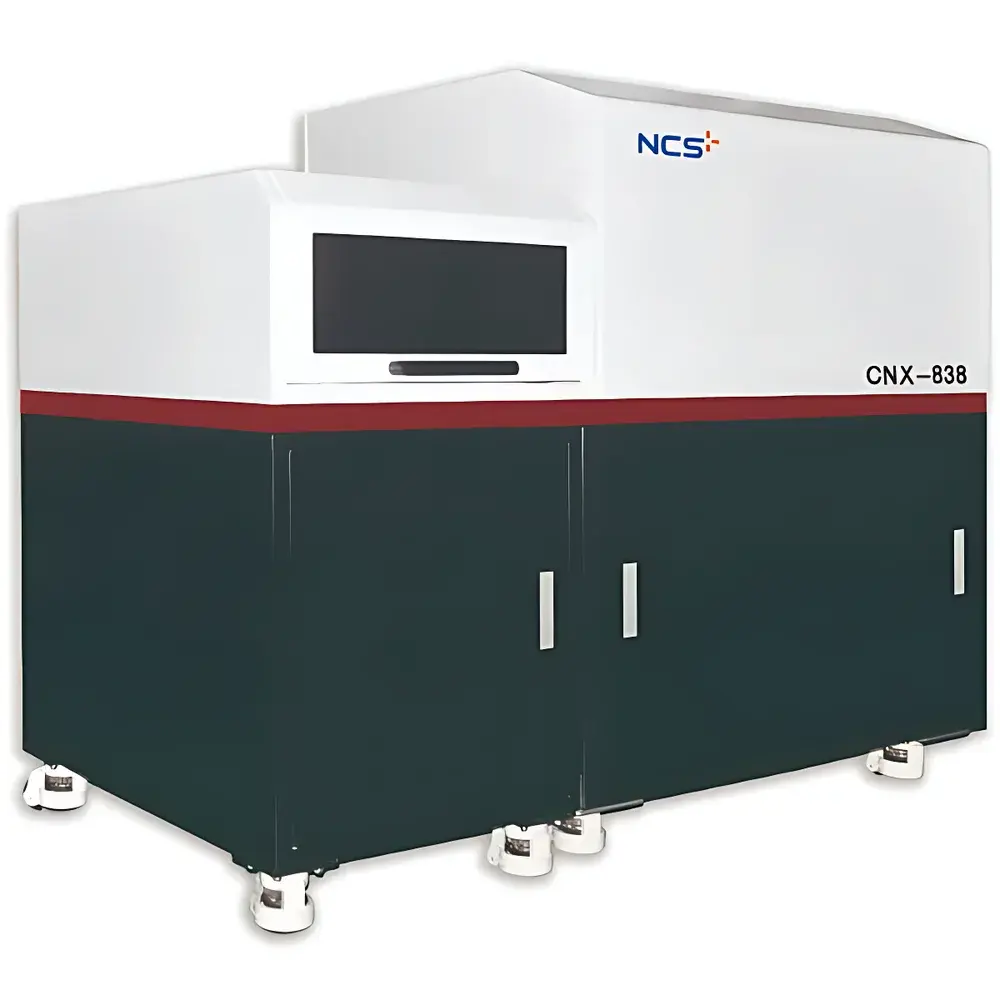
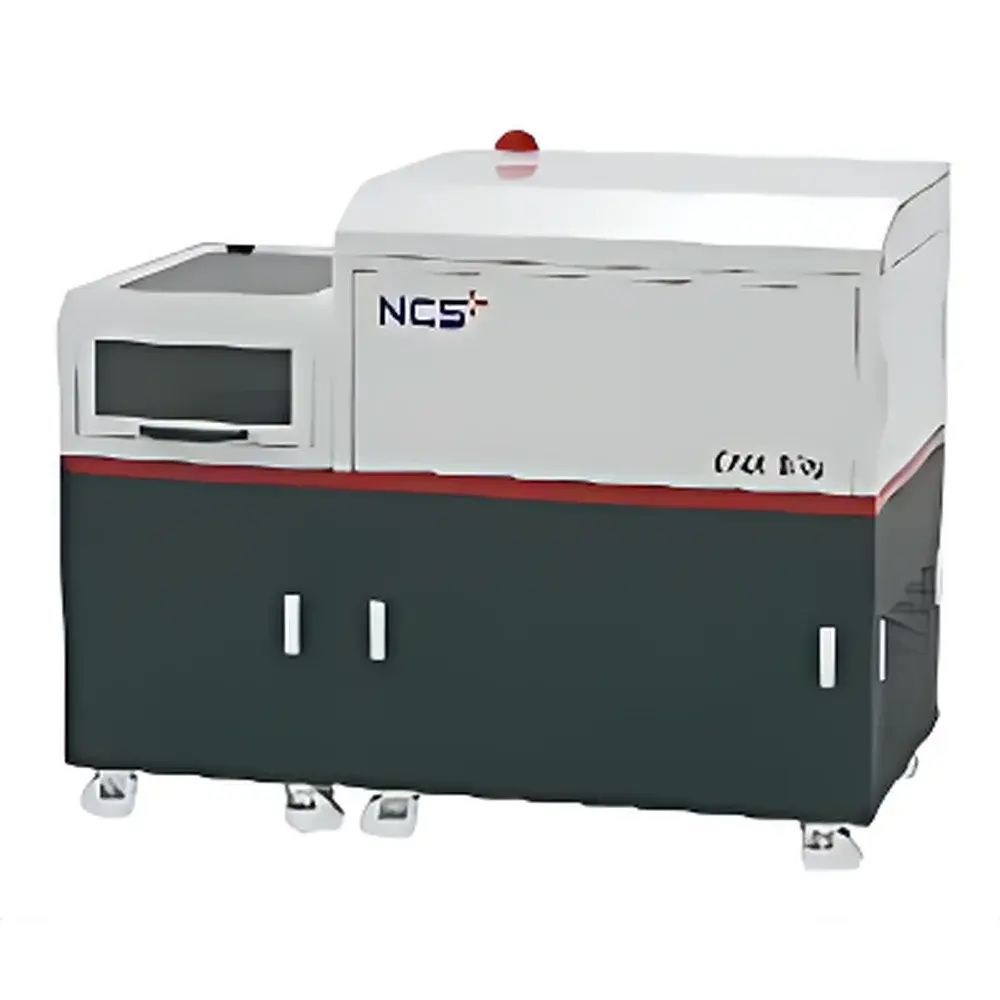
NCS CNX-838 Sequential Wavelength Dispersive X-Ray Fluorescence Spectrometer
| Brand | NCS |
|---|---|
| Origin | Beijing, China |
| Manufacturer Type | Direct Manufacturer |
| Instrument Type | Floor-standing |
| Instrument Category | Scanning-type |
| X-ray Tube Power | 4 kW |
| Analyzable Elements | B to U |
| Beryllium Window Thickness | 75 μm (optional ≤75 μm variants) |
| Goniometer Angular Reproducibility | θ–2θ independent drive |
| Scan Ranges | SC (1–118°), PC (10–148°) |
| Step Angles | 0.001°, 0.002°, 0.005°, 0.01°, 0.02°, 0.05°, 0.1° |
Overview
The NCS CNX-838 Sequential Wavelength Dispersive X-Ray Fluorescence (WDXRF) Spectrometer is a high-precision, floor-standing analytical platform engineered for quantitative and qualitative elemental analysis of solid, powder, and fused-bead samples across the periodic table—from boron (B, Z=5) to uranium (U, Z=92). Based on Bragg’s law and sequential wavelength dispersion, the instrument employs crystalline diffraction optics to isolate characteristic X-ray emission lines with exceptional spectral resolution and peak-to-background ratio. Its 4 kW high-power Rh-anode end-window X-ray tube—coupled with dual-vacuum chambers (analysis chamber and sample introduction chamber), thermally stabilized goniometry (±0.1°C), and ultra-low-drift high-voltage generator (60 kV / 150 mA, long-term stability ≤0.01%)—ensures robust signal intensity, measurement repeatability, and trace-level detection capability in routine laboratory and industrial QA/QC environments.
Key Features
- High-power excitation: 4 kW Rh-target X-ray tube with 75 μm Be window (optionally thinner for light-element sensitivity); optimized for enhanced intensity of low-Z elements (B–F) and stable high-Z line intensities.
- Precision goniometric system: θ–2θ independently driven mechanical stage with angular reproducibility <0.001°; programmable step angles from 0.001° to 0.1°; dual scan ranges (SC: 1–118°, PC: 10–148°) for flexible crystal selection and peak positioning.
- Multi-crystal diffraction optics: Standard set includes LiF200 (K-series lines, K–U), PET (Al–Cl), Ge (P–Cl), and synthetic multilayer (O–Mg), enabling full coverage of major analytical lines with optimal d-spacing matching.
- Dual-detector configuration: Scintillation counter (SC) for high-count-rate heavy-element analysis and flow-proportional counter (F-PC) for high-sensitivity light-element detection (e.g., Na, Mg, Al, Si) under He or vacuum purge.
- Automated sample handling: 48-position robotic autosampler with polar-coordinate sample stage, integrated sample spin function, and customizable stainless-steel cups (up to φ50 mm × H30 mm) for heterogeneous solids and pressed pellets.
- Thermal and vacuum integrity: Constant-temperature goniometer housing (36.5 ± 0.1 °C); dual-pump vacuum system achieving <15 Pa in both analysis and load-lock chambers—critical for oxygen-sensitive measurements and minimizing hydrocarbon contamination.
Sample Compatibility & Compliance
The CNX-838 supports direct analysis of metals, alloys, ceramics, geological samples, catalysts, cement, polymers, and environmental solids—without matrix-matched standards in many cases due to fundamental parameter (FP)-assisted quantification. Sample preparation options include pressed pellets (with binder), fused beads (Li-tetraborate/Li-metaborate), and direct metal discs. The system complies with ISO 22036 (XRF for soils and sediments), ASTM E1621 (standard guide for WDXRF analysis), and supports audit-ready operation per GLP/GMP requirements through time-stamped log files, user-access control, and full measurement history retention. Optional 21 CFR Part 11-compliant software modules are available for regulated pharmaceutical and materials certification workflows.
Software & Data Management
The proprietary NCS WDXRF analysis suite provides fully integrated instrument control, method development, calibration management, and reporting. Core capabilities include automated qualitative scanning (peak search and identification), FP-based and empirical calibration (including standardless analysis), automatic background correction, inter-element interference correction (alpha coefficients), and multi-layer thin-film quantification. All measurement parameters—including voltage/current, crystal/detector selection, collimator/aperture settings, counting time, and vacuum status—are logged with timestamps and operator ID. Export formats include CSV, PDF reports (customizable templates), and XML for LIMS integration. Audit trail functionality records all method modifications, result edits, and user login/logout events.
Applications
The CNX-838 delivers trace-to-major element quantification in diverse sectors: metallurgical QC (Fe, Al, Cu, Ti, Ni alloys); geochemical exploration (major oxides, REEs, PGEs in rocks/soils); cement and clinker analysis (SiO₂, Al₂O₃, Fe₂O₃, CaO, SO₃); catalyst composition verification (Pt, Pd, V, Mo); and regulatory compliance testing (RoHS, ELV, WEEE screening for Pb, Cd, Hg, Cr⁶⁺, Br). Its high-resolution diffraction optics enable separation of overlapping peaks (e.g., V Kβ / Ti Kα, S Kα / Pb Mα), critical for accurate analysis in complex matrices where energy-dispersive systems face spectral overlap limitations.
FAQ
What is the minimum detectable limit (MDL) for light elements such as sodium or magnesium?
MDL depends on sample matrix, acquisition time, and vacuum/purge conditions; typical MDLs range from 10–50 ppm for Na–Mg in optimized fused-bead configurations using F-PC detection under He flush.
Can the CNX-838 perform thin-film or coating thickness analysis?
Yes—the instrument supports multi-layer film quantification using fundamental parameter algorithms and optional thin-film calibration standards; depth resolution is governed by incident beam energy and take-off angle.
Is remote diagnostics and software update support available?
NCS provides secure remote access via encrypted VPN for technical diagnostics; software updates are delivered quarterly with version-controlled release notes and validation documentation.
How is calibration traceability maintained for regulatory submissions?
Certified reference materials (CRMs) from NIST, BAM, or IRMM are supported; calibration certificates include uncertainty budgets per ISO/IEC 17025 guidelines, and raw data files retain full spectral metadata for reprocessing.
What maintenance intervals are recommended for the X-ray tube and vacuum pumps?
X-ray tube lifetime exceeds 20,000 hours under nominal 4 kW operation; diffusion pump oil replacement every 12 months and scroll pump maintenance every 6 months are advised based on vacuum performance monitoring.





