
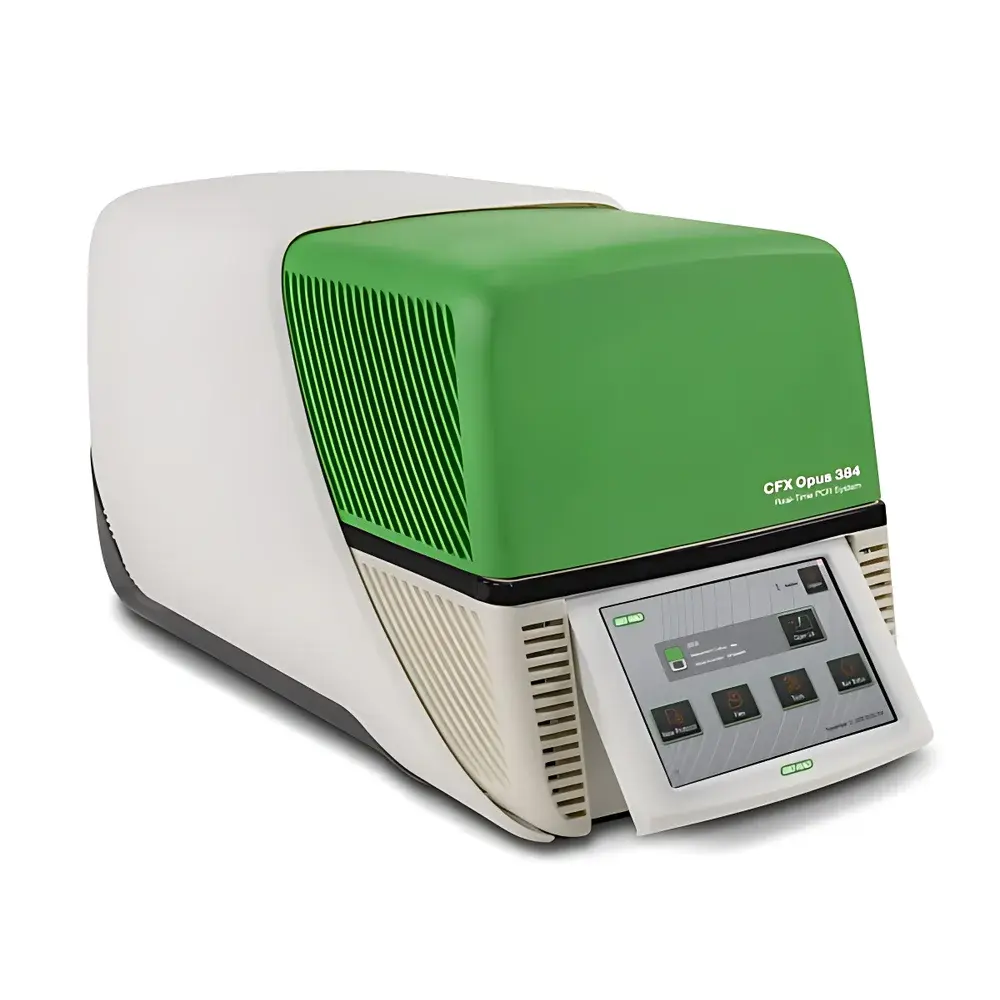

Bio-Rad CFX Opus 384 Real-Time PCR Detection System
| Brand | Bio-Rad |
|---|---|
| Origin | Singapore |
| Model | CFX Opus 384 |
| Instrument Type | Real-Time Fluorescent Quantitative PCR System |
| Sample Throughput | 384-well format |
| Heating Rate | 2.5 °C/sec |
| Temperature Accuracy | ±0.2 °C |
| Well-to-Well Temperature Uniformity | ±0.3 °C |
Overview
The Bio-Rad CFX Opus 384 Real-Time PCR Detection System is a high-throughput, thermally precise platform engineered for quantitative nucleic acid amplification and detection using fluorescent probe– and dye-based chemistries. Built upon the foundational principles of polymerase chain reaction kinetics and real-time fluorescence monitoring, the system employs a solid-state thermal cycling block with proprietary lightweight aluminum sample plate architecture to minimize thermal mass and maximize ramping efficiency. Each well is independently monitored via a spatially resolved optical detection system that eliminates optical crosstalk and path-length variability—enabling true per-well excitation and emission collection without the need for inter-well fluorescence normalization or calibration. Designed for research-grade reproducibility in gene expression profiling, genotyping, pathogen detection, and miRNA quantification, the CFX Opus 384 meets stringent requirements for assay robustness, inter-run consistency, and low-coefficient-of-variation (CV) data output across all 384 positions.
Key Features
- Precision thermal control: Patented low-mass sample block delivers ±0.2 °C accuracy and ±0.3 °C well-to-well uniformity—critical for minimizing edge effects in high-density plates.
- Dynamic temperature gradient functionality: Enables rapid empirical optimization of annealing conditions across 12 distinct temperature zones within a single run.
- Per-well optical excitation and detection: Eliminates fluorescence bleed-through and photometric bias; supports multiplexed assays up to 6 targets per well without spectral unmixing artifacts.
- FRET-capable optical channels: Integrated dual-excitation/dual-emission pathways facilitate homo-FRET and hetero-FRET applications including molecular beacon and scorpion primer assays.
- Touchscreen interface with adjustable tilt (12°–55°): Fully operable with bare hands or single/double-layer nitrile gloves; responsive haptic feedback via color-shift navigation cues.
- Multi-modal connectivity: Native Ethernet and Wi-Fi support enables local network integration, BR.io cloud access, and direct USB storage—no dedicated host PC required for basic operation.
Sample Compatibility & Compliance
The CFX Opus 384 accepts standard 384-well PCR plates (including skirted, semi-skirted, and non-skirted formats) and compatible optical seals. It supports all major qPCR chemistries—including SYBR Green I, hydrolysis probes (TaqMan), molecular beacons, scorpions, and FRET hybridization probes—without hardware modification. The system operates in full compliance with ISO/IEC 17025–aligned laboratory quality practices and supports audit-trail–enabled workflows aligned with GLP and GMP documentation standards. While not cleared for clinical diagnostic use, its performance specifications align with ASTM E2599-22 (Standard Guide for Real-Time PCR Instrument Performance Verification) and USP recommendations for environmental monitoring instrumentation qualification.
Software & Data Management
CFX Maestro Software v5.x provides an integrated environment for experiment design, real-time monitoring, statistical analysis, and publication-ready visualization. It includes automated reference gene selection algorithms, ΔΔCt workflow templates, and built-in statistical modules (unpaired t-tests, one-way ANOVA with post-hoc Tukey correction). All analyses generate traceable metadata logs compliant with FDA 21 CFR Part 11 requirements when used in secure mode with electronic signatures enabled. Data export options include SVG, TIFF, and PDF formats—with customizable annotations (p-values, arrows, text overlays), scalable fonts, and editable legends. Integration with Bio-Rad’s PrimePCR Assay database allows one-click import of pre-validated primer/probe sets, complete with MIQE-compliant validation reports and amplification efficiency metrics. Local storage, network drive mapping, and BR.io cloud synchronization are supported simultaneously—ensuring data integrity across hybrid infrastructure deployments.
Applications
- High-throughput gene expression profiling across large sample cohorts (e.g., time-course studies, drug screening panels).
- SNP genotyping and copy number variation (CNV) analysis using allele-specific hydrolysis probes.
- Viral load quantification and antimicrobial resistance gene detection in clinical research settings.
- MicroRNA expression analysis leveraging stem-loop RT primers and locked nucleic acid (LNA) probes.
- Quality control of CRISPR editing efficiency via T7E1 or RFLP-coupled qPCR endpoints.
- Validation of RNA-seq results through targeted re-sequencing of differentially expressed transcripts.
FAQ
Is the CFX Opus 384 validated for diagnostic use?
No. This instrument is intended solely for research purposes and is not approved by regulatory authorities for clinical diagnosis or patient management.
Can I perform melt curve analysis on the CFX Opus 384?
Yes. The system supports high-resolution melt (HRM) analysis with continuous fluorescence acquisition during linear ramping (0.01–0.2 °C/sec), enabling discrimination of single-base variants and methylation status.
Does CFX Maestro support LIMS integration?
Yes. Through standardized CSV and XML export protocols, as well as optional REST API access (via BR.io), the software supports bidirectional data exchange with common laboratory information management systems.
What file formats are supported for assay design import?
CFX Maestro accepts .csv, .xlsx, and PrimePCR-specific .ppa files. Custom assay configurations can also be defined manually with full control over probe sequences, dye assignments, and reaction volumes.
How is data security managed in BR.io cloud deployments?
All data transmitted to and stored on BR.io is encrypted in transit (TLS 1.2+) and at rest (AES-256). Role-based access controls, session timeouts, and mandatory two-factor authentication (2FA) are configurable per organizational policy.







