
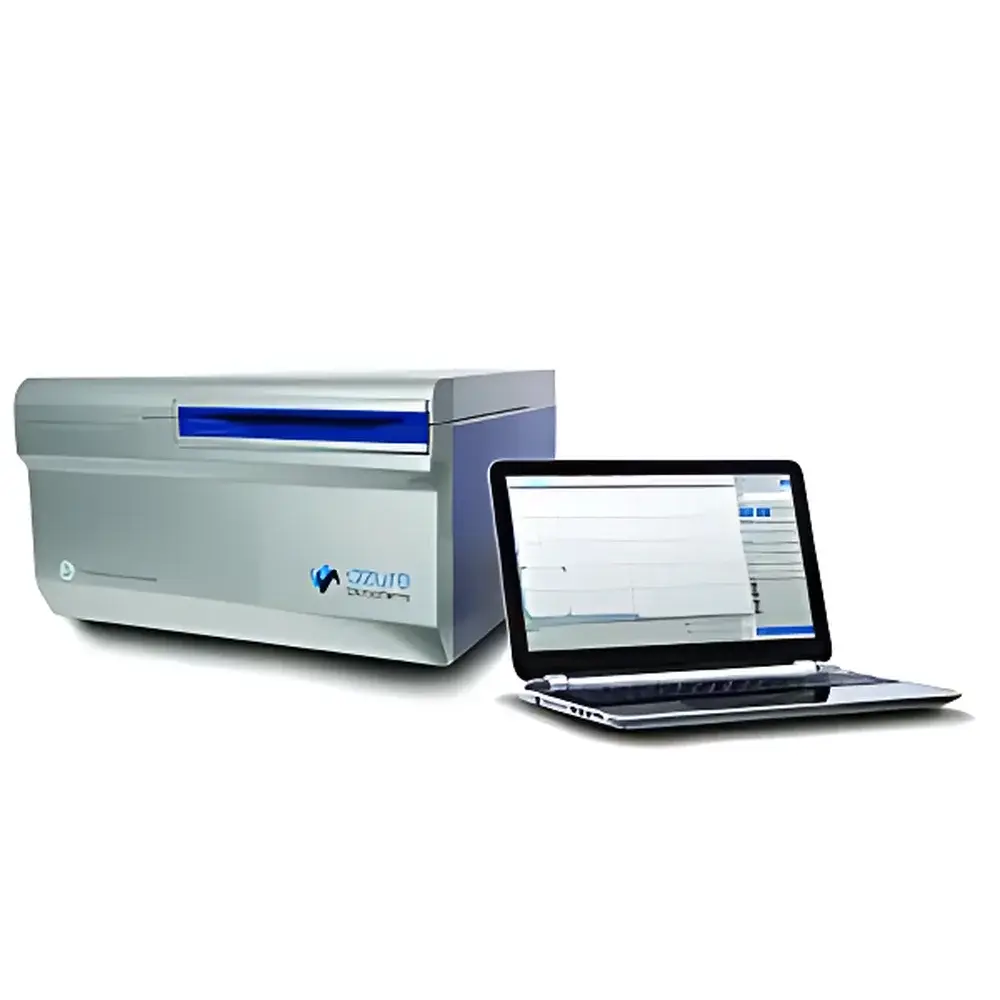
Azure Biosystems Sapphire NIR-Q Dual-Mode Multispectral Laser Gel Imaging System
| Brand | Azure Biosystems |
|---|---|
| Origin | USA |
| Model | Sapphire NIR-Q |
| Instrument Type | Multicolor Fluorescent Gel Imaging System |
| CCD Resolution | 6.1 MP |
| Bit Depth | 16-bit |
| Dynamic Range | 0–6 OD |
| CCD Sensor Size | 1-inch |
| Detection Sensitivity | fg-level protein |
| Signal-to-Noise Ratio | ≥72 dB |
| Lens | Motorized Autofocus |
Overview
The Azure Biosystems Sapphire NIR-Q Dual-Mode Multispectral Laser Gel Imaging System is an engineered platform for quantitative, reproducible Western blot analysis using near-infrared (NIR) fluorescence detection and total protein normalization. Unlike conventional chemiluminescent or single-channel fluorescent imagers, the Sapphire NIR-Q integrates three independent optical detection channels: two dedicated to high-sensitivity NIR fluorescence (700 nm and 800 nm), and a third optimized for total protein staining—enabling simultaneous acquisition of target proteins and total protein signal without stripping, re-probing, or membrane reprocessing. Its core measurement principle relies on laser-excited fluorescence detection with precisely calibrated photomultiplier tube (PMT) amplification and temperature-stabilized CCD imaging, ensuring linear response across six orders of optical density (0–6 OD). This architecture supports true quantitative immunoblotting in compliance with evolving best practices endorsed by leading journals and quantitative proteomics consortia.
Key Features
- Dual NIR fluorescence channels (700 nm & 800 nm) enable multiplexed detection of phosphorylated/non-phosphorylated isoforms, co-immunoprecipitated partners, or species-specific secondary antibodies—without spectral bleed-through or cross-excitation.
- Dedicated total protein channel eliminates reliance on housekeeping proteins; supports direct, lane-wise quantification of total protein load per transfer membrane using validated fluorescent stains such as AzureRed.
- 16-bit dynamic acquisition with ≥72 dB SNR ensures accurate digitization of low-abundance bands while preserving saturation-free linearity across the full 0–6 OD range—critical for ratio-based normalization.
- Motorized autofocus system maintains consistent focal plane across variable membrane thicknesses and mounting configurations, reducing operator-induced variability in repeated acquisitions.
- 6.1-megapixel, 1-inch cooled CCD sensor delivers high spatial resolution (≤25 µm effective pixel size) for precise band delineation and background subtraction in dense electrophoretic lanes.
- Modular hardware design allows field-upgradable components—including laser modules, emission filters, and sample trays—to accommodate future assay formats without platform replacement.
Sample Compatibility & Compliance
The Sapphire NIR-Q accommodates standard nitrocellulose and PVDF membranes (up to 20 × 20 cm), as well as SDS-PAGE gels, 2D gels, and nucleic acid blots. It supports all major NIR-compatible dyes (e.g., IRDye 680/800, Alexa Fluor 790) and total protein stains including AzureRed, REVERT, and LI-COR TotalStain Q. The system meets ISO/IEC 17025 documentation requirements for instrument calibration traceability and is compatible with GLP/GMP-aligned workflows through audit-trail-enabled software logging (see Software section). While not FDA-cleared as a diagnostic device, its performance characteristics align with ASTM E2924–22 guidelines for quantitative immunoblot validation and USP recommendations for analytical method verification in biopharmaceutical characterization.
Software & Data Management
AzureSpot™ software (v7.0+) provides end-to-end image acquisition, quantification, and reporting within a 21 CFR Part 11–compliant environment. Key capabilities include automatic lane and band detection with adaptive background modeling, integrated total protein normalization workflows, and batch processing of multi-condition experiments. All acquisition parameters—including laser power, PMT gain, exposure time, and focus position—are logged with timestamps and user IDs. Audit trails record every modification to region-of-interest (ROI) definitions, normalization coefficients, and export actions. Raw image data are stored in open-format TIFF (with embedded metadata) and can be exported to CSV, PDF, or MIAME-compliant MAGE-TAB for integration into LIMS or ELN systems. Optional cloud synchronization enables secure remote review and collaborative annotation across geographically distributed labs.
Applications
- Quantitative Western blotting with total protein normalization for publication-grade data submission.
- Multiplexed phospho-protein profiling (e.g., p-ERK vs. total ERK) without antibody cross-reactivity or sequential stripping.
- Comparative expression analysis across cell lines, time courses, or drug-dose responses under controlled loading conditions.
- Validation of CRISPR/Cas9 knockouts or siRNA-mediated knockdowns via absolute signal reduction relative to total protein baseline.
- Quality control of electrophoretic transfer efficiency through post-staining visualization of residual gel-bound proteins.
- High-throughput screening of antibody specificity using orthogonal detection channels to exclude off-target binding artifacts.
FAQ
Can the Sapphire NIR-Q perform chemiluminescent detection?
No—the system is optimized exclusively for fluorescence-based detection. Chemiluminescence requires separate instrumentation with intensified CCD or EMCCD sensors.
Is AzureRed compatible with downstream immunodetection?
Yes—AzureRed is non-covalent, reversible, and does not interfere with epitope recognition when applied pre-blocking. Protocols support staining prior to primary antibody incubation.
How does total protein normalization improve reproducibility versus housekeeping proteins?
Total protein normalization accounts for technical variation in sample loading and transfer efficiency, whereas housekeeping proteins exhibit biological variability across cell states, treatments, and tissue types—introducing systematic bias into fold-change calculations.
Does the system support automated alignment of multiple channel images?
Yes—hardware-based registration ensures sub-pixel spatial congruence between NIR and total protein channels. AzureSpot applies no software-based warping, preserving quantitative integrity of co-localized signals.
What maintenance is required for long-term calibration stability?
Annual PM includes laser power verification, PMT gain calibration against NIST-traceable standards, and CCD dark-current profiling. No consumables or user-serviceable optics are required between service intervals.




