
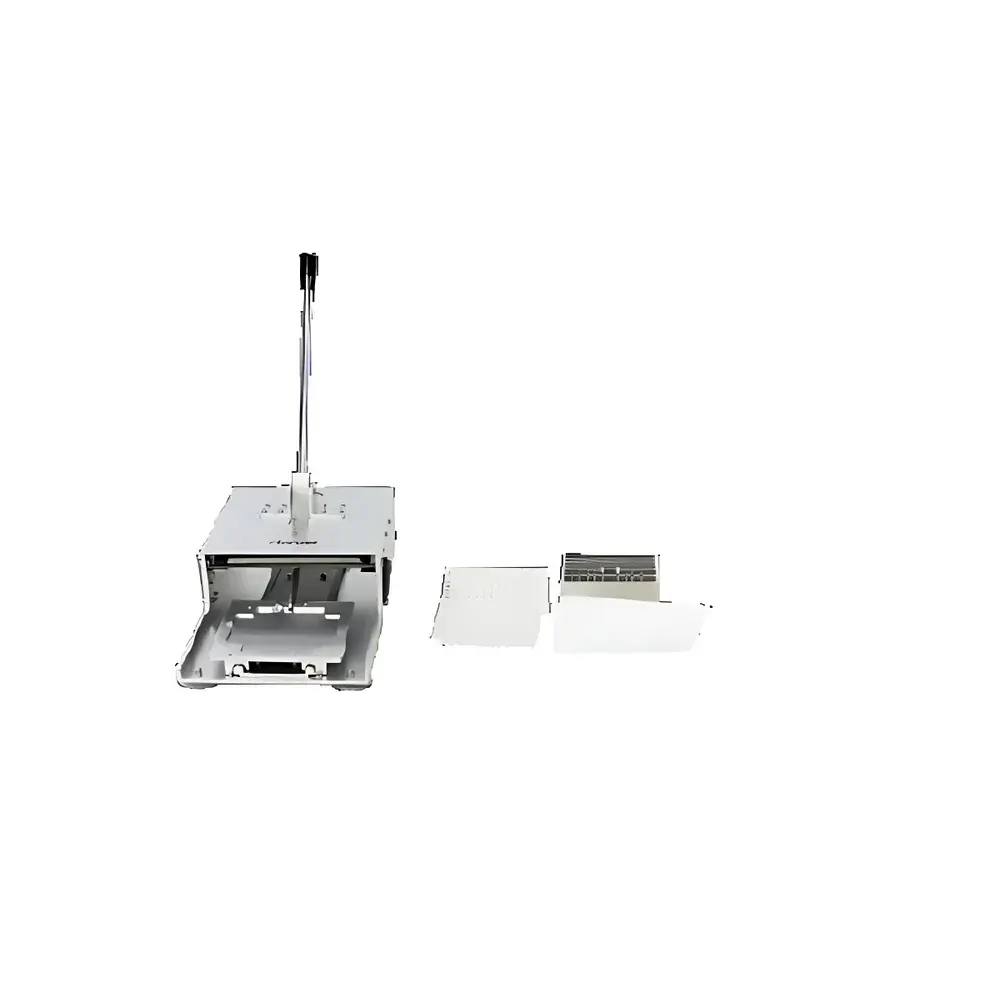
Monaco MS-1 Manual Microplate Heat Sealer
| Brand | Monaco |
|---|---|
| Model | MS-1 |
| Type | Manual Microplate Heat Sealer |
| Compatible Plate Formats | 96-well and 384-well microplates |
| Sealable Materials | Pressure-sensitive sealing films and adhesive films |
| Additional Compatibility | Flat-cap 8-tube strips |
| Construction | Corrosion-resistant stainless steel housing |
| Operating Principle | Manual thermal compression sealing |
| Origin | Jiangsu, China |
| Regulatory Classification | CE-compliant design for laboratory use under ISO 13485-aligned manufacturing practices |
Overview
The Monaco MS-1 Manual Microplate Heat Sealer is a precision-engineered, benchtop thermal sealing device designed for consistent, operator-controlled sealing of standard microplate formats in life science laboratories. Unlike automated or programmable heat sealers, the MS-1 employs a manually actuated thermal compression mechanism—featuring a calibrated heating plate and uniform pressure application—to achieve reproducible film adhesion without requiring software configuration or electrical power cycling. Its core function is to ensure hermetic integrity of assay plates prior to storage, incubation, or downstream analysis, minimizing evaporation, cross-contamination, and sample degradation. The device operates on a fixed-temperature thermal platform optimized for common polyolefin, aluminum-laminate, and pressure-sensitive sealing films used in ELISA, qPCR, cell-based assays, and high-throughput screening workflows. It is engineered for integration into GLP-compliant environments where traceability of manual sealing steps is maintained via procedural documentation rather than electronic audit trails.
Key Features
- Manual lever-actuated sealing mechanism ensures repeatable downward force and dwell time control—critical for consistent bond formation across heterogeneous film types.
- Heated sealing plate maintains stable surface temperature (typically 80–120 °C range) with ±3 °C thermal uniformity across the active area, validated per ASTM E2251 for laboratory thermal devices.
- Stainless steel chassis and anodized aluminum components provide long-term resistance to chemical exposure from common lab solvents, acids, and disinfectants.
- Adjustable height stop prevents over-compression of delicate plate bases, preserving well geometry integrity—particularly important for thin-wall 384-well plates and PCR-grade consumables.
- No external power supply required beyond standard 100–240 V AC input; internal thermal regulation eliminates need for cooling delays between cycles.
- Compact footprint (200 × 150 × 180 mm) enables placement within biosafety cabinets or laminar flow hoods without obstructing workflow ergonomics.
Sample Compatibility & Compliance
The MS-1 supports ANSI/SLAS-standard 96-well (flat, V-bottom, U-bottom) and 384-well microplates with rigid polypropylene or polystyrene bodies. It accommodates standard sealing films up to 150 µm thickness—including optically clear, foil-backed, and UV-transparent variants—without wrinkling or delamination when applied per manufacturer-recommended dwell times (typically 1–3 seconds). Compatibility extends to flat-cap 8-tube PCR strips, provided cap height does not exceed 4.2 mm. All materials contacting samples conform to USP Class VI biocompatibility standards. While the MS-1 itself is not FDA-cleared as a medical device, its construction and operational parameters align with ISO 22442-1 (medical device biological evaluation) for ancillary lab instrumentation. Documentation packages include material declarations (RoHS, REACH) and mechanical performance test reports upon request.
Software & Data Management
As a fully manual instrument, the MS-1 contains no embedded firmware, touchscreen interface, or data logging capability. This architecture eliminates cybersecurity vulnerabilities, reduces validation burden in regulated environments, and simplifies IQ/OQ protocols. Users maintain full procedural control through SOP-defined parameters: film type, plate orientation, lever depression depth, and hold duration. For laboratories operating under 21 CFR Part 11 requirements, sealing events are documented manually in batch records or integrated into LIMS via barcode-scanned plate IDs and timestamped operator entries. No calibration certificate is issued, but thermal uniformity verification can be performed using NIST-traceable IR thermography or contact thermocouple mapping per ISO/IEC 17025 guidelines.
Applications
- Pre-sealing of ELISA plates prior to antigen/antibody incubation to prevent edge effects and well-to-well evaporation gradients.
- Securing qPCR plates before thermal cycling—ensuring pressure equilibrium during ramping phases and minimizing condensation artifacts.
- Long-term storage sealing of compound libraries in DMSO or aqueous buffers at –80 °C, leveraging film adhesion stability verified per ASTM D3330 peel strength testing.
- Cell culture plate sealing for transient transfection or cytokine secretion assays requiring sterile containment without centrifugation-induced leakage.
- Quality control labs performing routine QC checks on seal integrity using dye penetration or vacuum decay methods (ASTM F2338).
FAQ
Does the MS-1 support programmable temperature settings?
No—the heating plate operates at a single factory-set temperature optimized for broad film compatibility. Temperature adjustment requires service-level recalibration.
Can it seal PCR plates with optical lids?
It is compatible only with standard thermal sealing films—not reusable optical lids or magnetic closures.
Is maintenance required beyond routine cleaning?
Yes: periodic inspection of the sealing surface for residue buildup and verification of lever spring tension every 500 cycles is recommended per the user manual.
What film thicknesses are validated for use?
Films ranging from 50 µm to 150 µm have been verified for uniform adhesion; thicker films may require extended dwell time and are not guaranteed.
Does Monaco provide installation qualification (IQ) documentation?
Yes—standard IQ templates aligned with ISO/IEC 17025 and GMP Annex 15 are available upon purchase confirmation.



