
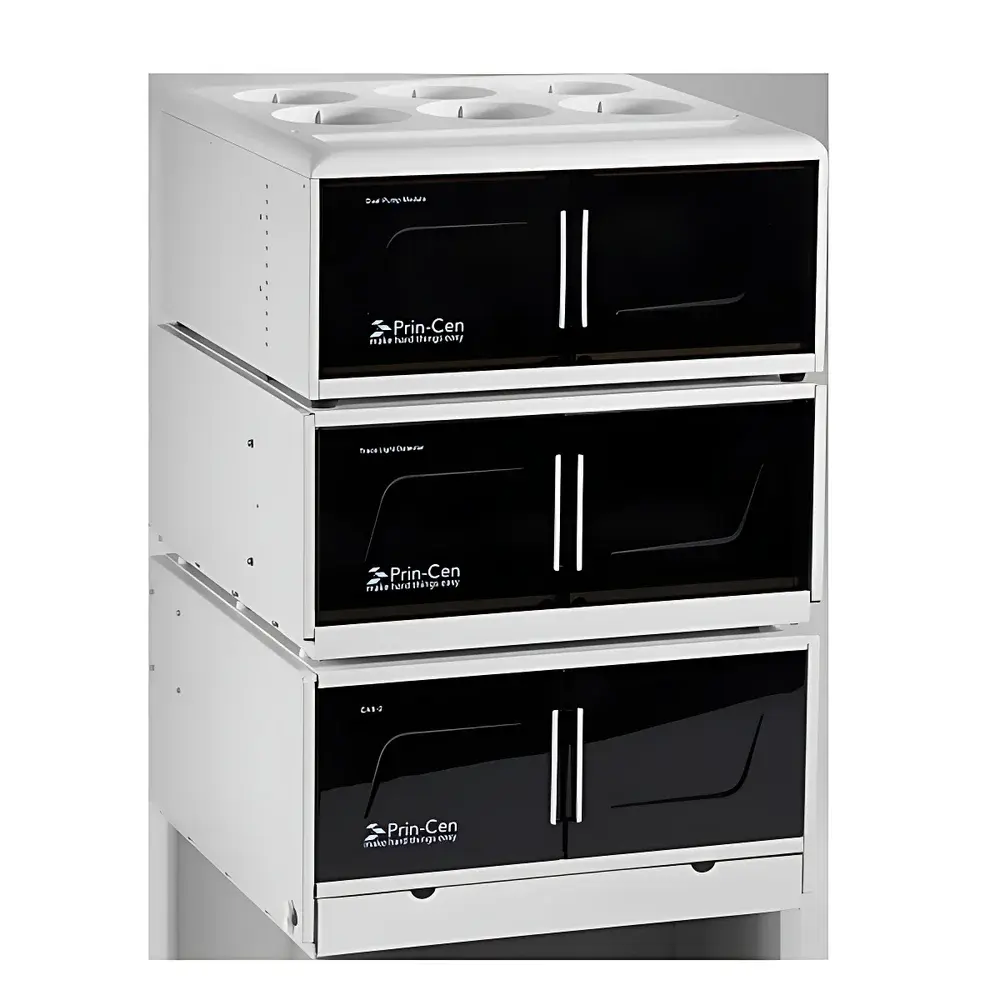
Prin-Cen ELSpe-2 Ultra-Trace Hexavalent Chromium Analyzer
| Brand | Prin-Cen |
|---|---|
| Origin | Guangdong, China |
| Manufacturer Type | Direct Manufacturer |
| Instrument Category | Domestic |
| Model | ELSpe-2 |
| Pricing | Upon Request |
| Instrument Type | Ultra-High-Performance Liquid Chromatograph (UHPLC) |
| Application Scope | General-Purpose |
| Flow Rate Range | 0.001–10.000 mL/min |
| Maximum Operating Pressure | 50 MPa |
| Autosampler Capacity | 120 positions × 2 mL vials |
| Injection Volume Range | 1–50 µL |
| Column Oven Temperature Range | (Ambient + 10 °C) to 60 °C |
| UV-Vis Detection Wavelength Range | 190–700 nm |
| Data Acquisition Frequency | 50 Hz |
Overview
The Prin-Cen ELSpe-2 Ultra-Trace Hexavalent Chromium Analyzer is a purpose-built UHPLC-based system engineered for the quantitative determination of Cr(VI) at sub-part-per-trillion (ppt) concentration levels in environmental, industrial, and regulatory compliance matrices. It implements post-column derivatization coupled with ion chromatography and UV-Vis spectrophotometric detection—a method validated per EPA Method 7196A and ISO 11083, and aligned with ASTM D5282 for chromium speciation in water and solid extracts. The system separates Cr(VI) anions (e.g., chromate, dichromate) on a high-efficiency anion-exchange column under suppressed conductivity-compatible eluent conditions, followed by precise, pulse-free post-column mixing with acidic 1,5-diphenylcarbazide (DPC) reagent. In acidic medium, Cr(VI) quantitatively oxidizes DPC to form a stable magenta-colored diphenylcarbazone-Cr(III) complex with maximum absorbance at 540 nm. This reaction—kinetically robust and stoichiometrically defined—enables trace-level specificity without interference from Cr(III), Fe(III), or common anions such as sulfate and nitrate when properly optimized.
Key Features
- Dual high-precision ion chromatography pumps: Independent binary gradient pump for separation and a dedicated, low-pulsation IC pump for post-column derivatization reagent delivery—reducing baseline noise and improving signal-to-noise ratio by >40% versus single-pump configurations.
- Thermally stabilized luminescence-decoupled (TLD) UV-Vis detector: Features dual-beam optical path, temperature-controlled flow cell (±0.1 °C), and real-time spectral compensation to suppress matrix-induced drift and photometric interference.
- Integrated column oven with PID-controlled thermal management: Maintains consistent retention time reproducibility (<0.05% RSD over 24 h) across ambient fluctuations, critical for long-sequence regulatory batch analysis.
- Autosampler with 120-position 2 mL vial capacity and programmable needle wash: Supports unattended operation for multi-day EPA-compliant monitoring campaigns; injection precision <1.0% RSD at 5 µL.
- Modular fluidic architecture: All wetted parts constructed from PEEK, PTFE, and titanium—resistant to aggressive eluents (e.g., KOH, NH₄NO₃) and acidic DPC reagent streams.
Sample Compatibility & Compliance
The ELSpe-2 accepts aqueous extracts from EPA SW-846 Methods 3060A (alkaline digestion for soils/sludges), 6800 (microwave-assisted extraction), and ISO 11083 filter leachates. It accommodates filtered samples (0.22 µm nylon or PVDF) with total dissolved solids ≤500 mg/L. System validation meets ICH Q2(R2) guidelines for specificity, linearity (0.01–10 µg/L, r² ≥ 0.9998), LOD (0.003 µg/L), and LOQ (0.01 µg/L) in ultrapure water and drinking water matrices. Full audit trail, electronic signatures, and 21 CFR Part 11–compliant software modules support GLP/GMP environments. Certificates of conformance are provided per ISO/IEC 17025:2017 for testing laboratories.
Software & Data Management
Controlled via ChromaLink™ v4.2 workstation software, the ELSpe-2 supports method development, sequence scheduling, peak integration using tangent skim and valley-to-valley algorithms, and automated calibration curve generation with forced zero-intercept options. Raw data files (.chd) are stored in vendor-neutral HDF5 format with embedded metadata (instrument ID, operator, timestamp, audit log). Software includes built-in EPA 7196A report templates, QC flagging (e.g., retention time shift >0.2 min, peak area RSD >5%), and export to LIMS via ASTM E1467-compliant XML schema. All user actions—including method edits, result overrides, and calibration updates—are time-stamped and digitally signed.
Applications
- Regulatory monitoring of Cr(VI) in drinking water per US EPA Maximum Contaminant Level (MCL) of 10 µg/L and California Prop 65 actionable level of 0.02 µg/day.
- Leachate analysis from chrome-plated metal waste, tanned leather, and pigment-containing consumer products per EU REACH Annex XVII restrictions.
- Process stream verification in electroplating facilities and stainless steel passivation baths.
- Speciation studies in soil pore water and groundwater plumes impacted by historical chromite ore processing.
- Reference material certification (e.g., NIST SRM 2701, 2702) and interlaboratory comparison exercises.
FAQ
What regulatory methods does the ELSpe-2 directly support?
EPA Method 7196A, ISO 11083, ASTM D5282, and EN ISO 17294-2 for chromium speciation in water and extractable matrices.
Can the system quantify Cr(VI) in high-salt matrices like seawater or brine?
Yes—with optional inline dilution module and matrix-matched calibration; recovery validation required per sample type per ISO/IEC 17025 clause 7.7.
Is post-column derivatization chemistry fully automated and reagent-stable?
DPC reagent is prepared daily per EPA protocol; the system monitors reagent expiration via barcode-scanned vial labels and halts injection if beyond 8 h stability window.
Does the TLD detector require annual lamp replacement?
The deuterium-tungsten dual-source lamp has a rated lifetime of ≥2,000 hours; software tracks cumulative usage and triggers preventive maintenance alerts.
How is system suitability verified before sample analysis?
Automated system suitability test (SST) runs include resolution check (Cr(VI)/Cl⁻ ≥ 2.5), sensitivity (S/N ≥ 100 at 0.1 µg/L), and retention time repeatability (RSD ≤ 0.15% over 5 injections).



