
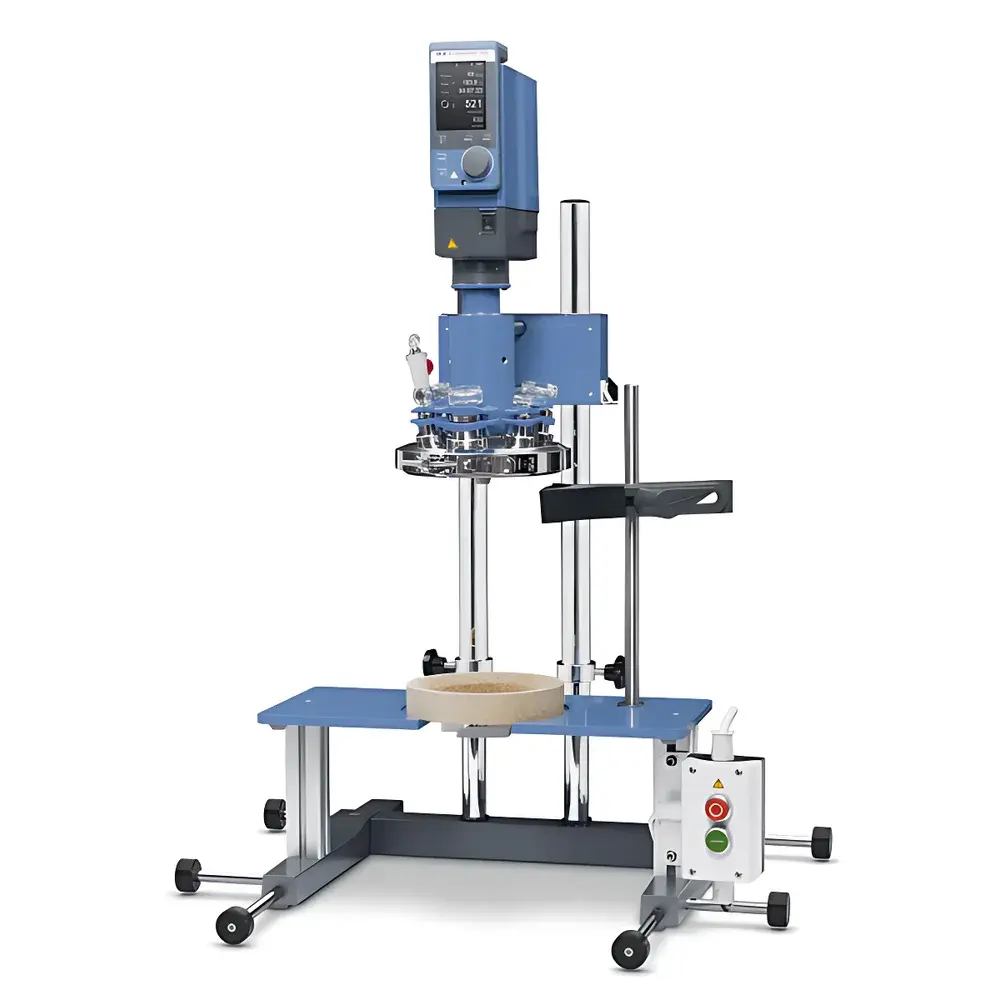
IKA LR-2.ST the Allrounder Modular Laboratory Reactor System
| Brand | IKA |
|---|---|
| Origin | Germany |
| Manufacturer | IKA Werke GmbH & Co. KG |
| Model | LR-2.ST the Allrounder |
| Reactor Type | Jacketed Glass Reactor System |
| Working Volume | 0.5–2.0 L |
| Maximum Operating Pressure | Up to 6 bar (gauge) |
| Vacuum Capability | ≤25 mbar (abs) |
| Temperature Range | Ambient to +230 °C |
| Speed Range | 8–290 rpm |
| Max. Torque | 120 N·cm |
| Max. Viscosity | 100,000 mPa·s |
| Drive Motor | EUROSTAR 200 control motor with microprocessor-based speed regulation |
| Sealing Material | FFPM (perfluoroelastomer) for solvent and high-temp resistance |
| Wetted Parts | Borosilicate glass 3.3, PTFE, FFPM, 1.4571 stainless steel |
| Port Configuration | 3 × NS 29/32 + 2 × NS 14/23 standard ground glass joints |
| Vertical Travel of Lift Stand | 390 mm |
| Dimensions (W×H×D) | 460 × 1240 × 430 mm |
| Weight | 25 kg |
| Power Supply | 115 V, 50/60 Hz |
| Ambient Operating Conditions | 5–40 °C, ≤80 % RH |
Overview
The IKA LR-2.ST the Allrounder is a modular, benchtop-scale laboratory reactor system engineered for precise control and reproducible execution of synthetic, catalytic, polymerization, and process-optimization reactions under variable temperature, pressure, and vacuum conditions. Based on Couette-type mixing geometry and integrated torque-sensing technology, it enables real-time monitoring of rheological changes—such as viscosity evolution or gelation onset—during reaction progress. Its core architecture combines a borosilicate glass 3.3 vessel (2 L nominal capacity), a high-torque EUROSTAR 200 drive unit, and a fully configurable lid assembly accommodating multiple process interfaces. Designed for operation from ambient temperature up to +230 °C and down to vacuum levels of ≤25 mbar (abs), the system supports both exothermic and endothermic processes while maintaining mechanical stability across wide viscosity ranges (up to 100,000 mPa·s). The FFPM (perfluoroelastomer) sealing system ensures chemical compatibility with aggressive solvents—including halogenated, aromatic, and strongly acidic media—while sustaining thermal integrity at elevated temperatures.
Key Features
- Modular design with standardized NS ground-glass joints (3 × NS 29/32, 2 × NS 14/23) enabling rapid integration of temperature probes, pH electrodes, reflux condensers, addition funnels, gas inlets, and ULTRA-TURRAX® high-shear dispersers.
- Microprocessor-controlled speed regulation with closed-loop feedback ensures stable rotational velocity even under dynamic load changes—critical for kinetic studies requiring constant shear rate.
- Integrated torque measurement provides continuous, non-invasive monitoring of apparent viscosity trends during reaction progression, supporting endpoint detection and mechanistic interpretation.
- Motorized lift stand with 390 mm vertical travel allows safe, repeatable positioning of the stirring assembly relative to vessel geometry—essential for scalability studies and impeller clearance optimization.
- WiCo wireless controller enables full parameter adjustment and real-time data observation from outside fume hoods, eliminating cable hazards and improving operator safety during hazardous chemistry workflows.
- Interlocked safety switch prevents operation unless the reactor lid is fully seated and sealed—compliant with IEC 61010-1 requirements for laboratory electrical equipment.
Sample Compatibility & Compliance
The LR-2.ST accommodates heterogeneous, multiphase, and highly viscous reaction mixtures—including slurries, suspensions, and polymeric melts—without compromising seal integrity or mechanical stability. All wetted components meet USP Class VI and FDA-compliant material specifications: borosilicate glass 3.3 (DIN ISO 3585), PTFE (ASTM D4894), FFPM elastomers (ASTM D1418), and 1.4571 stainless steel (EN 10088-1). The system is compatible with GLP and GMP environments when paired with optional audit-trail-capable software (e.g., IKA Labworldsoft with 21 CFR Part 11 compliance modules). It satisfies key international standards including DIN EN 61000-6-3 (EMC), DIN EN 61000-6-2 (immunity), and conforms to CE marking requirements for laboratory instrumentation within the European Economic Area.
Software & Data Management
When connected via RS232 or USB to IKA Labworldsoft v4.x or higher, the LR-2.ST supports time-stamped logging of speed, torque, temperature (via external Pt100 probe), and system status. Data export is available in CSV and XML formats for downstream analysis in MATLAB, Origin, or statistical process control platforms. Optional validation packages support IQ/OQ documentation per ASTM E2500 and ISO/IEC 17025 guidelines. Remote monitoring via WiCo eliminates physical interface dependencies, reducing contamination risk and enabling unattended overnight operation under defined safety thresholds.
Applications
- Process development and scale-up studies for API synthesis, fine chemical manufacturing, and specialty polymer production.
- Kinetic profiling of esterification, transesterification, amidation, and Grignard reactions under controlled vacuum or inert atmosphere.
- Emulsion and nanoparticle synthesis requiring simultaneous high-shear dispersion and precise thermal management.
- Catalyst screening and deactivation studies under elevated temperature and pressure conditions.
- Educational use in advanced organic and physical chemistry laboratories for teaching reaction engineering principles, mass/heat transfer, and rheokinetics.
FAQ
Can the LR-2.ST operate under inert gas blanket?
Yes—the reactor lid includes dedicated gas inlet/outlet ports compatible with standard Schlenk-line manifolds and mass-flow controllers.
Is the system suitable for corrosive halogenated solvents?
Yes—FFPM seals and PTFE-coated components provide broad resistance to chlorinated, fluorinated, and brominated solvents at temperatures up to 200 °C.
What is the maximum allowable working pressure?
The standard configuration is rated for up to 6 bar gauge pressure; custom pressure-rated lids and reinforced vessels are available upon request.
Does the torque sensor provide calibrated viscosity output?
Torque values are reported in N·cm; absolute viscosity requires calibration using Newtonian reference fluids per ISO 2555 or ASTM D2196 protocols.
Can third-party temperature controllers be integrated?
Yes—the system features analog 0–10 V and digital RS232 outputs for synchronization with external heating/cooling circulators and PLC-based process control systems.



