
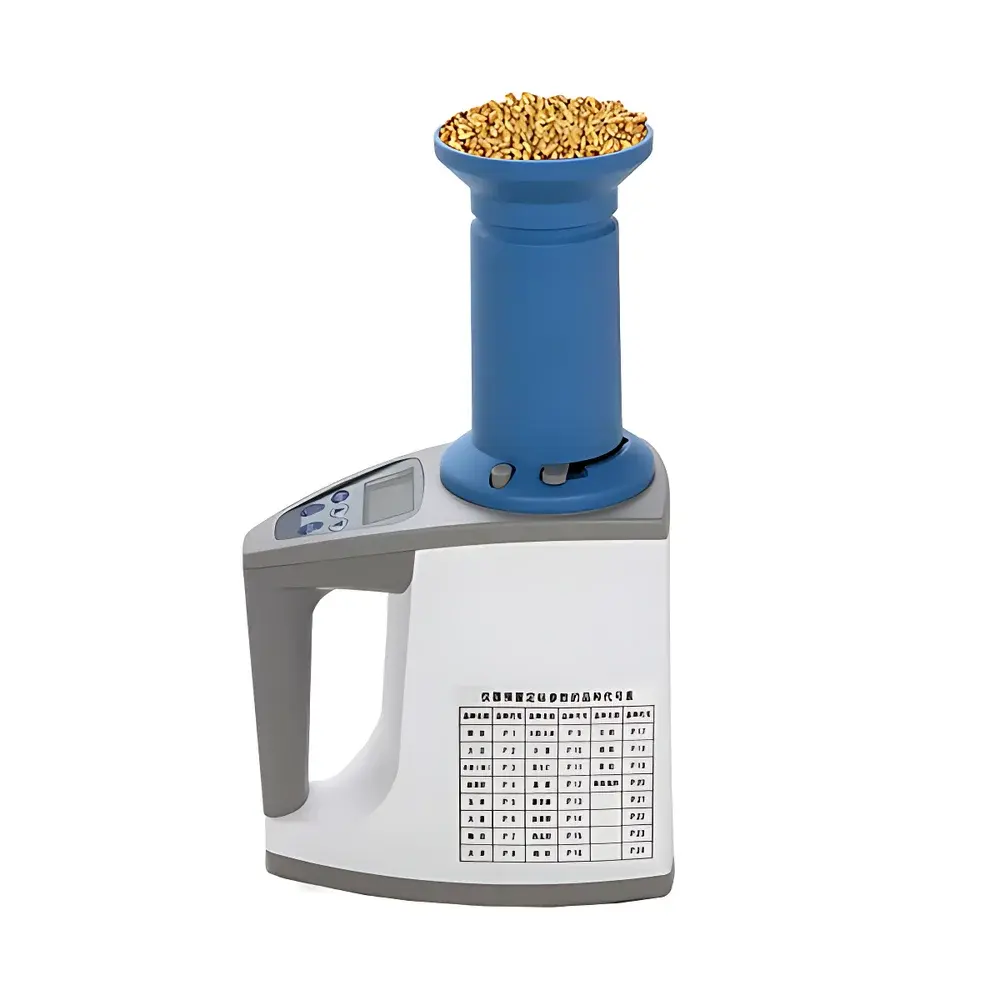
Senbe SEN-821 Portable Grain Moisture Meter
| Brand | Senbe |
|---|---|
| Origin | Jiangsu, China |
| Manufacturer Type | Manufacturer |
| Origin Category | Domestic |
| Model | SEN-821 |
| Instrument Type | Portable |
| Function Type | Multifunctional |
| Moisture Range | 3–35% (w/w) |
| Net Weight | 1 kg |
| Power Supply | DC 6 V (4 × AA alkaline batteries) |
| Measurement Time | < 5 s |
| Accuracy | ±0.5% (w/w) |
| Temperature Compensation | Automatic |
| Calibration Method | Floating 4-point calibration |
| Pre-programmed Crops | 20 common varieties |
| Operating Ambient Temperature | 0–40 °C |
| Auto Power-off | After 3 minutes of inactivity |
| Bulk Density Conversion | Integrated sampling device for wheat bulk density calculation |
Overview
The Senbe SEN-821 Portable Grain Moisture Meter is an engineered field and laboratory instrument designed for rapid, non-destructive moisture quantification in granular agricultural commodities. It operates on the principle of electrical capacitance and impedance spectroscopy—techniques standardized in ISO 712:2017 and AOAC Official Method 983.13—where dielectric properties of grain samples correlate with water content under controlled frequency excitation. Unlike oven-drying reference methods (e.g., ISO 6540 or ASAE S352.2), the SEN-821 delivers results in under five seconds without sample grinding, drying, or weighing, making it suitable for real-time quality assessment during harvest, storage, trading, and processing. Its robust housing, low-power architecture, and battery-operated design meet the operational demands of rural grain elevators, feed mills, seed certification labs, and mobile inspection units across variable environmental conditions (0–40 °C).
Key Features
- Multi-crop capability: Pre-calibrated for 20 major cereal and oilseed varieties—including wheat (hard red, soft white), maize (dent, flint), barley, rice (indica, japonica), soybean, rapeseed, peanut kernel, cottonseed, sorghum, sesame, and compound feed formulations—ensuring traceable performance without user recalibration.
- Bulk density integration: Includes a dedicated volumetric sampling cup and mechanical tare mechanism enabling direct bulk density (kg/hL or lb/bu) derivation from the same measurement cycle used for moisture, aligned with USDA FGIS and ISO 7970 methodologies.
- Floating 4-point calibration: Supports user-defined calibration curves using locally sourced reference samples; accommodates regional varietal deviations and post-harvest conditioning effects not covered by factory presets.
- Statistical measurement mode: Automatically accumulates up to 99 sequential readings per batch, computes arithmetic mean, standard deviation, and max/min values—critical for GLP-compliant sampling protocols and QA documentation.
- Environmental compensation: Real-time temperature correction algorithm mitigates drift caused by ambient thermal fluctuations, maintaining accuracy within ±0.5% (w/w) across the full operating range.
- Low-maintenance portability: Weighing only 1 kg with ergonomic grip and sealed keypad, powered exclusively by four AA alkaline cells (no charging circuitry), and featuring auto-shutdown after 3 minutes of inactivity to extend battery life beyond 2000 measurements per set.
Sample Compatibility & Compliance
The SEN-821 is validated for use with non-metallic, free-flowing particulate materials having particle sizes between 0.5 mm and 12 mm and bulk densities ranging from 400–850 kg/m³. It complies with electromagnetic compatibility requirements per IEC 61326-1 for industrial environments and meets safety standards IEC 61010-1 for handheld electrical measuring equipment. While not certified for regulatory submission under FDA 21 CFR Part 11, its audit-ready data logging (via optional RS-232/USB interface and Senbe DataLink software) supports traceability in GMP-aligned feed manufacturing and ISO 22000-certified grain handling facilities. Calibration verification is recommended before each shift using NIST-traceable moisture reference standards (e.g., SRM 2894 or equivalent).
Software & Data Management
When connected via optional serial-to-USB adapter, the SEN-821 interfaces with Senbe DataLink v3.x—a Windows-based desktop application supporting CSV export, batch ID tagging, time/date stamping, and PDF report generation. The software maintains a local database with user-accessible audit trails for calibration events, firmware updates, and measurement history—facilitating internal quality reviews and third-party audits. All stored records include instrument serial number, operator ID, ambient temperature, and raw sensor impedance values for forensic reanalysis. No cloud upload or remote telemetry is implemented, preserving data sovereignty in compliance with GDPR and CCPA frameworks.
Applications
- On-farm moisture screening prior to combine harvesting and bin loading
- Receiving inspection at grain elevators and cooperatives per GAFTA/AFMA contractual moisture tolerances
- In-process monitoring in feed pellet mills to prevent mold growth and binder inefficiency
- Seed certification labs verifying compliance with ISTA Rule 4.3 (moisture limits for germination testing)
- Export documentation support where moisture content directly affects freight class and phytosanitary clearance
- Research applications in postharvest physiology studies evaluating drying kinetics and equilibrium moisture relationships (EMR)
FAQ
Does the SEN-821 require sample grinding or crushing before measurement?
No. It measures intact kernels or particles using contact-based capacitance sensing; grinding introduces unnecessary variability and violates standardized test procedures.
Can calibration curves be exported or shared between instruments?
Calibration parameters are stored internally and cannot be transferred; however, users may replicate curves by entering identical 4-point reference values manually on another unit.
Is the bulk density function applicable to all grain types?
It is optimized for wheat and barley; for other crops, users must validate correlation coefficients against gravimetric volumetric methods per ISO 7970 Annex B.
What maintenance is required to sustain long-term accuracy?
Annual verification against certified reference materials and cleaning of the electrode chamber with dry compressed air or lint-free swabs is recommended; no lubrication or sensor replacement is needed under normal use.
How does temperature compensation affect measurement repeatability?
The built-in thermistor adjusts baseline impedance thresholds dynamically, reducing inter-day variance to ≤0.3% RSD when ambient shifts between 15 °C and 35 °C.






